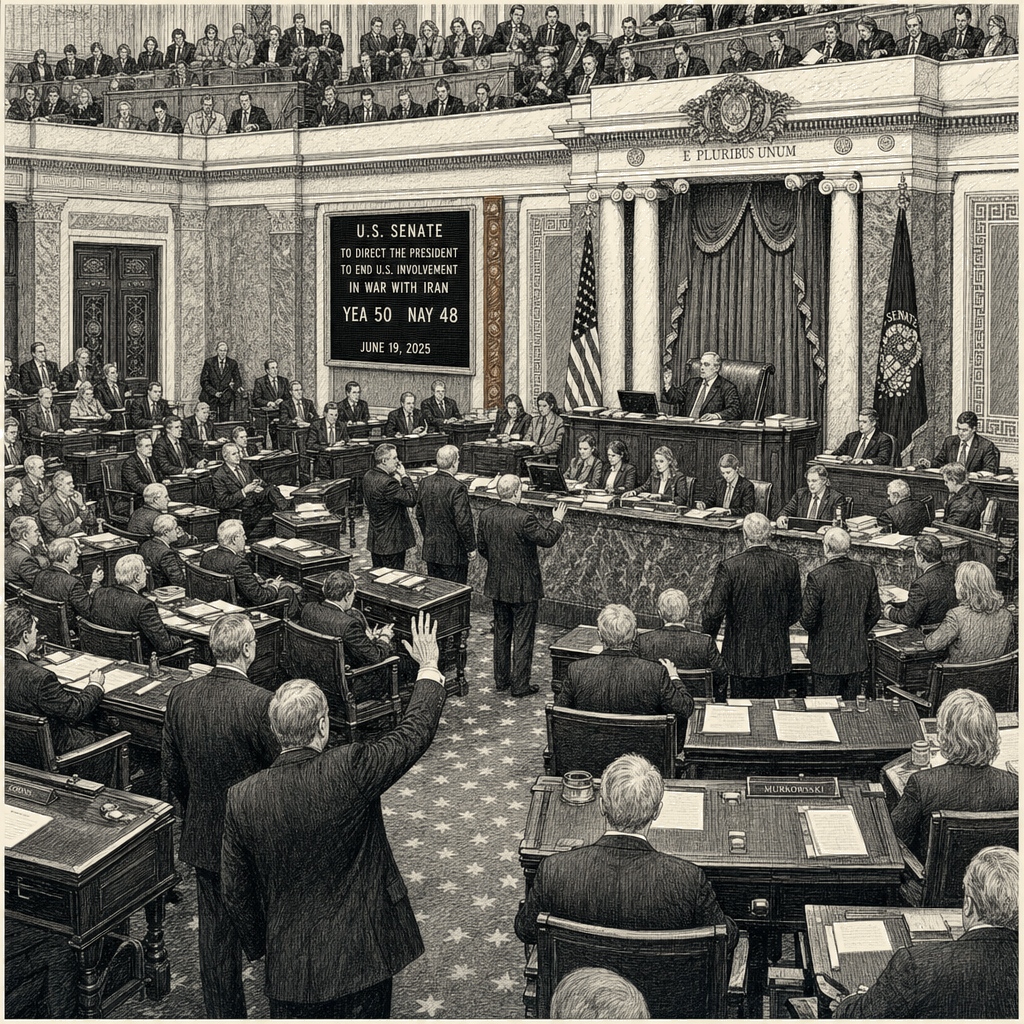
WASHINGTON — The Senate voted 50-48 on Tuesday to pass a concurrent resolution directing President Trump to end U.S. military hostilities against Iran without congressional authorization, as four Republicans broke with their party to join nearly all Democrats in a bipartisan censure of the administration’s conduct of the conflict.
The measure directs the president to remove U.S. armed forces from hostilities against Iran unless Congress explicitly authorizes military action or it is necessary to defend America, an ally or a partner from “imminent attack,” according to the resolution’s text. The House passed the same resolution on June 3 by a 215-208 vote, with four Republicans also crossing party lines.
The resolution is nonbinding — a concurrent resolution is not sent to the president for his signature or veto — but its passage in both chambers represents the first time Congress has approved identical language curtailing Trump’s authority to wage the war. The vote came a week after Trump signed a memorandum of understanding with Iran that administration officials said involves lifting the U.S. blockade on Iranian ports, reopening the Strait of Hormuz and setting the stage for extended talks on Iran’s nuclear program.
Senators Bill Cassidy of Louisiana, Susan Collins of Maine, Lisa Murkowski of Alaska and Rand Paul of Kentucky joined nearly all Democrats in support. Senate Minority Leader Chuck Schumer of New York said the war “will go down in the history books as one of the worst foreign policies America has ever made or any country has ever made.”
Democratic Sen. John Fetterman of Pennsylvania voted against the measure. Senate Majority Leader Mitch McConnell of Kentucky, who has been absent while hospitalized, missed the vote, as did Sen. Dave McCormick of Pennsylvania.
Trump described the war-powers vote as “poorly timed and meaningless” in a social media post, adding, “These Senators have just made my job more difficult, but I will get it done, one way or the other, because I always get it done!”
Sen. Jim Risch of Idaho, the Republican chairman of the Senate Foreign Relations Committee, urged his colleagues to vote no, arguing that Trump would pay no attention to the resolution but that Iran would. “If this passes, the Iranians are going to simply stand up and walk away from negotiations. They’re going to say this thing’s over,” Risch warned.
Republican senators had voted to block similar Iran war-powers resolutions eight times since February, but support for limiting Trump’s authority has grown as concerns mount about the conduct of the war and the durability of peace negotiations. A spokeswoman for Sen. John Barrasso of Wyoming, the No. 2 Senate Republican, noted that the number of Republican “yes” votes did not grow from a prior procedural vote and dismissed the resolution as “pure political messaging from Democrats.”
“It doesn’t go to the president’s desk, cannot become law, and does nothing to impact policy,” the spokeswoman said.
Sen. Tim Kaine of Virginia, who has led weekly war-powers votes since the conflict began in February, called the outcome historic. “I don’t think both houses have ever passed a resolution, the same resolution, telling the president that it’s an illegal war,” he told reporters after the vote. “And so it’s a powerful vote.”
Brian Finucane, a senior adviser with the U.S. program at the International Crisis Group, said the resolution’s passage is significant even if it is not legally binding, noting that the prevailing view of legal scholars is that such concurrent resolutions are unconstitutional legislative vetoes under a 1980s Supreme Court ruling.
“Even if it’s not binding as such, it still has legal effect inasmuch as it represents Congress’s view of the allocation of war powers and that the president doesn’t have authority to conduct this war,” Finucane said.
MSI has previously covered the growing congressional push to restrict the president’s war-making authority in Iran, including the House’s June 3 passage of an identical resolution and the Senate’s earlier procedural votes.