- Wealth among US billionaires surged 31.8% in 2026 to $9.2tn, while workers’ share of gross domestic product fell to a record low of 53.8%, according to data compiled by Americans for Tax Fairness and French economists Gabriel Zucman and Emmanuel Saez.
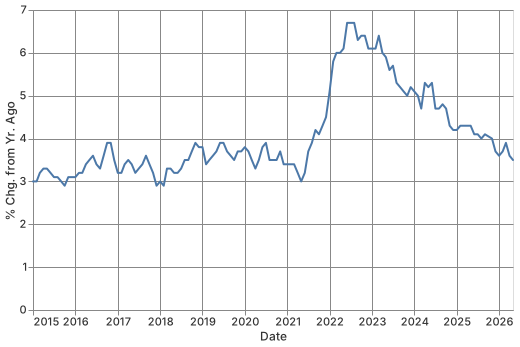
- Workers’ wages rose 3.5% over the past year, according to the Atlanta Federal Reserve’s Wage Growth Tracker, but inflation at 4.2% in May erased those gains, and 66 million US workers — 45% of all workers — earn less than $25 an hour, the Guardian reported.
- Worker advocates said public anger over the widening gap has fueled a surge in campaigns for higher wages and supported the California billionaire tax measure that officially qualified for the November ballot this week.
- Economists and historians warned that the concentration of wealth among a tiny elite — now at levels roughly four times greater than the Gilded Age — poses an existential risk to democratic governance.
The wealth of the richest Americans has reached levels that surpass any period in modern history, while millions of workers struggle with eroding purchasing power, rising debt, and the inability to afford basic necessities. The disparity has sparked a backlash that includes ballot initiatives, union organizing drives, and a national debate over the political power of the superrich.
Elon Musk, who briefly became the world’s first trillionaire this month after SpaceX’s stock market listing, has seen his fortune rise from about $28 billion in 2020 to nearly $1 trillion, according to data cited by the Guardian. Musk lost his trillionaire status this week as investor sentiment on AI cooled, but he has still added $327 billion to his wealth in the past year alone. The United States is home to 989 billionaires who together hold more than $9.2 trillion — up 31.8% since 2025.
Workers describe a daily reality detached from those figures. Gilberto Rubio, a security officer in the San Francisco area, said he has worked as many as three jobs simultaneously and lived out of his car due to high housing costs. Though he makes $25 an hour, he has not received a raise in years, and the living wage for a single adult in the San Francisco area exceeds $30 an hour, according to MIT’s living wage calculator. “I haven’t been able to get ahead working one job,” Rubio told the Guardian. “Your life is working and we don’t have anything to show for it. There’s no savings, there’s no retirement plan. I can’t even afford to buy a house.”
Jessica Ordeñana, a bartender in midtown Manhattan, makes a little more than $11 an hour plus tips, which she said fluctuate greatly. “I can’t afford air conditioning, so this will be my second summer without AC,” Ordeñana said. “The fact that the rich keep getting richer for no good reason is really, really, really disgusting to me. It worries me a lot. I don’t even know if I’m going to have social security to retire.”
Workers’ share of gross domestic product fell to 53.8% in the third quarter of 2025, the lowest level since the Bureau of Economic Analysis began recording the series in 1947. The US inflation rate hit 4.2% in May 2026, the Guardian reported, more than erasing the 3.5% wage gain recorded by the Atlanta Fed’s Wage Growth Tracker over the same period. Credit card debt reached a record $1.277 trillion in the fourth quarter of 2025, up 63% since early 2021, as workers turned to borrowing to cover rising costs.
Cienna Pangan, a Starbucks barista and shift supervisor in Chicago, said the gap between worker pay and executive compensation is stark. The median pay for a Starbucks worker in 2024 was $14,674, according to company filings cited by the Guardian, compared with CEO Brian Niccol’s compensation of $97.8 million that year. CEO pay grew 20 times faster than average worker pay in 2025, according to an analysis by Oxfam and the International Trade Union Confederation. “We aren’t making enough to pay for groceries, we’re not making enough to pay rent,” said Pangan, whose Starbucks store recently unionized. “I think it’s really disgusting to see the huge disparity.”
The response to the growing concentration of wealth is taking political shape. On Thursday, California’s controversial billionaire tax measure officially qualified for the November ballot after a campaign that pitted some of the world’s richest people against grassroots organizers. Saru Jayaraman, president of One Fair Wage, said the surge in wealth inequality has driven explosive growth in organizing for higher minimum wages. “I’ve never experienced this kind of explosive campaign growth over the last year as I have in 20 years, 25 years of organizing,” Jayaraman said.
Gabriel Zucman, an economist at the University of California, Berkeley, said it is unclear when a democratic society tips into oligarchy. “Is it when the wealth of the ultrarich exceeds 50% of GDP, as in the US today? 100%? 200%?” Zucman said. “Nobody knows the exact concentration of wealth at which the kinds of plutocratic collapse we have seen in history becomes inevitable.”
Daniel Mandell, emeritus professor of history at Truman State University, said the national debate could signal change. “Will the current awareness of the dangers of this yawning economic chasm, spotlighted by the outrageous behavior of ‘tech bros’ like Elon Musk with his $1tn, lead to policy changes? I hope so,” Mandell said. “The US’s foundational democratic ideal included the warning that great wealth, especially in politics, was toxic for the republic.”
Starbucks and SpaceX did not respond to multiple requests for comment, the Guardian reported.