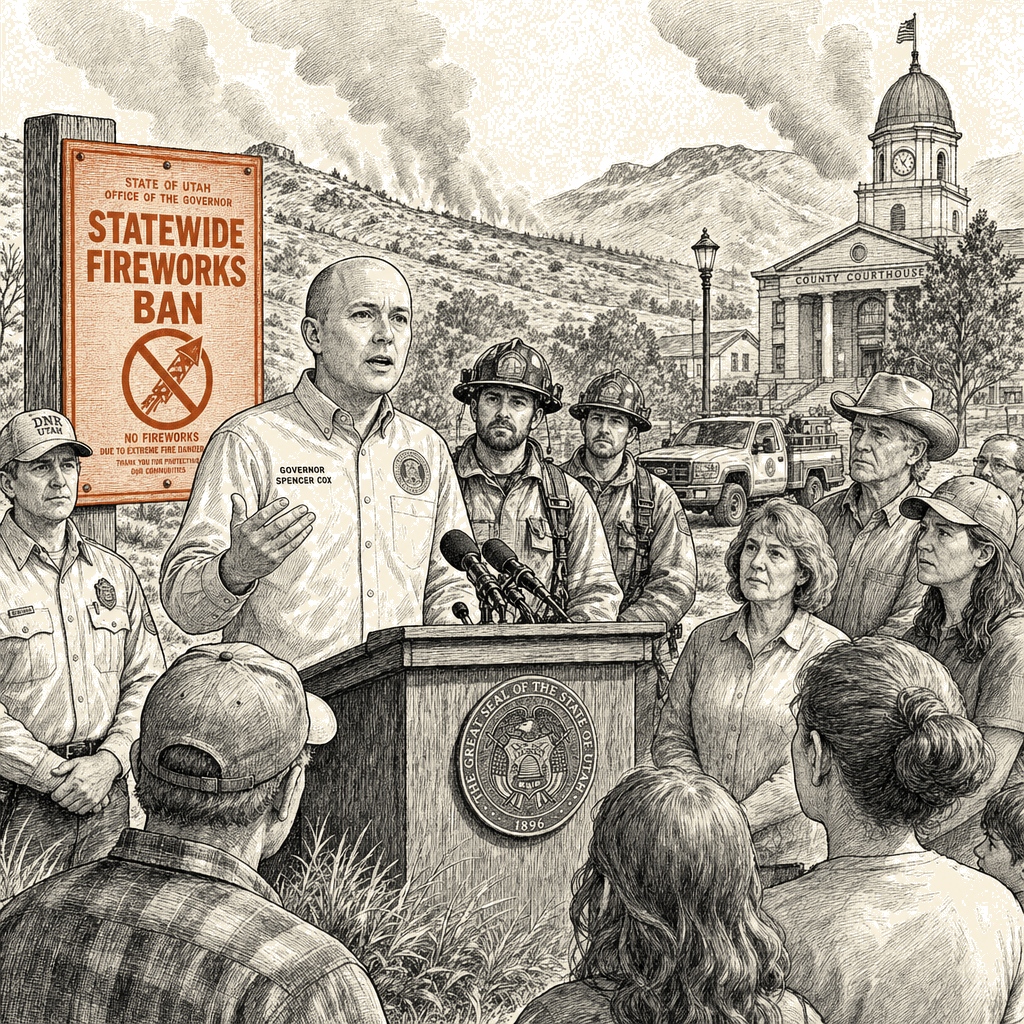
Utah Gov. Spencer Cox declared a state of emergency Thursday and ordered a temporary statewide ban on personal fireworks through July 5 as unprecedented wildfire conditions continued to produce large blazes across the state, according to the governor’s office.
The executive order temporarily suspends a 2024 state law that had prevented the Utah state forester from banning fireworks in cities. Under the new order, the state forester now has authority to prohibit fireworks anywhere in the state.
“It’s not about taking decisions away from local communities,” Cox said during a Thursday press conference. “In fact, we want to put local knowledge at the center of this process.” He added that while the default position is that fireworks are prohibited, local fire chiefs and officials can still designate areas where fireworks are allowed if conditions permit. “We think this strikes the right balance,” Cox said.
As of Friday, Utah had nine active wildfires burning across more than 143,000 acres, according to the state’s wildfire dashboard. So far this year, 373 wildfires have been recorded in the state, and all but 100 of them have been human-caused, officials said.
Among the current blazes is the Cottonwood fire, which officials discovered on Monday and which Cox described as the most destructive fire in the state’s history. The fire has burned nearly 72,000 acres and is at 0% containment, according to Utah fire information. It has forced the closure of Eagle Point ski resort and damaged several surrounding structures.
On the same day the fireworks ban was announced, the National Weather Service in Salt Lake City declared what it called a “particularly dangerous situation” red flag warning — the first such alert in the service’s history, according to a post on X.
Billowing smoke from the fires has blanketed surrounding areas, with smoke columns high enough to be seen from across the state. Air quality has been affected at popular vacation destinations such as Zion National Park and Bryce Canyon National Park, both located far south of the flames, officials said.
More fire danger is expected in the coming days as a heat wave blankets the U.S. West Coast, with troubling conditions also forecast for Colorado and Arizona.