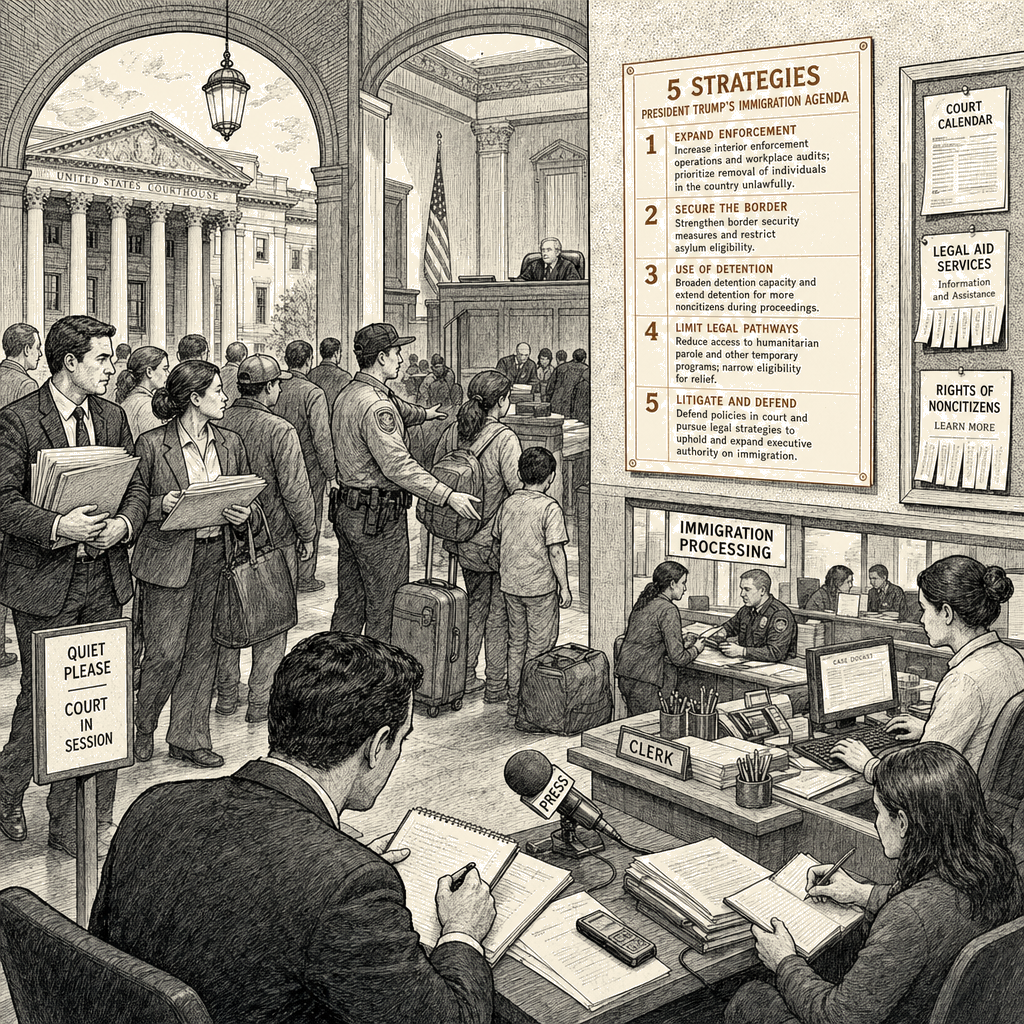
President Donald Trump campaigned on a promise of mass deportations. More than a year into his second term, the White House has taken a sweeping approach to curbing both illegal and legal migration, NPR reported Tuesday, detailing a five-part coordinated strategy.
NPR immigration policy correspondent Ximena Bustillo, in an explanatory video, broke down the five prongs of the administration’s approach: providing historic funding for immigration enforcement agencies, stripping legal pathways for immigrants, reshaping the previously little-known immigration court system, and expanding the infrastructure focused on increasing the number of those detained and deported, according to the report.
The strategy, Bustillo reported, limits immigrants’ options for arguing for permission to stay in the U.S. and eliminates previous pathways to legal status.
Federal courts have issued a mixed record on the administration’s immigration policies. Over the past year, judges as high up as the U.S. Supreme Court have weighed in on the measures taken. In some instances, district court rulings have barred some of the strategies, including ordering federal officers to stop making arrests in immigration courts, NPR reported.
Other efforts have been upheld. The Supreme Court recently allowed the administration to end temporary protected status (TPS) for Haitians and Syrians and upheld a policy that allows border officials to turn migrants away before they physically cross to claim asylum, according to the report.
The Supreme Court on Tuesday is scheduled to weigh in on Trump’s landmark executive order that sought to end birthright citizenship, NPR reported.
Bustillo traveled to Arizona, California, and New York to document the strategy and its impacts on the agency, federal workers, and immigrants navigating the systems, according to the report. The analysis drew on over a year of reporting, policy memos, data, and dozens of interviews.