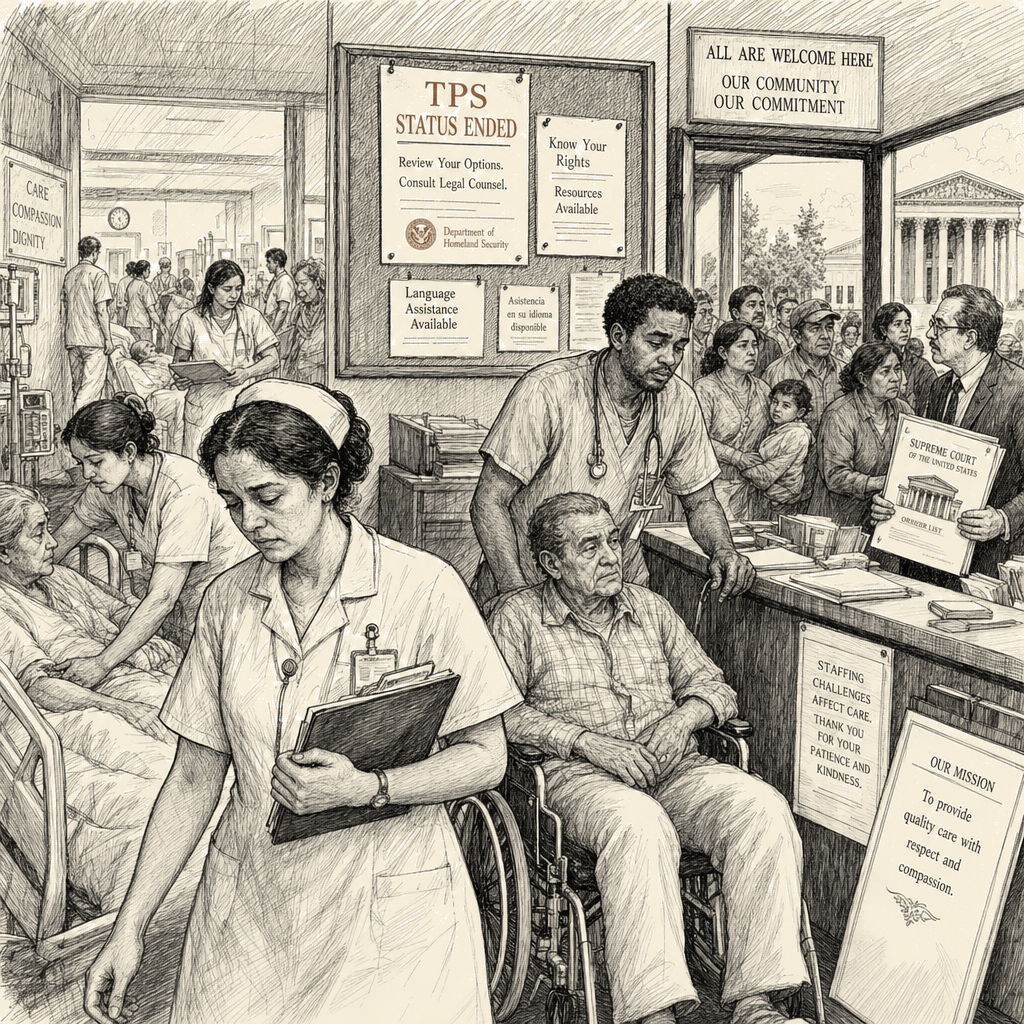
Hospitals, nursing homes face staffing shortages as TPS protections end
The Supreme Court’s June ruling cleared the way for the Trump administration to cancel Temporary Protected Status for Haitians and Syrians, affecting more than 330,000 people from those two countries. The program, established under the Immigration and Nationality Act of 1990, grants temporary legal status and work authorization to nationals of countries experiencing armed conflict, natural disasters, or other extraordinary conditions.
Health policy experts said the healthcare sector, already strained by persistent workforce shortages, faces severe disruptions. Steffie Woolhandler, a distinguished professor of health policy at City University of New York at Hunter College and a Harvard Medical School faculty member, told NPR that the ruling’s impact would be felt hardest in long-term care.
“It’s going to be a disaster in the Boston area, where a lot of our nursing home and home care aides are Haitian,” Woolhandler said. She added that if the United States becomes inhospitable to noncitizens, “we’re going to have a lot of problems staffing our entire healthcare system.”
Massachusetts has the third-largest population of Haitians with TPS at 19,000, behind Florida’s 158,000 and New York’s 40,000, according to Census data cited in Woolhandler’s 2025 report. The report, analyzing the potential effects of mass deportation plans, found that roughly 50,000 physicians in the U.S. — about 9 percent of all doctors — are noncitizens, and another 145,000 are registered nurses. The advocacy group FWD.us estimated that 21,000 Haitian TPS holders work in hard-to-fill jobs as nursing assistants and caregivers.
The ruling compounds existing staffing pressures. Woolhandler said two-thirds of hospitals report they have closed beds because of insufficient staff, and about half of nursing homes say they cannot take new admissions due to personnel shortages. She warned that the loss of TPS workers could create bottlenecks in care delivery, with patients remaining in hospitals or emergency rooms if nursing home beds or home care aides become unavailable.
“The thing that has to be said is that the healthcare of everybody is going to be compromised by this,” Woolhandler said. “If you start throwing out workers that play a key role in the whole continuum of care … it tends to create a bottleneck or a backup.”
Katie Smith Sloan, president and CEO of LeadingAge, a trade association representing more than 5,300 aging service providers, called the ruling a direct threat to care delivery. “It puts older adults and the providers who care for them in an untenable position,” Sloan said in a statement. “Staff and caregivers who support older adults every day — legal employees who in some of our communities represent 8% or more of the entire workforce — can now lose their jobs overnight.”
The Trump administration has released little detail about how it will withdraw protections for the affected TPS holders. On Wednesday, the Department of Homeland Security announced that existing Employment Authorization Documents will expire on July 10, giving recipients days to adjust their legal status or face deportation.
The uncertainty has caused widespread anxiety in communities with large Haitian populations, particularly in Springfield, Ohio, where one in four residents is of Haitian descent. Viles Dorsainvil, co-founder and executive director of the Haitian Support Center in Springfield, said he has fielded dozens of panicked calls from TPS holders since the ruling.
“They’re wondering if they can still keep their assets or money at the bank, if they can still go to work because TPS came with the work permit, and with the drivers license privilege,” Dorsainvil told NPR. “The community is devastated.”
Dorsainvil, himself a TPS recipient who came to the U.S. from Haiti in 2020, said he is advising people to sign powers of attorney to someone they trust and, for parents with American-born children, to plan for potential guardianship in case the Department of Homeland Security pursues family separations. He said he has little else to offer beyond moral support.
It was the Biden administration’s extension of the TPS program for Haitians that allowed him and his brother to stay in the country, Dorsainvil said. His brother, a former doctor in Haiti who now works as a nurse in Chicago, applied for asylum in 2024 and their applications remain unresolved.
Dorsainvil said his phone calls home to his mother and daughter, which once focused on armed gang violence in Haiti, now center on the political turmoil in the United States. “When I was outside of the U.S., the way they sell it to you, you would believe that if you came to this country everything would be okay,” he said. “But it’s totally different.”