Hegseth reviews US forces in Europe as NATO 3.0 vision emerges
Trump leaves Monday evening for the summit in the Turkish capital, hosted by President Recep Tayyip Erdogan, whom Trump counts as a close friend. The White House said Trump will meet Wednesday with Ukrainian President Volodymyr Zelenskyy, and plans separate sideline meetings with Syrian President Ahmad al-Sharaa and with Erdogan. No bilateral meetings with other NATO leaders are scheduled.
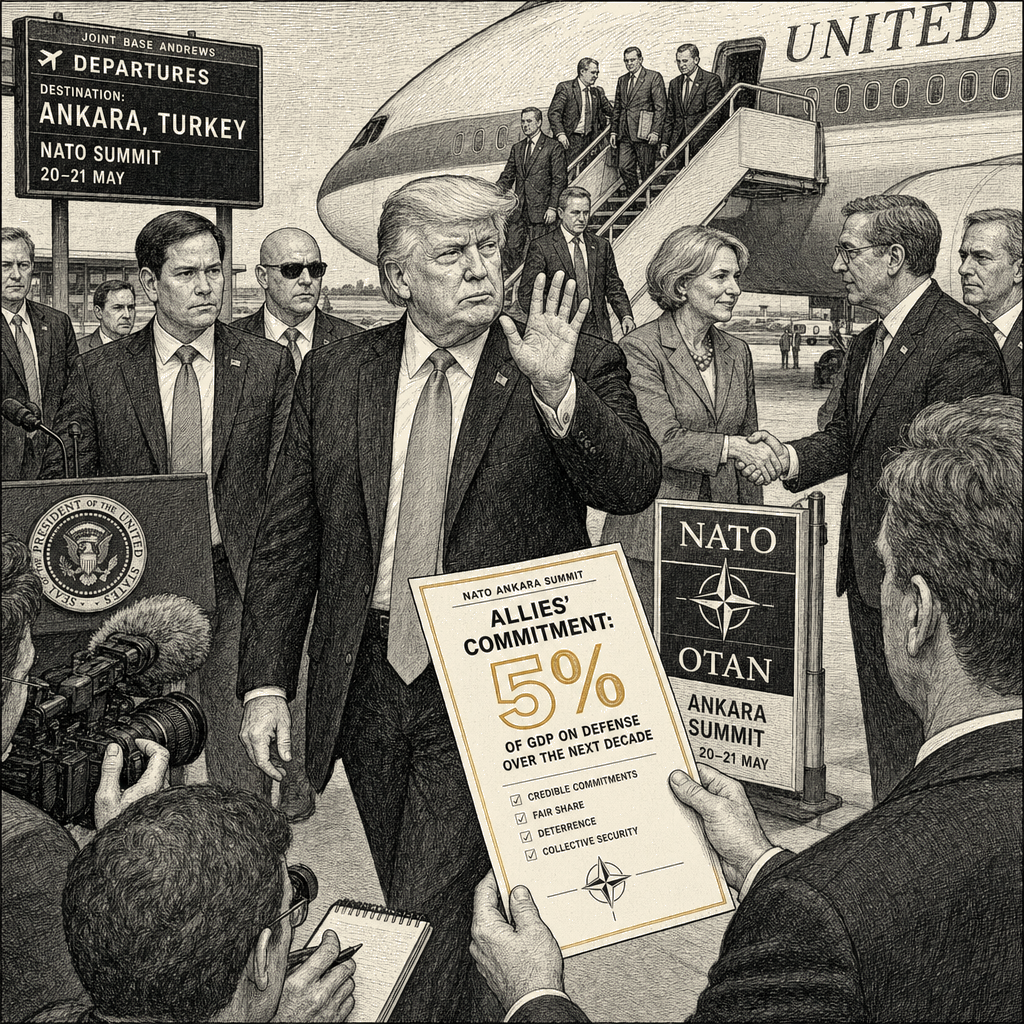
The summit is the first gathering of alliance leaders since last year’s meeting in The Hague, where NATO countries — driven by Trump’s demands — agreed to spend 5% of GDP on defense over the next decade, with 3.5% allotted to core defense spending and the remainder to related expenses such as infrastructure. Spain said at the time that it could not meet the levels. Luke Coffey, a senior fellow at the Hudson Institute, described the Ankara summit as the “first report card” on the pledge.
“If NATO members play their cards right — if the leaders show up demonstrating a commitment and a reasonable plan to meet these spending targets — then it’ll allow President Trump to take a victory lap,” Coffey said.
NATO Secretary General Mark Rutte, in an Oval Office meeting with Trump last month, displayed charts showing what he called “The Trump Trillion” — the increase in allies’ spending commitments since 2017. Whitaker, previewing the U.S. message, said Trump expects allies to act “immediately” and “with urgency.”
The war in Ukraine, now in its fifth year, is expected to be a key focus. Trump spoke with both Zelenskyy and Russian President Vladimir Putin on July 4 ahead of the summit.
Trump’s administration has also rolled out a strategy called “NATO 3.0,” outlined by Undersecretary of Defense Elbridge Colby earlier this year, which envisions Europe shouldering more of its defense needs so the U.S. can shift focus elsewhere. Defense Secretary Pete Hegseth, in a speech to NATO defense ministers last month, announced a six-month review of U.S. forces in Europe — a move that surprised allies who had anticipated coordination with the Trump administration. Trump himself sparked confusion earlier this year by announcing he would send 5,000 U.S. troops to Poland weeks after ordering the same number pulled out of the continent.
Despite increased pledges and spending, experts said most European countries remain reliant on the U.S. for defense under Article 5 — the alliance’s mutual-defense clause. Liana Fix, a senior fellow for Europe at the Council on Foreign Relations, said most European nations are “far from being able to defend themselves without the United States, even if they’re starting to develop all that.”
The summit also comes as Trump has engaged in public spats with several allied leaders. He proclaimed that British Prime Minister Keir Starmer would resign before Starmer made it official, arguing Starmer had “failed badly” on immigration and energy. Trump asserted that Italian Prime Minister Giorgia Meloni had begged him for a photo, prompting a denial from her office and the cancellation of a U.S. visit by Italy’s foreign minister; Trump then posted a photo of Meloni on social media with the words “RESTRAINING ORDER NEEDED.” He has also remained on tense terms with Canadian Prime Minister Mark Carney.
Sen. Jeanne Shaheen, D-N.H., is leading a bipartisan Senate delegation to Ankara, seeking to represent what she said is broad congressional support for the alliance.
“They are our best allies, they are our best trading partners, they are critical to our national security, to our economic success, and we need to encourage those relationships,” Shaheen said. She said the Trump administration’s approach “fails to understand” the threat posed by Russia under President Vladimir Putin.
NATO earlier this year introduced “Arctic Sentry,” a military exercise aimed at countering Russian and Chinese activities in the region, and also designed to address Trump’s repeated threats to seize Greenland, the semiautonomous Danish territory, for strategic reasons.