Media I visas capped at 240 days, Chinese at 90
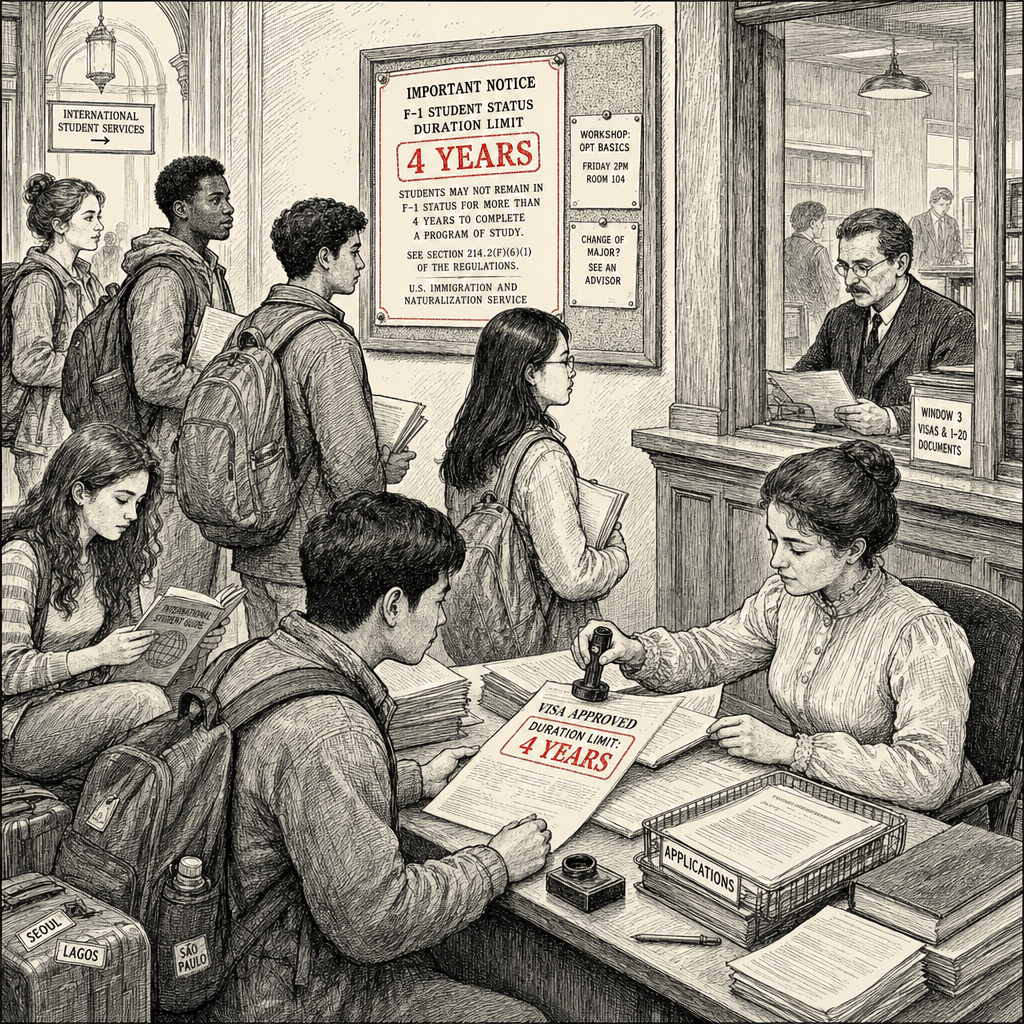
WASHINGTON — The Trump administration announced a regulation Thursday that limits the duration of most foreign student visas to a maximum of four years, replacing a policy that had governed student admissions for roughly five decades.
The new rule, which the Department of Homeland Security described as the “duration of status” rule, caps the length of a student visa at the number of years its holder is enrolled in a particular program, with a maximum of four years. Under the previous policy, student visas were granted for the full duration of a student’s academic program plus any authorized Optional Practical Training, or OPT, a work authorization program that allows foreign graduates to work in the U.S. for up to three years after graduation.
Students enrolled in programs longer than four years — including doctoral programs, which typically run six years — will need to apply for an extension of status to remain in the country. The rule also requires nearly all students to apply for an extension in order to use their OPT. When filing for an extension, students must demonstrate their academic success and financial stability.
DHS Secretary Markwayne Mullin said in a statement that “for decades, foreign students have been admitted into the U.S. indefinitely, allowing thousands to abuse our immigration system by perpetually enrolling in courses to avoid having to leave the U.S.” He said the rule allows the United States to “reclaim its ability to properly screen, vet, and monitor individuals within our borders.”
The regulation reduces the postgraduation grace period — the time students have to prepare to leave, change schools, or change legal status — to 30 days, down from 60 days. It applies to F-1 student visas and J-1 exchange visitor visas.
The Wall Street Journal reported that immigration restrictionists have long criticized the OPT program, arguing that it allows U.S. companies to hire foreign students directly after graduation without regulations ensuring they are paid the same as American-born graduates. Companies in Silicon Valley and on Wall Street most often hire new university graduates on OPT before applying for longer-term visas such as the H-1B, the Journal reported. If students cannot use their OPT, they are much less likely to qualify for an H-1B, curtailing their chances of remaining in the U.S. long term after studying there.
The American Council on Education warned during the public comment period on a proposed version of the rule that “establishing a fixed period of admission for student and exchange visa holders and creating unreasonable time limits for international students will have a devastating impact on institutions, international students, and the entire U.S. economy,” according to regulatory comments submitted by the group.
The rule also extends to foreign journalists entering the U.S. on I visas. Most of those visas will carry a cap of 240 days. For Chinese citizens, the cap will be 90 days.