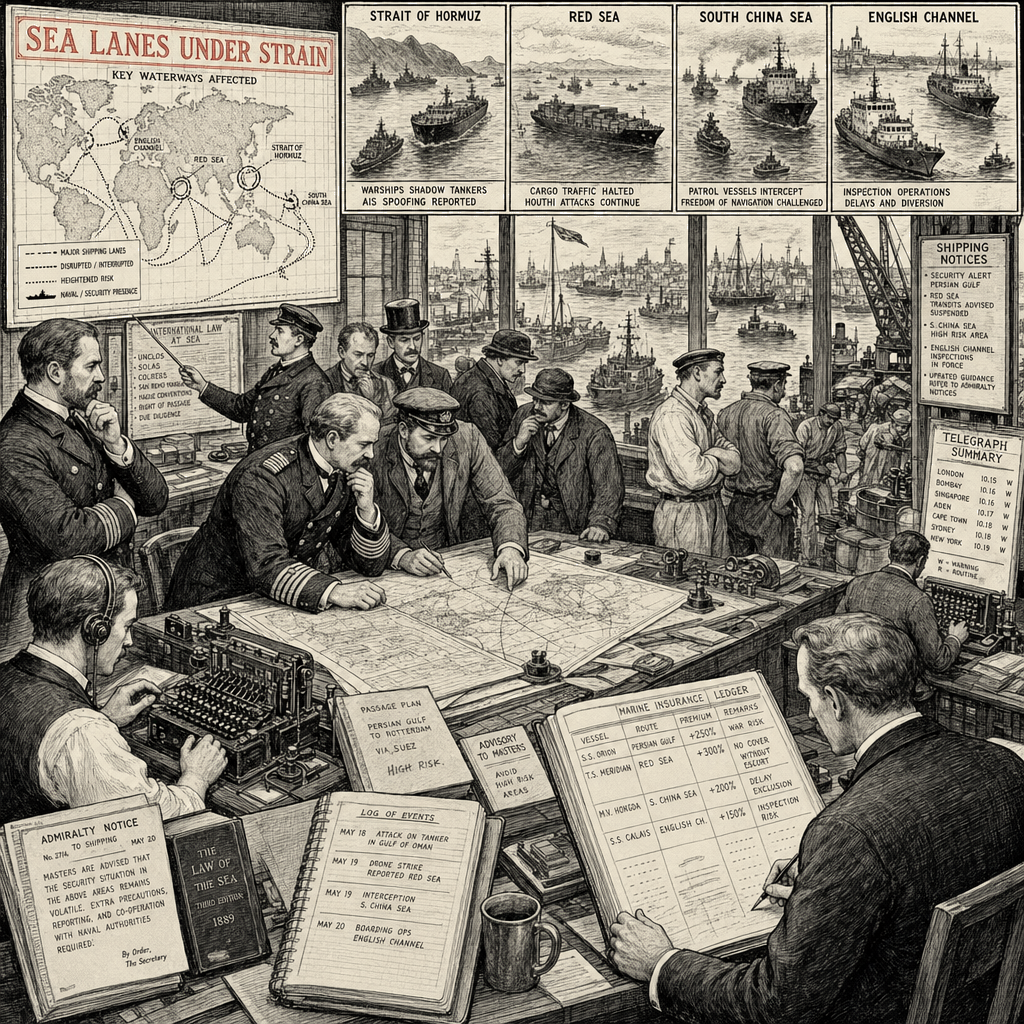
A British foreign affairs commentator warned Sunday that the United States’ military campaign in the Strait of Hormuz is contributing to a wider erosion of maritime legal norms, as military confrontations and copycat blockades emerge in strategic waterways from the Red Sea to the South China Sea to the English Channel.
Simon Tisdall, a columnist for The Guardian, wrote that the Strait of Hormuz standoff is encouraging other actors to challenge the centuries-old principle of freedom of navigation, threatening supply chains and energy markets. About 80% of global trade by volume moves by sea.
Iran-aligned Houthi militias in Yemen have begun a blockade of the Bab al-Mandab strait at the southern entrance to the Red Sea and struck two oil tankers this week, according to the column. Indonesia is debating whether to impose tolls on the Strait of Malacca, through which about 22% of global maritime shipping passes.
A Chinese missile destroyer conducted a live-fire drill inside Japan’s exclusive economic zone about 180 kilometers from Okinotori island last week, accompanied by a Russian frigate, Tisdall wrote. China also test-fired a long-range ballistic missile from a nuclear submarine in the South Pacific this month.
Russian naval activities have increased in European waters, the column stated. A Russian warship conducted a live-fire exercise 70 nautical miles south of Plymouth, England, on Monday, July 20. Last month, a Russian frigate fired warning shots near a private yacht off the Isle of Wight. The actions are part of what the column described as a broader pattern of Russian maritime operations in the North Atlantic, North Sea, and English Channel that include suspected mapping of undersea infrastructure. Russia’s Black Sea Fleet has suffered severe losses from Ukrainian missile and drone attacks since 2022 and its ships are largely confined to port as a result, Tisdall noted.
The column cited additional incidents contributing to strains on maritime order: the sinking of an Iranian warship by a U.S. submarine off Sri Lanka in March, recent clashes between Chinese and Philippine ships, President Donald Trump’s renewed threats to annex Greenland, and U.S. bombing of civilian boats off Venezuela.
Regarding the Strait of Hormuz itself, Tisdall wrote that Trump initially suggested the United States could impose tolls on shipping but later retreated from that position. U.S. Secretary of State Marco Rubio said in June that “no country is allowed to charge tolls or fees on an international waterway,” according to the column. A subsequent memorandum of understanding between the U.S. and Iran reportedly accepts Iran’s right, with Oman, to monetize transit through the strait, Tisdall wrote, and that MOU currently remains the only basis for a future peace deal.
The column warned that the cumulative effect is a breakdown in “the fundamental concept of global commons or shared space” and described the trend as “Lord Palmerston-style gunboat diplomacy writ large.”