Chinese-made vehicles account for 37% of South Korea’s import market
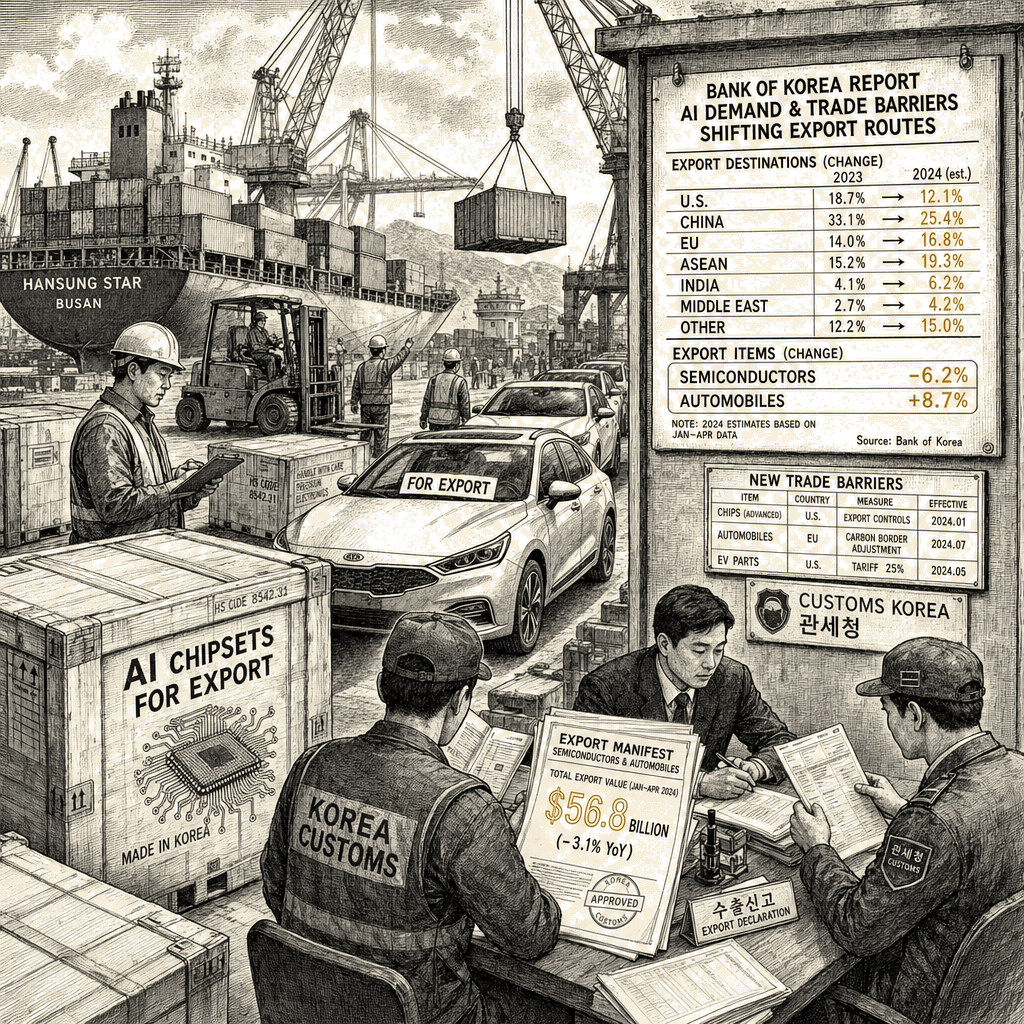
The United States remained South Korea’s largest automobile export market in 2025, with shipments valued at $30.15 billion and accounting for 41.9% of total finished-vehicle exports, according to a Bank of Korea report released Monday.
The central bank’s “Map of Production and Supply Chains for South Korea’s Major Manufacturing Industries” found that the U.S. share of South Korea’s electric vehicle exports fell from 33.6% in 2022 to 5.2% in 2025. The bank said U.S. subsidies, local production requirements and tariff barriers had weakened the competitiveness of electric vehicles manufactured in South Korea and shipped directly to the United States.
South Korean automakers have responded by expanding U.S. factory operations while increasing exports of hybrid vehicles, the bank said. Hybrids’ share of South Korea’s finished-vehicle exports rose from 11.6% in 2022 to 20.4% in 2025. The bank attributed the shift to automakers’ efforts to respond to slowing electric vehicle demand and insufficient charging infrastructure by offering vehicles that combine electric motors with internal combustion engines.
China’s growing influence was most apparent in South Korea’s automobile import market, the bank said. The share of vehicle imports from China increased from 3.5% in 2022 to 37.2% in 2025. Chinese-made vehicles accounted for about 70% of South Korea’s electric vehicle imports by value in 2025. The report attributed the increase to China’s price competitiveness and its supply chain covering vehicles, batteries and components.
The Bank of Korea’s report, based on 2024 and 2025 data, also found that South Korean semiconductor exports to Taiwan nearly tripled from $12.78 billion in 2022 to $36.77 billion in 2025. Taiwan’s share of South Korea’s semiconductor exports rose from 9% to 19.9%, moving it from the fourth-largest export destination to the second.
The bank attributed the change to a shift in demand from conventional dynamic random-access memory chips to graphics processing units and high-bandwidth memory used in AI systems. The AI semiconductor supply chain generally involves U.S.-based Nvidia designing graphics processors, Taiwan Semiconductor Manufacturing Co. producing and packaging the chips and Samsung Electronics and SK hynix supplying high-bandwidth memory, the bank said. That structure has increased the volume of South Korean semiconductor products shipped to Taiwan.
China remained the largest destination for South Korean chips, but its share fell from 53.1% in 2022 to 40.3% in 2025.
Domestic semiconductor production rose from 74 trillion won in 2014 to 210.8 trillion won in 2024, the equivalent of $50.4 billion to $143.6 billion, and its share of total manufacturing production doubled from 5% to 10.1% during the same period. Production remains concentrated in the greater Seoul area, which accounted for 82.3% of the national total, the bank said. Major facilities include Samsung Electronics plants in Hwaseong, Pyeongtaek and Giheung and SK hynix’s plant in Icheon.