Lula administration denies visas to two U.S. State Department officials over voting-system concerns
Brazil’s standoff with Argentina and the Trump administration escalates ahead of October vote
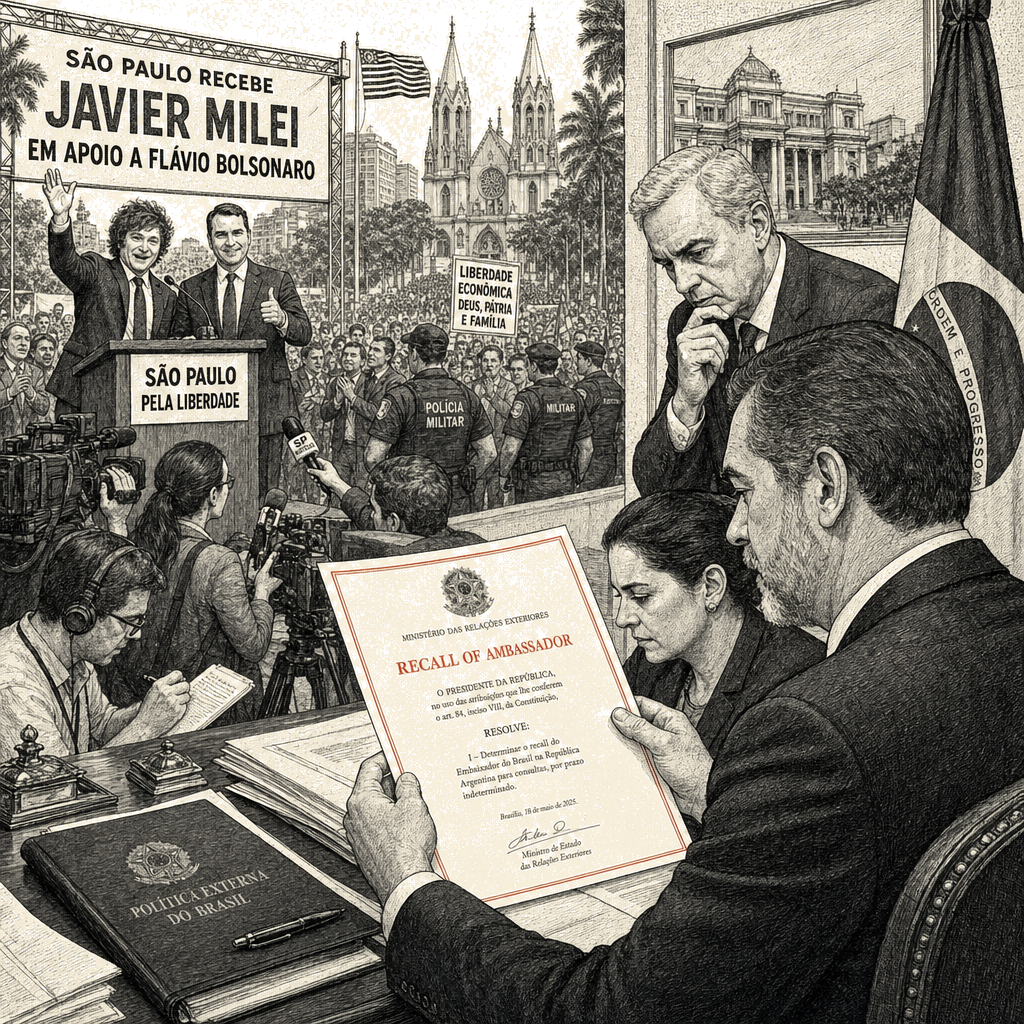
SÃO PAULO — Brazil recalled its ambassador to Argentina on Sunday in protest of Argentine President Javier Milei’s visit to São Paulo to endorse Flávio Bolsonaro, the candidate of the Brazilian right and the son of jailed former President Jair Bolsonaro.
Speaking to cheering supporters Saturday, Milei called President Luiz Inácio Lula da Silva a corrupt “thief,” urged conservatives across the region to unite against socialism and called Supreme Court Judge Alexandre de Moraes, who led investigations into Jair Bolsonaro, a “bald piece of garbage.”
Brazilian Finance Minister Dario Durigan dismissed Milei as a “clown” on Monday during a local radio interview, pointing to the relative strength of Brazil’s economy compared to Argentina’s.
“It’s completely unacceptable for the president of another country to come here without any official notice, insult our authorities, criticize our economic policy and dance around,” Durigan said. “We couldn’t just let that go unanswered.”
The rift between South America’s two largest economies is part of a broader confrontation. Lula’s administration sees a coordinated effort by the Trump administration and an emerging alliance of right-wing leaders across Latin America to shape October’s presidential election and return the Brazilian right to power, according to the Wall Street Journal.
Brazil’s Foreign Ministry said Saturday that it had denied visas to two U.S. State Department officials over concerns they planned to visit the country this week as part of a broader effort to undermine confidence in Brazil’s electronic voting system. Brazilian officials believe the planned trip was part of a concerted campaign by the Bolsonaro family and the Trump administration to discredit the election should Flávio Bolsonaro lose in October, according to people close to Lula.
The U.S. State Department confirmed the officials were scheduled to visit Brazil to discuss election integrity, religious freedom and freedom of expression, calling any suggestion the trip was intended to undermine Brazil’s democracy “a baseless lie.”
Officials in Lula’s administration said Bolsonaro’s sons — including presidential candidate Flávio, Eduardo in the U.S., and Carlos — are coordinating with the Trump administration to attack Brazil’s electoral system, pointing to meetings with foreign diplomats in which they allegedly spread false information about the reliability of the country’s electronic voting machines.
Lula, who leads Flávio Bolsonaro by 5 percentage points according to the latest Datafolha poll, wrote in an opinion article in the Washington Post over the weekend that “Brazil’s destiny is for Brazilians alone to determine — without foreign interference or subservience.” He accused the U.S. of imposing “ideological constraints on the bilateral partnership” and noted that Brazilian exports to the U.S. had fallen to a near-30-year low while commerce with China — now Brazil’s biggest trading partner — has surged.
The standoff with the U.S. began in July last year, when President Trump announced some of the highest tariffs of his second term on Brazil while calling for an end to criminal proceedings against Jair Bolsonaro. Brazil’s Supreme Court convicted Bolsonaro of plotting a coup two months later and sentenced him to 27 years in prison.
With recent elections in Colombia, Chile and Peru delivering victories to conservatives broadly aligned with Trump’s worldview, Brazil is poised to be South America’s last large country governed by the left, the Journal reported.
Oliver Stuenkel, senior fellow at the Carnegie Endowment for International Peace in Washington, said the region was seeing “a complete breakdown of a diplomatic tradition that was alive and well in the ’90s in Latin America about just not openly meddling in each other’s domestic affairs.”
Political analysts said the escalating confrontation could benefit Lula politically, as fears over foreign interference have historically strengthened nationalist sentiment and rallied voters around the incumbent. Stuenkel said Milei’s appearance alongside Bolsonaro “is not going to mobilize centrists, who are really going to be decisive in this election.”
The dispute has also unnerved diplomats in Argentina, whose economy depends far more on trade with Brazil than Brazil’s does on Argentina. While China is Brazil’s biggest trading partner, Brazil is Argentina’s largest.