Baltic states report near-weekly drone incursions; German general calls it a ‘gray-zone campaign’
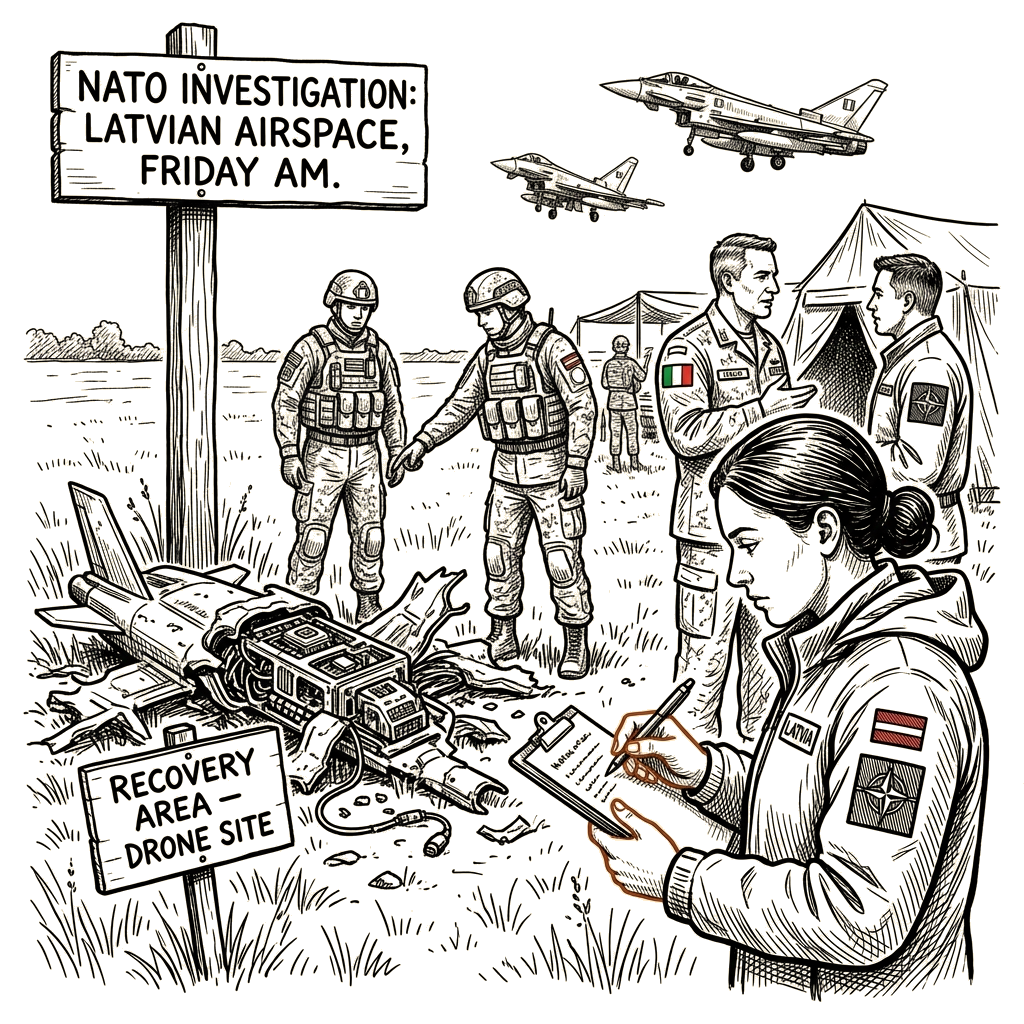
An Italian Eurofighter jet shot down an unidentified drone in Latvian airspace in the early hours of Friday, NATO said. Latvia’s Ministry of Defense said the drone had entered its airspace “as a result of Russian electromagnetic warfare,” and a NATO spokesman said an investigation is under way. NATO scrambled four fighters in total — a second Italian jet and two Turkish jets — to respond to the incursion.
A senior Latvian official told The Wall Street Journal that the drone had not been recovered and that the country would not rush to conclude where it came from.
The Latvian incident is the latest in a series of near-weekly drone incursions across NATO’s eastern frontier this summer. Russia has deployed spoofing and jamming networks across its western military district to disrupt the satellite-navigation systems on Ukrainian long-range strike drones, The Wall Street Journal reported. When Russian electronic warfare scrambles a drone’s navigation, the drone drifts with prevailing winds or follows a default flight path rather than reaching its intended target inside Russia, leading to repeated inadvertent crossings into neighboring NATO states.
The pattern has played out across the Baltic states and beyond. Ukraine apologized to Finland in March after two drones crashed in the country’s southeast, attributing the failures to Russian signal interference. Estonia confirmed in March that a Ukrainian drone had struck a power station in eastern Estonia, near the Russian port of Ust-Luga, which Ukraine was attacking at the time. Lithuania issued air-raid alerts in Vilnius after a drone flew toward the capital. A Romanian fighter in May shot down a drone over Estonia.
Baltic officials worry that Russia may use captured Ukrainian drones to stage a false-flag attack on alliance territory. Latvia, Lithuania and Estonia have responded by tightening security around national infrastructure including power plants and natural-gas facilities.
Germany’s top military officer, Gen. Carsten Breuer, told The Wall Street Journal that Russia is waging an intensifying gray-zone campaign aimed at destabilizing European governments and institutions. U.S. intelligence has concluded that Russia likely sent an explosive-laden drone discovered near a Ukrainian cargo plane at an airport in eastern Germany earlier this month; Germany’s interior minister said the incident represented “a new level of danger.”
NATO first shot down Russian drones over a member state in September 2025, when Poland said its airspace had been breached 19 times in one night, prompting authorities to close major airports and declare the country closer to open conflict than at any point since World War II. A Russian cruise missile crashed in eastern Poland in July; the missile was likely targeting Ukraine, roughly 60 miles away. NATO jets also pursued drones that entered Romanian airspace near the Ukrainian border on Thursday, the alliance said, without specifying the origin of the unmanned vehicles.
U.S. intelligence assessments, as reported by The Wall Street Journal, hold that Russian President Vladimir Putin could seek to test NATO’s resolve with a limited attack on one of its members in the coming years.
Scrambling jets or launching missiles is an expensive way to deal with comparatively cheap mass-produced drones, and the combination of stray drones and what the alliance describes as hybrid threats from Moscow is testing NATO’s resilience and its coffers.