Klein says no law authorizes Interior to refund wind leaseholders
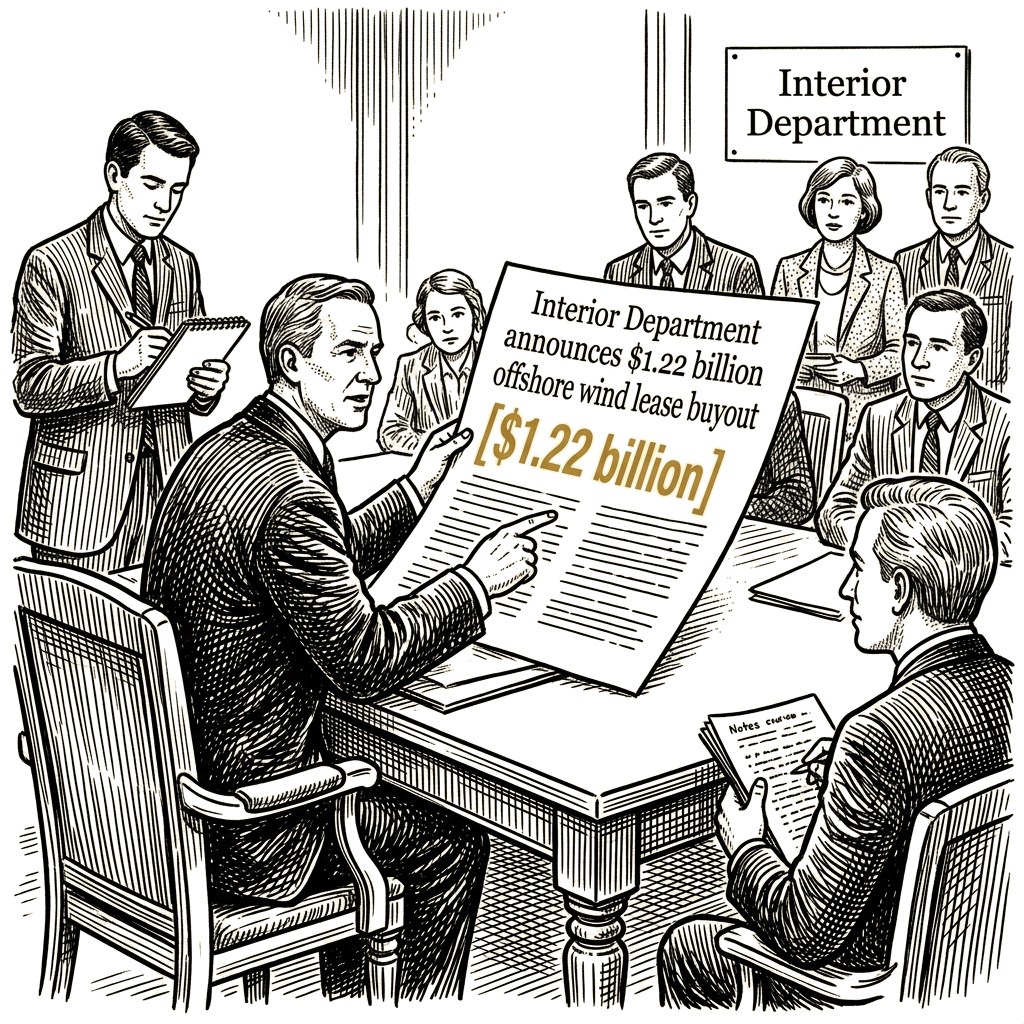
The Interior Department’s latest offshore wind lease buyout, totaling more than $1.22 billion, was announced Aug. 7, according to United Press International. Together with prior agreements, the federal government has committed roughly $3.97 billion to companies in exchange for terminating their offshore wind leases — agreements under which the federal government would pay leaseholders not to develop offshore wind projects.
There are 44 offshore wind projects in development under federal leases, according to the Offshore Wind Power Hub, ranging from four under construction to 10 under contract.
The payments flow through the Judgment Fund, a mandatory federal fund administered by the Bureau of the Fiscal Service under the Treasury Department. According to the Bureau of the Fiscal Service, agencies may draw from the Judgment Fund only when their own congressionally appropriated funds are not legally available. The fund is normally used to pay court judgments and settlements when the federal government is a defendant. None of the leaseholders receiving payments in the offshore wind buyouts has filed suit against the government, according to UPI.
Elizabeth Klein, former director of the Bureau of Ocean Energy Management under President Biden, told UPI the agreements break from established norms “on multiple fronts, including from a fiscal sense and legal perspective.”
“At the Interior Department, in my past experience, we have used it to settle claims made by tribes in tribal trust litigation,” Klein said. “All past examples of the use of the Judgment Fund pale in comparison to the billions of dollars that are being paid here.”
Payments from the Judgment Fund are published in bi-weekly reports on the Treasury website and in annual reports to Congress.
In one prior case with a different legal posture, the Department of Energy used the Judgment Fund last month to pay Dominion Energy and two of its subsidiaries more than $12 million for breach of express contract, after the company filed suit against the Trump administration over an executive order halting offshore wind leasing and permitting.
Dominion’s project was among several under construction affected by the executive order. The Revolution Wind farm off Rhode Island and the Empire Wind project off Long Island, N.Y., were suspended in December after stop-work orders from the Interior Department. All three projects were allowed to resume in January.
Two state lawsuits have followed.
New York Attorney General Letitia James and Gov. Kathy Hochul filed suit over the administration’s $1 billion payment to French energy company TotalEnergies to cancel its planned offshore wind projects off New York’s coast. Under the agreement, TotalEnergies is instead investing in oil and gas production in Texas.
“This pay-not-to-play scheme pressuring a foreign company to forego planned offshore wind projects in America in favor of gas and oil drilling is an outrageous abuse of taxpayer dollars that hurts our ability to meet our energy needs, create good jobs, and help secure American energy independence while reducing emissions,” Hochul said in a statement.
The New York lawsuit alleges the administration violated the Administrative Procedures Act by making an “arbitrary and capricious” decision, the National Environmental Policy Act by failing to weigh environmental impacts, and the Outer Continental Shelf Lands Act by canceling leases without the required hearing and without coordinating with affected states’ governors.
California has filed a separate lawsuit alleging a similar OCSLA violation, adding that the federal government is required to suspend a lease for five years before canceling it.
Klein said there is no provision in federal law for the Interior Department or BOEM to refund companies that decide against developing their leases.
“If you are a company that has participated in a lease sale, whether it’s for offshore wind or some other purpose — there is no provision in the law that says if you change your mind and you want your money back, that’s not an option,” Klein said.
Klein noted that companies may end a lease, but they are not entitled to recover their investment. The structure is designed in part to prevent anticompetitive tactics such as purchasing a lease solely to block a competitor.
“There are actually very high profile and very expensive examples in the past of offshore oil and gas companies, for instance, relinquishing leases after they have decided for whatever reason not to move forward on them and they do not get their money back,” Klein said.
Trump’s opposition to wind energy has been a feature of his campaign speeches and press briefings throughout his 10-year political career.
Trump has called wind energy expensive. Onshore wind is among the cheapest electricity sources globally, according to data from the International Renewable Energy Agency and the U.S. Energy Information Administration cited by UPI. Offshore wind is more expensive to build and maintain than onshore wind but yields greater electricity production due to consistent winds. The levelized cost of offshore wind has become competitive with natural gas and coal as the technology has matured.
Trump has alleged that offshore wind farms are responsible for whale deaths. At a January 2025 rally in South Carolina, Trump said wind energy projects are “driving the whales, I think, a little batty” and that whales are “washing up on shore on levels never seen before.” The National Oceanic and Atmospheric Association, which investigates whale mortality, said in 2023 there was no evidence that offshore wind farms had caused the death of any whales.
On bird deaths, the National Audubon Society’s 2025 Birds and Offshore Wind Report said wind turbines “can pose a risk to birds” but the risks can be minimized through strategic planning. The report noted that climate change poses a persistent risk, with 389 bird species — about two-thirds of bird species — facing extinction from rising temperatures and habitat loss.
“There’s no way to rationalize this from the federal government’s perspective and from the taxpayers perspective,” Klein said. “The only entities that benefit here are the companies that are getting paid off.”