One Big Beautiful Bill Act projected to cut Medicaid by $900 billion-plus
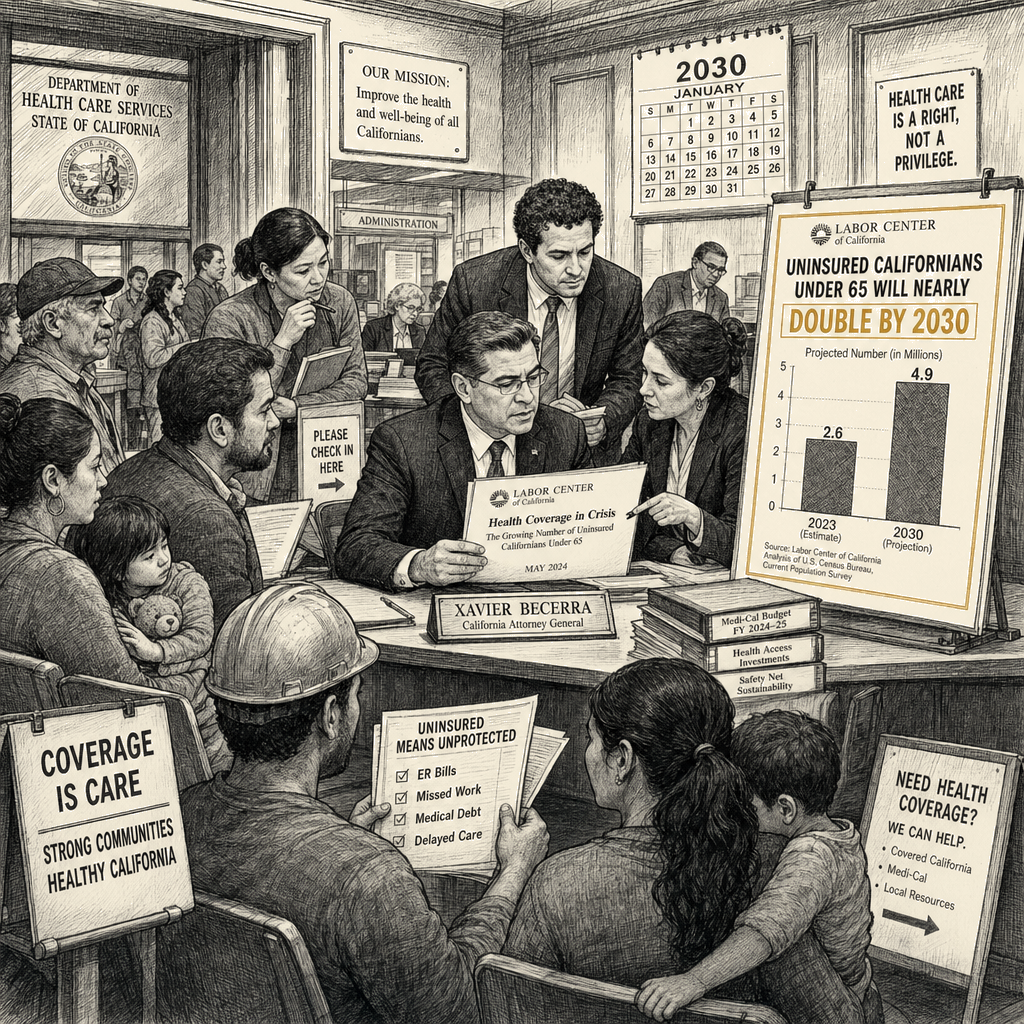
Xavier Becerra, the Democratic frontrunner for California governor, faces a projected near-doubling of the state’s uninsured under-65 population if he wins in November, according to a UC Berkeley Labor Center analysis that quantifies the health insurance consequences of recently enacted federal and state coverage cuts.
By 2030, the number of uninsured Californians under 65 is expected to rise from 2.4 million to 4.6 million as the cuts roll back historic coverage gains, according to the May analysis. In February, Miranda Dietz, the labor center’s healthcare program director, told legislators the changes could cost California about 200,000 jobs, mostly in healthcare. The projected rise in the uninsured population could have broad implications for hospital systems, insurers, and the state’s economy.
The federal backdrop is the One Big Beautiful Bill Act, which Congress passed last summer and which Republicans argued preserves Medicaid for those who need it most while rooting out fraud and waste. The law is expected to cut Medicaid spending by more than $900 billion over a decade. Congress also allowed enhanced premium tax credits for Affordable Care Act marketplace plans to expire last year, spiking premiums for middle-income Americans and driving down marketplace enrollment by nearly 3 million this year.
“We are now witnessing almost a wholesale reversal of pretty much all those policies” that helped cover millions more Americans, said Sabrina Corlette, co-director of the Center on Health Insurance Reforms at Georgetown University.
Becerra has pledged an executive order to keep Californians affected by the federal cuts insured, but he has not detailed how the state would backfill as much as $30 billion in annual federal funding California stands to lose. At a policy forum hosted by Politico this month, Becerra promised Californians would not lose health coverage despite the federal rollback, saying he would push the industry to eliminate waste from “attorneys, accountants, pencil pushers” that cost consumers billions.
“I’m going to ask them to help me extract some of that waste and put it into healthcare, which helps us cover the cost of keeping Californians insured,” Becerra said.
His Republican opponent, Steve Hilton, a former Fox News commentator, is campaigning to cut off state-funded coverage for Californians without legal status and use those savings to issue state income tax breaks. Hilton is trying to appeal to voters opposed to President Donald Trump despite receiving the president’s endorsement. He has also criticized state leaders for a revised provider tax he asserts will send premiums soaring and called for more competition in California’s health insurance market, though he has offered no specific ideas.
“We all understand that the healthcare system is a mess and needs major reform,” Hilton said in an interview. “The quickest thing we can do on healthcare costs is actually to tax people less.”
Becerra’s relationship with the Affordable Care Act stretches back to 2010, when he was part of House Speaker Nancy Pelosi’s leadership team and helped whip up votes to pass the law. He later defended many of its provisions as California attorney general, including access to birth control. Before the ACA, some 50 million Americans — roughly one in six — were uninsured; within a few years of its passage, the law’s expansion of Medicaid eligibility and financial aid to lower-income marketplace enrollees helped cut the U.S. uninsured rate by nearly half.
A decade later, as President Biden’s secretary of Health and Human Services, Becerra said his primary mission was to carry out Biden’s vision to expand access and cut costs under the ACA. He launched aggressive public awareness campaigns, loosened enrollment rules, and distributed hundreds of millions in grants to pay healthcare navigators to help enrollees wade through paperwork. Millions more gained coverage during the COVID-19 pandemic after Becerra implemented a freeze on Medicaid disenrollment. Under Biden and Becerra, the share of Americans with health insurance reached a historic high of 92%, or 310 million people, in 2024.
“One of the common things we would hear from him as a leader was, ‘Who’s being left behind?’” said Benjamin Sommers, a Harvard health policy professor who served as a deputy assistant secretary under Becerra.
Conservatives argued those policies inflated enrollment by attracting fraudulent and wasteful coverage. “It’s simple and easy to say, well, the numbers are up so the program must be working,” said Edmund Haislmaier, a senior research fellow at the Heritage Foundation, a conservative think tank. “My argument would be that’s the wrong metric.”
Hospital executives have begun reporting more unpaid medical bills, and health policy experts warn premiums will rise further as insurers are left with enrollees who are, on average, sicker and more expensive to cover. “It’s triage,” said Jessica Altman, executive director of Covered California, the nation’s largest state-run health insurance marketplace. “That’s what the next governor is walking into.”
Federal funds account for one-third of California’s overall budget and more than 60% of Medi-Cal, the state’s Medicaid program. Gov. Gavin Newsom has frozen enrollment for immigrants without legal status, enacted monthly premiums for some enrollees, and plans to only temporarily backfill federal assistance for legal immigrants and refugees. Newsom and Democratic lawmakers agreed to delay some cuts until July 2027, leaving the next governor to weigh further rollbacks against increased taxes.
Becerra, a California native born to Mexican immigrants, opposes a so-called billionaire tax on November’s ballot. This month, he said he supported legislative efforts to penalize large corporations whose workers rely on Medi-Cal, arguing that taxpayers are subsidizing employers’ low wages and paltry benefits. County governments, which are legally required to provide healthcare to uninsured residents too poor to afford care, are lobbying lawmakers for funding to treat what they describe as a fresh deluge of patients needing free care.
“It’s a pretty big cliff if all this stuff goes into effect,” Dietz said. “And there’s a choice whether to make it less bad and maintain coverage for folks.”
The consequences are already reaching individual Californians. For Eric Maciel, the $800 cost of a Covered California plan is too much. The 28-year-old stays home more and rarely plays pickup soccer at the park to avoid injury. “That’s another car note,” Maciel said. “I’d be left with nothing.” Health economists say Maciel is the type of customer insurers need to stabilize their risk pools: young, healthy, and less costly.