Federal government holds option to acquire 20% stake in company
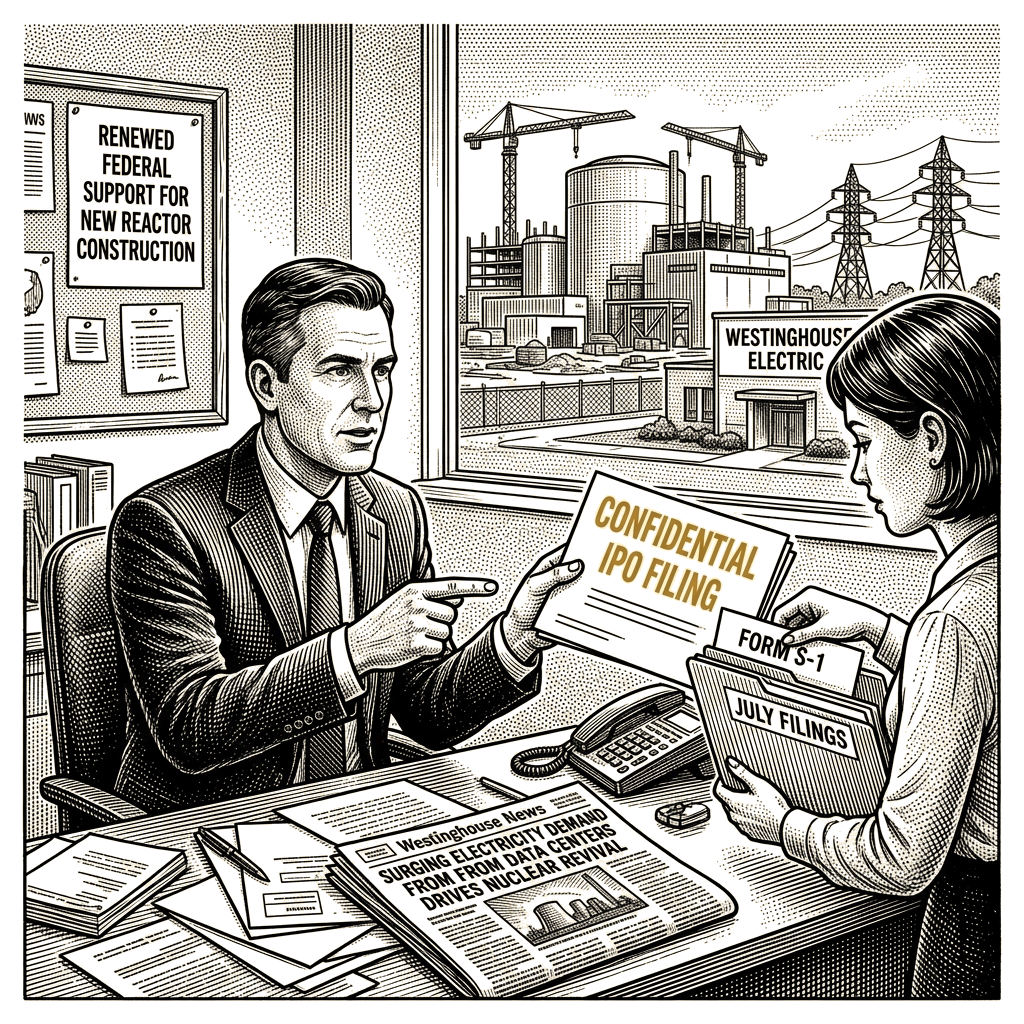
Westinghouse Electric confidentially filed in July for an initial public offering, the Wall Street Journal reported Monday, citing a turnaround driven by rising electricity demand from data centers and federal support for new reactor construction. Chief Executive Dan Sumner framed the moment in industry terms: “There really is no credible path to the AI build-out and energy security without nuclear,” he said in an interview.
Under an $80 billion federal push for new Westinghouse reactors, the U.S. government holds an option to take a 20% stake in the company, contingent on orders coming through by 2029 and Westinghouse’s market valuation reaching $30 billion, the Journal reported. Since reaching that agreement last year, the U.S. has offered low-interest loans to utilities to finance equipment orders and signed a 30-year nuclear cooperation agreement with Saudi Arabia from which Westinghouse would likely benefit.
The Energy Department has set aside a $17.5 billion pool of low-interest loans that would allow five projects, each featuring two reactors, to begin manufacturing while working through permits and final investment decisions. “This lets them purchase something, get some confidence, see how much negative feedback they get and test a lot of things before signing up for a $20 billion project,” said Adam Stein, director of nuclear energy innovation at the Breakthrough Institute.
Westinghouse’s revival follows a high-profile collapse in 2017. Then owned by Toshiba, the company incurred billions of dollars in cost overruns related to the planned construction of four nuclear reactors in the southeastern United States. Two — the AP1000 units at Vogtle in Georgia — were ultimately completed; two others were halted. The completed Vogtle reactors were projected to cost $14 billion but ultimately cost about $35 billion, coming online seven years behind schedule.
Since the bankruptcy, Westinghouse has narrowed its focus to its core business of manufacturing nuclear fuel, refueling reactors, and maintaining many of the world’s nuclear power plants, while declining to act as general contractor or assume the risk of building an entire power plant. The company estimates an “overnight cost” of roughly $10 billion per reactor — a figure that excludes financing charges and assumes construction could theoretically be completed overnight. Its signature AP1000 generates enough electricity to power a city the size of San Francisco, the Journal reported; a smaller version, the AP300, is under development.
Utility executives remain cautious. Southern Company operates the only two AP1000 reactors in the United States at Vogtle, and CEO Chris Womack told analysts the utility is supportive of new nuclear construction but added: “Southern’s not going to be next. Let me be clear about that.” Duke Energy CEO Harry Sideris said this month that his company is “keeping our options open” for nuclear power but is focused on “how do we offset the financial risks for our customers and our investors?”
Stein, of the Breakthrough Institute, said that successful reactor proposals depend on more than financial models. “It’s not just the number on the paper,” he said. “Does the CEO or the public utility commission have confidence? The numbers could look perfect, and they might still say no.”
Sumner called figuring out how to share risks among different companies “real roll-up-your-sleeves-type work.” He said the U.S. industry has lagged: “We’ve been sitting here for the last 35 years while, by the way, other countries are rapidly expanding their domestic nuclear fleets.” He added: “As an industry we needed the shot in the arm.” China, by Sumner’s account, is home to the four other AP1000 reactors currently operational worldwide and has 14 under construction, plus its own domestic reactor design.
Westinghouse has been privately held since 2023, when Canadian companies Brookfield Asset Management and uranium miner Cameco bought it for about $8 billion. The buyers at the time assigned no value to the possibility of building new reactors but valued Westinghouse’s fuel fabrication and services business. David Nicholas, president of Xfunds, which operates a nuclear-income exchange-traded fund, said Westinghouse could reasonably command a valuation of $15 billion to $20 billion in an IPO, adding: “I wouldn’t rule out a number north of $20 billion if investors give it credit for the AP1000 pipeline.”
President Trump has called for quadrupling U.S. nuclear power output by 2050, and Japanese financing secured through a trade deal could help back the federal push for new reactors, the Journal reported. Beyond the Westinghouse stake option, the federal government has recently taken equity positions in other major companies: it converted about $9 billion in federal grants into a 10% stake in Intel and holds a “golden share” in U.S. Steel that gives it sweeping veto power over corporate decisions.
In July, the U.S. agreed to provide Saudi Arabia with a civilian nuclear program under a 30-year, multibillion-dollar deal that could give Westinghouse a central role in developing infrastructure. Though not named in the pact, Westinghouse is the only U.S. company marketing large-scale reactors, the Journal reported. The deal has proved controversial because it would potentially open the door for uranium enrichment on Saudi territory.