Japan’s debt burden and rising rates add to global pressures
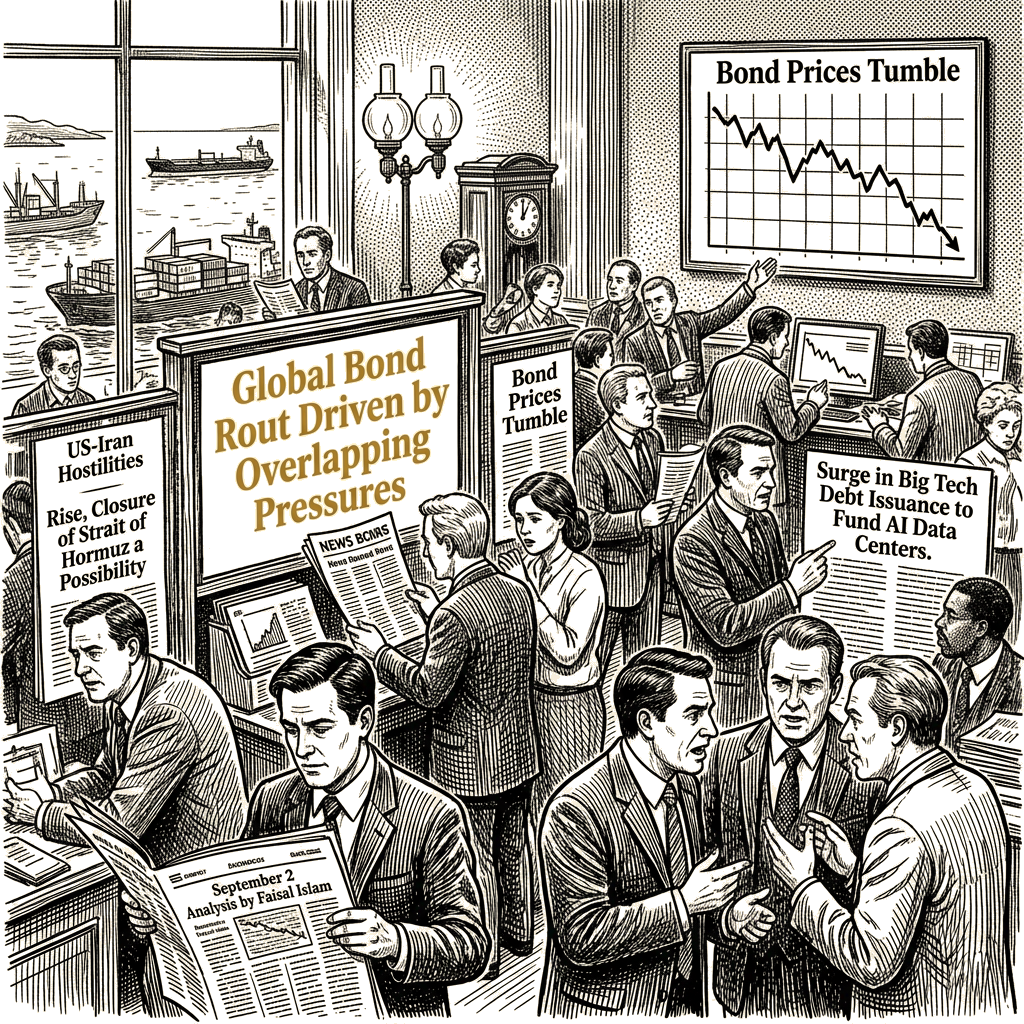
The world’s bond markets — where governments and companies raise debt from investors — are repricing simultaneously as multiple pressures compound, according to a September 2 analysis by BBC News Economics Editor Faisal Islam. The 10-year US Treasury yield, a benchmark for mortgage rates and corporate borrowing costs, stood at 4.79% on September 2, 2026, per Federal Reserve Economic Data, near its highest level since January 2025.
Islam identifies the closure of the Strait of Hormuz and renewed US-Iran hostilities as the immediate trigger of the summer’s moves. The conflict has pushed oil and gas prices higher and raised expectations of higher interest rates in major economies. Markets had assumed tensions would subside before November’s US midterm elections, on the hope that President Donald Trump would seek a Middle East resolution — “wishful thinking,” Islam wrote.
Beneath the geopolitical trigger, the analysis points to a structural shift: surging Big Tech borrowing for artificial-intelligence data centers. US “hyperscalers” including Google, Amazon and Meta have issued more than $219bn (£162bn) of debt so far in 2026, with nearly a third of that issued in currencies other than the dollar, including sterling. Total issuance by those firms was $93bn last year and had averaged less than $40bn annually before that. Some market participants expect tech giants to raise $400bn to $500bn from bond markets this year.
The shift places technology companies in direct competition with governments for investor money, with implications for the price of sovereign borrowing.
Looking east, Japan presents a second structural pressure. It carries the highest debt-to-GDP ratio of any major economy and remains the largest single lender to the US government. Until recently, the Bank of Japan’s policy rate stood at zero; the rate has since risen to combat inflation. Japanese government bond yields have reached 30-year highs. The combination of a rising yen-region cost of capital, a declining yen and Japan’s outsized role in financing US debt creates cross-currents that complicate the global flow of money, Islam wrote.
The biggest factor pushing up borrowing costs, according to the analysis, is the credibility of borrowing plans set out by major countries. The repricing is not based on fears of sovereign default. But, Islam writes, “if a country wants to borrow more, and to do so without a credible plan, especially if there are doubts over the stability of a given government, it should expect to pay a higher rate.”
Influential economists offered competing emphases. Mohamed El-Erian told the BBC that AI-driven competition in bond markets was the biggest new factor. Lord Jim O’Neill attributed recent moves to uncertainty about US policy, and specifically to US Treasury efforts to manage down surging yields.
The analysis identifies a specific premium attached to political volatility in the UK. Multiple prime ministers, multiple chancellors and repeated policy U-turns have contributed to what the BBC describes as a “profound and rolling instability.” Sir Keir Starmer had made taking on “boring reforms” and offering markets stability a deliberate strategy aimed at lowering borrowing costs, Islam notes.
Labour’s failure to push through planned welfare-bill cuts despite a landslide parliamentary majority added to volatility in gilt markets — the market for UK government bonds. Long-term UK borrowing costs reached their highest level since 1998 ahead of the October Budget.
Some underlying economic indicators offer a partial counterweight. UK economic growth has outpaced peers so far in 2026 despite the energy-price spike, and consumer-confidence measures have ticked back up, the analysis reports.
The piece also examines the tradeoffs facing Prime Minister Burnham. A 10-year plan expected in November will need to address spending priorities, with Lord O’Neill — described by the BBC as Burnham’s former economic adviser — telling the broadcaster that the plan must show how it will tackle “excessive spending” on items including the state pension and welfare. As interest rates continue to rise, the tradeoffs facing the prime minister grow more difficult, the analysis concludes.
As covered on September 1, the US 10-year Treasury yield hit 4.79% amid renewed Middle East strikes. And as MSI reported on August 19, a global bond selloff was already raising borrowing costs across governments, businesses and families with little relief in sight. The September 2 BBC analysis places those yield moves within a broader repricing driven by Big Tech debt demand, Japan’s rising rates and political risk premiums attached to specific borrowers.