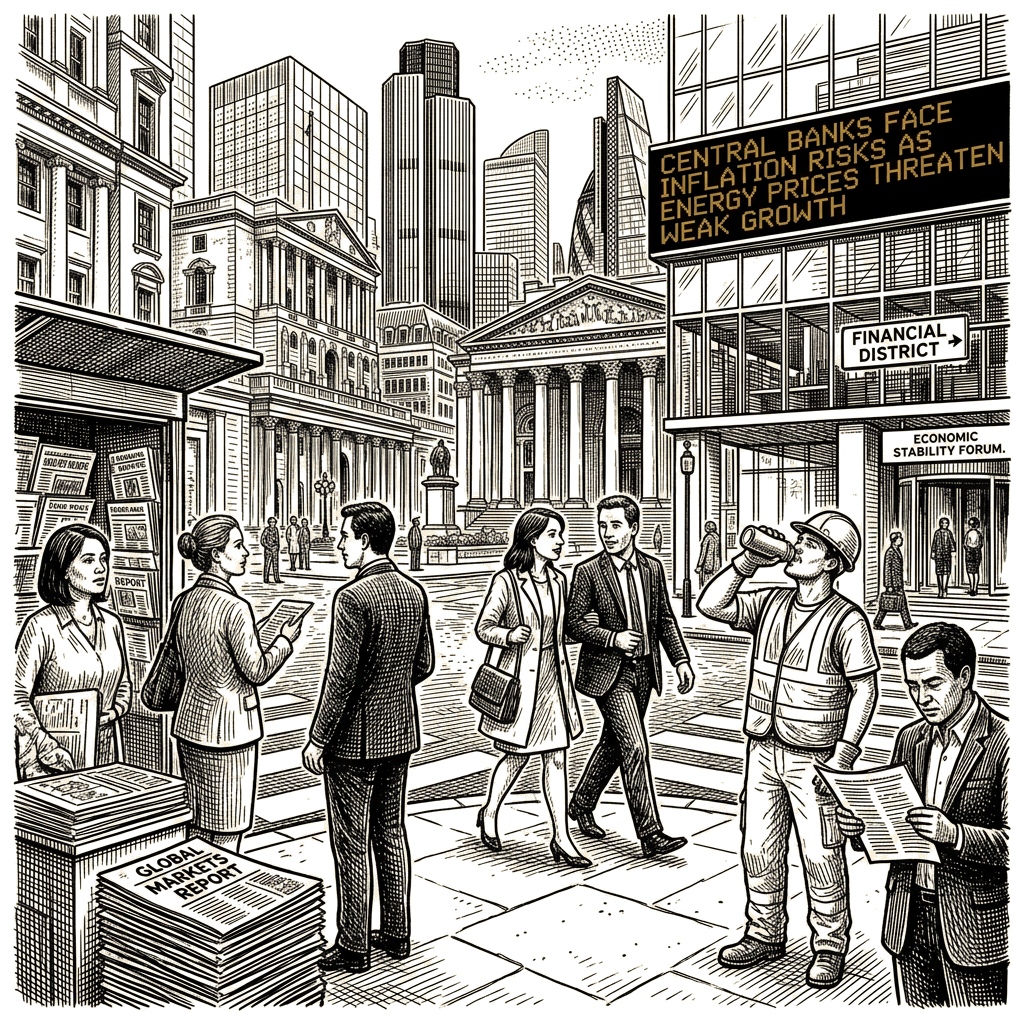
Fed, Bank of England and ECB reassess rate decisions amid oil-market uncertainty
Inflation had been easing across industrialized economies, but fluctuating fuel prices tied to the Iran war have made the outlook harder to assess. The Guardian reported that the Federal Reserve, Bank of England and European Central Bank are concerned that renewed oil-price increases could keep inflation above their 2% targets.
The central banks are also dealing with the consequences of earlier decisions. Officials faced criticism that they reacted too slowly after the Ukraine war began, when post-pandemic consumer demand was already pushing up prices for food, construction materials and other goods.
The current disruption has raised questions about whether a continuing blockade of the Strait of Hormuz could prolong inflation above target for another year. In the United States, inflation was 3.3% in July, and falling petrol prices had recently helped the annual rate ease. Brent crude later rose to about $90 a barrel, and that increase is expected to raise energy and transport costs in the second half of the year.
Federal Reserve officials are considering whether U.S. inflation could move back toward 4%, according to the report. The Fed held interest rates in July, and financial-market expectations pointed to another hold in September, although a rise remained possible. Markets anticipated at least one and possibly two quarter-point increases by the middle of next year, which would move the Fed’s target range from 3.5%-3.75% to 4%-4.25%.
Kevin Warsh, the Federal Reserve’s new boss, has started a broad review of the central bank’s operations with advice from 15 outside experts. Mohamed El-Erian, an economist and professor at the Wharton Business School, said Warsh’s review recognized weaknesses in established monetary-policy assumptions.
“The key issue for me is having someone there who’s committed to long-overdue Fed reforms. This is essential for future Fed effectiveness, credibility and political independence,” El-Erian said.
Warsh has abandoned forward guidance, the practice of explicitly signaling the likely future path of interest rates. He also declined to join other Fed policymakers in producing dot plots showing expected paths for the economy and inflation.
Mervyn King, the former governor of the Bank of England and one of Warsh’s 15 appointees, has argued that central banks should place more emphasis on uncertainty and rely less heavily on economic models that claim to predict the future. King has described forward guidance as “silly” because no central bank knows what the interest rate will be in six months or two years.
El-Erian called forward guidance “spurious accuracy” and said markets and the public instead need to understand the central bank’s “reaction function,” or how it will respond to different economic developments. Charlie Bean, a professor at the London School of Economics and a former Bank of England deputy governor, said Warsh had not clearly explained either the path of rates or how economic changes would affect policy.
“Warsh is getting in a bit of a mess in the way he is not giving a guide to where rates are going and also not talking about how changes in the economy will affect rates,” Bean said. “It means he is not saying anything of substance.”
The Bank of England has said it would raise borrowing costs if inflation became persistent, but it has kept its Bank Rate at 3.75% so far this year. The report said a majority of the nine-member Monetary Policy Committee were wary of raising rates when higher borrowing costs would do little to lower global oil prices and could further weaken the British economy.
The United Kingdom’s consumer price index fell to 2.6% in June, while analysts expected the July reading to rise to 2.9% or 3%. The Office for National Statistics was scheduled to publish the July figures on Aug. 19.
Charlie Bean also pointed to high and rising government debt. When a central bank raises rates in a heavily indebted country, the government’s debt-financing costs increase. Policymakers must then weigh the effect on public finances against allowing inflation to remain above target for longer.
Neil Shearing, chief economist at Capital Economics, said governments’ debt-fuelled spending could keep inflation elevated. He argued that central banks were expected to maintain a 2% target while tolerating somewhat higher inflation, without openly acknowledging that tension.
Supply shocks add another complication. Rate increases can reduce consumer spending, but they have limited immediate effect on imported goods whose prices rise because of global supply restrictions.
The European Central Bank has taken a different course from the Fed and Bank of England by raising borrowing costs this year. It increased rates in June after a modest inflation rise linked to the Middle East war and higher oil prices. Critics said the move came too early while the eurozone economy was still weakened by the energy shock that followed Russia’s invasion of Ukraine.
“The ECB was clearly fighting the previous war and prematurely raising rates. The underlying picture in the eurozone is one of weakness,” Shearing said.
Financial markets expected the ECB to raise its main deposit rate by a quarter point to 2.5% at its September meeting and possibly increase it again the following year. Shearing said those expectations could be wrong because higher oil prices both raise inflation and restrain economic activity, making another rate increase harder to justify while growth remains weak.