Steinem campaigned for abortion rights, the ERA and same-sex marriage
Gloria Steinem, the writer and activist whose public life was central to the U.S. women’s movement, died at 92 at her home in New York City, according to her foundation’s social media pages. Her foundation said in a statement that she “passed away peacefully,” surrounded by many who loved her.
The foundation’s post read, “Gloria’s greatest gift was her ability to listen to others, to make others feel seen and heard. Her words, actions, and example gave people permission to be their truest selves. Gloria lived true to her independent spirit, always with curiosity and a great sense of humor.”
Steinem was, The Wall Street Journal wrote in its obituary, “a living symbol of the women’s movement.”
Her life as an advocate was to a large degree spent on the road — speaking at college campuses and community centers, at rallies and marches, as the Associated Press noted. In January 2017, at age 82, she arrived on Washington’s National Mall to address the Women’s March on Washington, telling roughly half a million people, “We are linked. We aren’t ranked.” She called the gathering “an outpouring of energy and true democracy like I have never seen in my very long life.”
Steinem was born on 25 March 1934 in Toledo, Ohio. The Wall Street Journal wrote that she was named after her older sister’s favorite doll. Her father was a traveling antiques dealer and her mother, Ruth, a former newspaper reporter who struggled with mental illness. Her parents separated when she was 10, and Steinem did not attend school full-time until she was 12. She often said, about women of her generation, “Most of us are living out the unlived lives of our mothers.”
After graduating from Smith College in 1956, she won a fellowship to travel and write in India, spending two years there, including working with village women to organize non-violent protests against government policies — an experience she credited with kindling her interest in grassroots activism.
She moved to New York in the early 1960s to work as a freelance writer. Her breakthrough came in 1963, when she went undercover as a “bunny” cocktail waitress at the Playboy Club and described the experience in Show magazine, using the name Marie and saying she was 24 when she was actually older. The reporting described the underpaid life of a Bunny and the physical pain of wearing high heels and tight corsets for hours. In a 2016 interview, she said: “To this day when people don’t like me they introduce me as a former Bunny, as a put-down. On the other hand, I did improve the working conditions for those women.”
By 1968 Steinem was a columnist for New York magazine, where her writing on the connection between the Black Power movement and the emerging women’s liberation movement brought her national attention. At a 1969 abortion-awareness speak-in, she broke her silence about having obtained an illegal abortion in the UK at age 22, before going to India. She said of the doctor who performed it: “You must promise me two things. First, you will not tell anyone my name. Second, you will do what you want to do with your life.” She described the event as a “light bulb moment” and soon became a leading advocate, coining the term “reproductive freedom.”
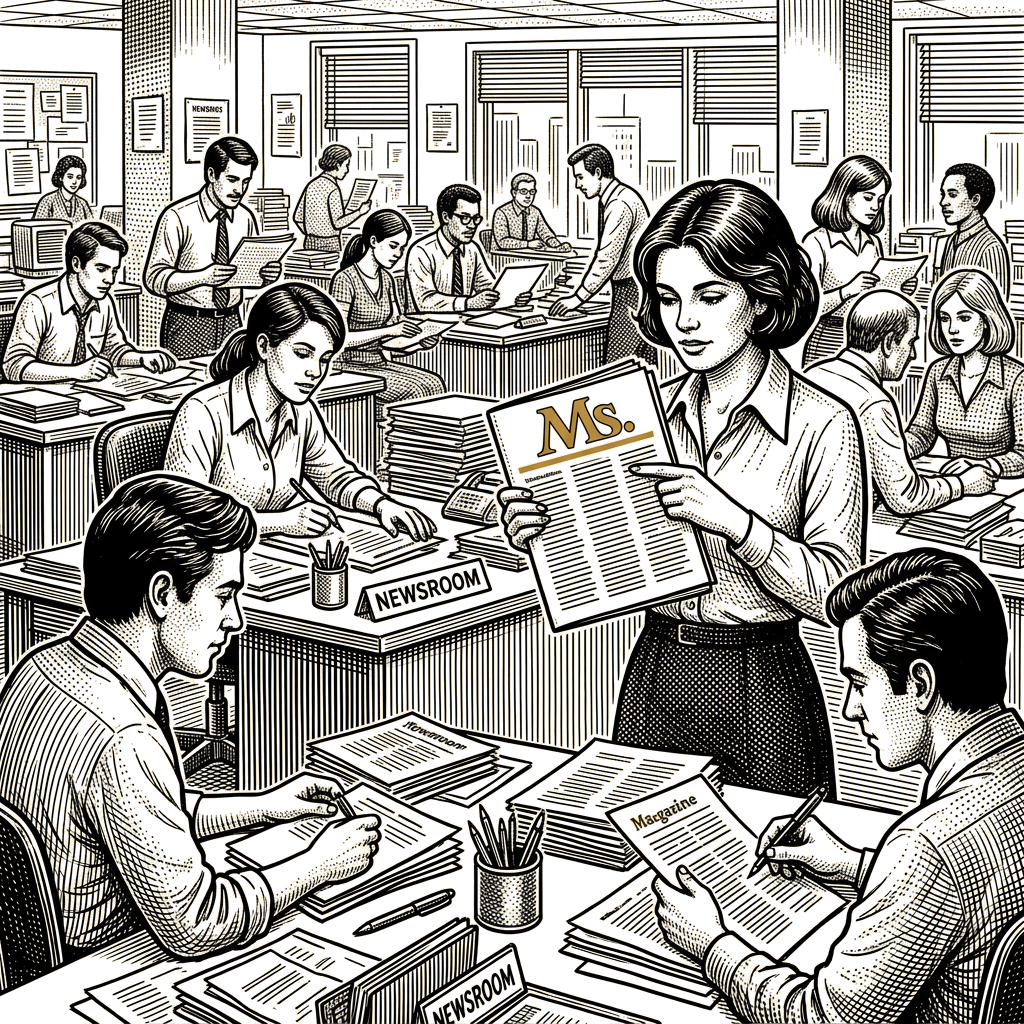
In 1972, Steinem co-founded Ms. magazine with a group of feminist activists — the first U.S. periodical designed to be an alternative to other women’s magazines that typically focused on housekeeping and fashion. Its first issue sold out within a week and generated 26,000 subscribers. When a news presenter, Harry Reasoner, said he expected the magazine to last six months “before they run out of things to say,” it is still published today. In 1978 Steinem wrote the Ms. essay “If Men Could Menstruate,” about how male bodies and political and economic power might differ if they did.
Steinem’s political organizing went beyond journalism. After Congress failed to pass the Equal Rights Amendment in 1970, she co-founded the National Women’s Political Caucus with fellow feminist leaders and more than 300 women across the United States. The same year she told a Senate committee: “I have been refused service in public restaurants, ordered out of public gathering places, and turned away from apartment rentals all for the clearly stated, sole reason that I am a woman.” She also spoke out for the legalisation of same-sex marriage and equal rights and pay for women, and protested against the death penalty and female genital mutilation.
Her prominence drew criticism. Betty Friedan, the author of “The Feminine Mystique,” accused Steinem of “ripping off the movement for private profit” when she launched Ms. magazine. Al Goldstein, publisher of Screw magazine, published her phone number next to fake advertisements. He also printed a graphic centrefold image of a Steinem look-alike, hung it open on display at the newsstand outside Ms. magazine’s office building. She had to look at it every day. President Richard Nixon reportedly demeaned Steinem in remarks that became public, and she responded publicly that “there is some opinion that Richard Nixon is the most sexually insecure chief of state since Napoleon.”
Steinem’s life was also a private one. She was well known for a dating life that included a Ford Foundation president Frank Thomas, film director Mike Nichols, and Olympic decathlete Rafer Johnson, who helped tackle the man who assassinated Robert F. Kennedy in 1968. She was known for her independence about relationships and chose not to marry for decades; in 2000, at 66, she married South African-born entrepreneur-environmentalist David Bale, father of the actor Christian Bale, and she described the union as a “green card marriage” — though she said they loved each other and were going to be together regardless. Bale died three years later of brain lymphoma.
In 1986, Steinem was treated for breast cancer and underwent a lumpectomy. In 2013, President Barack Obama awarded her the Presidential Medal of Freedom.
In her later years, she continued writing and hosted community gatherings at her home. She once said she wanted to live to 100, because “there’s so much to do.” At 90, she told the BBC she hoped her work would help individuals become the unique and valued persons they wanted to be.