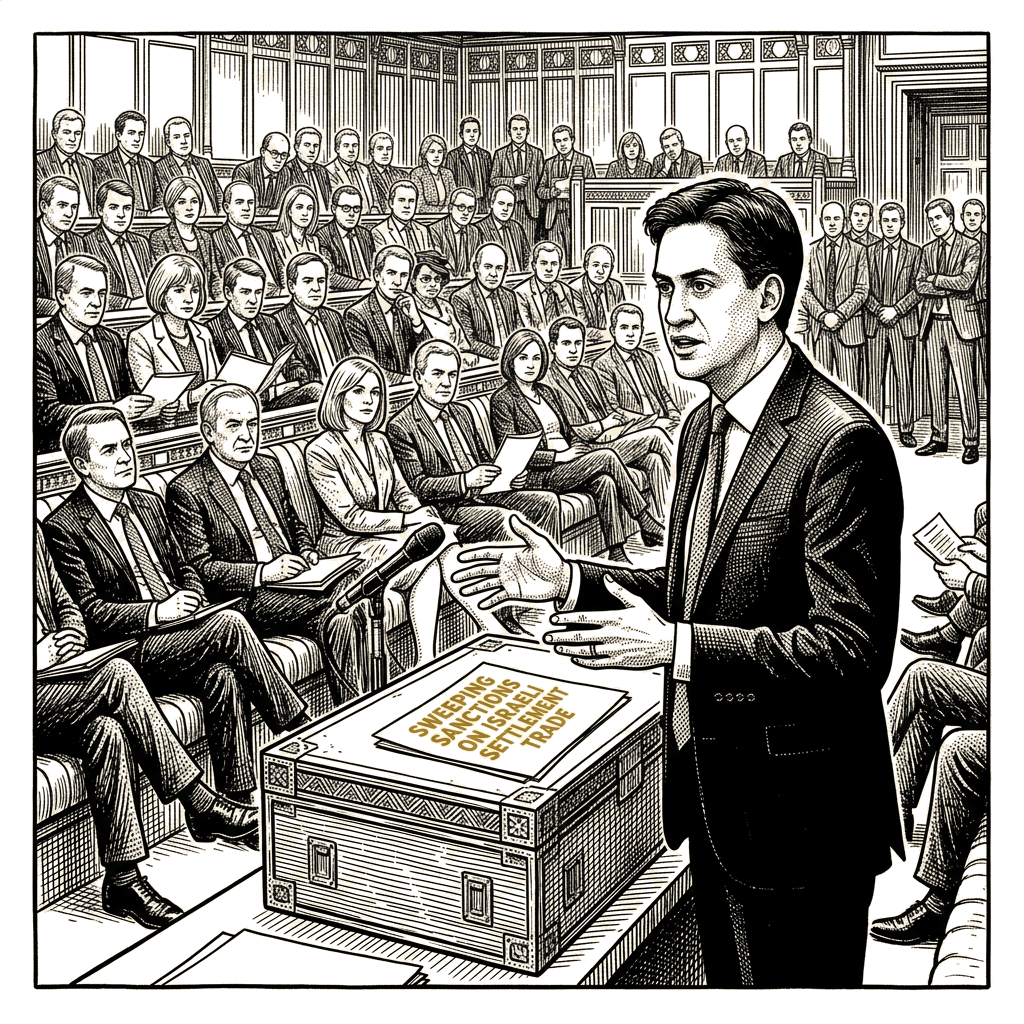
Miliband speech marks strongest UK statement on Israeli government actions
Foreign Secretary Ed Miliband told the House of Commons on Tuesday that the United Kingdom would impose a sweeping package of measures against Israeli settlement activity in the occupied West Bank, framing the move as an attempt to close what he described as a “deeply painful contrast” between British rhetoric and British policy.
The package includes a ban on imports of goods produced in illegal settlements, sanctions on banks and other companies that finance or “facilitate” settlement activity, and a refusal of all arms export licenses that contribute to the occupation of Palestinian territories. Miliband also announced that the British government now officially views Israel’s occupation as unlawful — a step beyond the longstanding UK position that declared settlements illegal while remaining silent on the wider occupation. In language carefully chosen to avoid arguing with Israelis “with whom the UK has unshakeable bonds,” Miliband accused “settler terrorists” of conducting “ethnic cleansing” in the West Bank.
Israeli human rights lawyer Michael Sfard observed that recognition of ethnic cleansing triggers legal obligations on the UK to prevent it, potentially dictating “many aspects of British policy towards Israel.” Patrick Wintour, the Guardian’s diplomatic editor, said Miliband’s stance reflects a more decisive posture than his predecessors Yvette Cooper and David Lammy, who condemned the E1 settlement plan but did not follow through with comprehensive sanctions. “He’s a more decisive foreign secretary,” Wintour said. “You can’t sporadically say this is an outrage, and then not mention it for two months.”
The economic impact of the import ban alone is likely to be limited, the Guardian reported. The settlement economy is relatively small, its products are already excluded from a 1995 EU free trade deal that reduces tariffs on Israeli imports to Europe, and it is sustained by generous Israeli government subsidies. Israeli exporters to Europe regularly obscure the origins of produce grown in settlements, the Guardian added — a problem Miliband said the UK would address through a “comprehensive sanctions regime” being developed with the business secretary.
More significant, the Guardian reported, is the diplomatic coordination: France and Canada will join the UK in sanctioning Israeli settlements. “The UK is a permanent member of the security council, and they’re worried that Miliband’s statement could shift the window in terms of what seems politically possible,” said Emma Graham-Harrison, the Guardian’s chief Middle East correspondent. “Someone else stands up and says it, and suddenly, you aren’t taking an initiative – you’re following another country.”
The action against financial facilitators could be among the package’s most transformative elements. Any individual or company that wants to bid for government-led construction projects in settlements needs a guarantor to underwrite their property, and settlement residents require banking services. Under the new measures, banks and other companies that provide services to Israeli settlements will be sanctioned. “Hypothetically, this could force mainstream financial organisations in Israel to choose between financing settlements, or doing business with the UK,” Graham-Harrison said.
Israeli ministers reacted forcefully. Bezalel Smotrich and Itamar Ben-Gvir — ministers the Guardian describes as far-right — came out against the sanctions; Ben-Gvir on Monday issued a statement in Spanish calling for sanctions on Britain over what he described as its “occupation” of the Falkland Islands. Israel announced it will close its consulate in Jerusalem and bar 11 British MPs from entering the country, with a list topped by former Labour leader Jeremy Corbyn.
The United States threatened “repercussions.” “There is no limit on what Trump could potentially do,” Wintour said, adding that the US president is “quite ambivalent about Netanyahu at the moment” amid a souring relationship over Israel’s refusal to agree to Trump’s peace plan and the ongoing conflict in Iran. Earlier in the week, Mike Huckabee, the US ambassador to Israel, attacked Miliband over the not-yet-announced sanctions plans, accusing him of “Jew hate” — though Huckabee has also called settler violence an “act of terror.” Rahm Emanuel, Obama’s former chief of staff who is sounding out a presidential bid, said he would back sanctions on companies financing illegal settlements.
The number of settlers in the occupied West Bank, including East Jerusalem, has risen from about 270,000 in 1993 at the time of the Oslo Accords to roughly 770,000 today, according to the Guardian. In August, Prime Minister Benjamin Netanyahu’s government opened the tendering process for construction work on the E1 settlement — a project for 1,200 homes that would cut across the heart of the West Bank and divide it in two. Final bids for the E1 contracts close days before the Israeli election next month. “Netanyahu is trying to make E1 an election issue,” Wintour said.
The UK announcement comes amid a political backdrop that includes a forthcoming byelection in Holborn and St Pancras, where Green party leader Zack Polanski will contest Keir Starmer’s former seat. Miliband acknowledged on Tuesday that “Labour has not done enough in the face of what is happening,” and the Guardian reported that Labour’s post-match analysis of its May local elections identified the Greens as a larger threat to its vote than Reform UK. The Guardian’s front page on Wednesday carried the headline “UK condemns ‘ethnic cleansing by Israeli terrorists’ in West Bank”; the Times led with “Israel reacts with fury to UK curbs on settlements” and the i Paper ran “Israeli fury after UK accuses settlers of ethnic cleansing.”