Black paid Epstein $170 million from 2013 to 2017 for tax and estate services
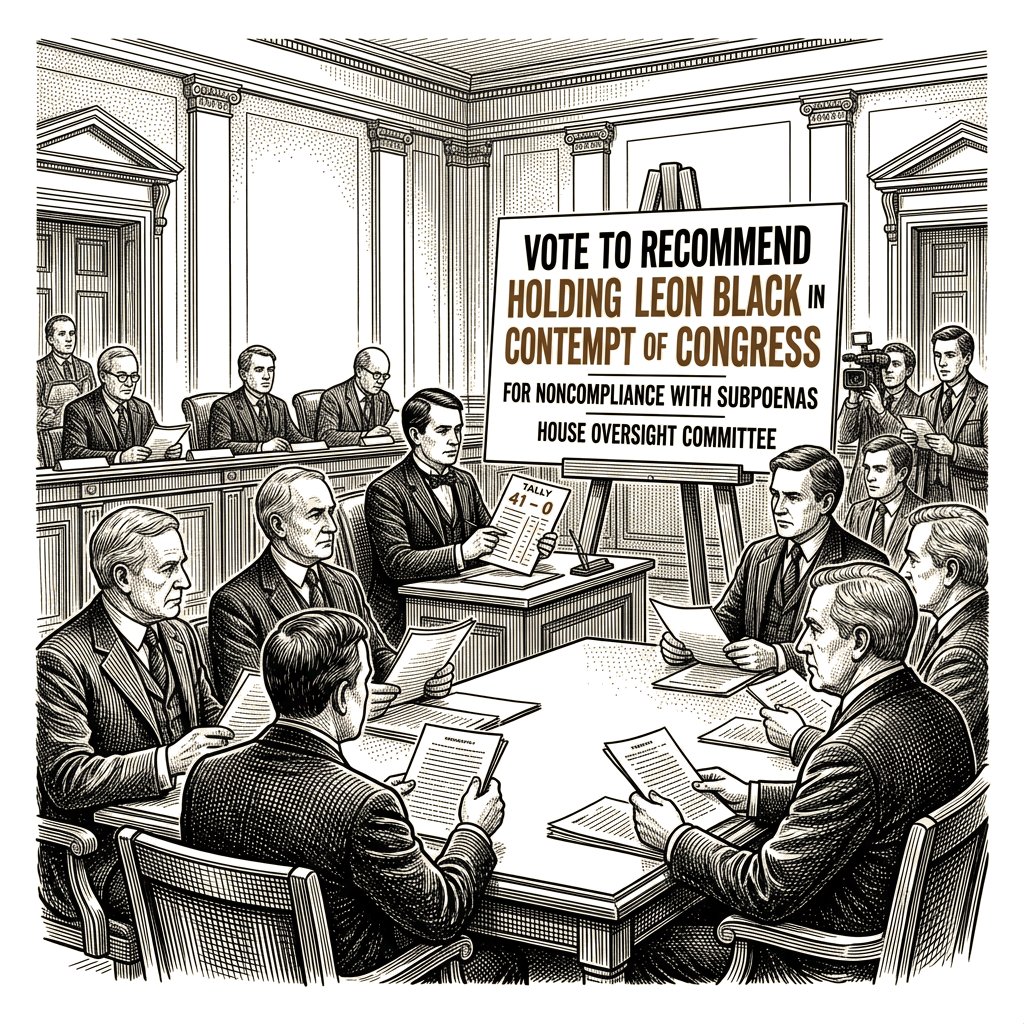
The House oversight committee voted unanimously Tuesday to recommend that the full House hold Leon Black, the billionaire financier, in contempt of Congress after he refused to comply with subpoenas for his testimony and for nondisclosure agreements sought as part of the committee’s investigation into Jeffrey Epstein.
Representative James Comer, the Republican who chairs the committee, said before the vote that “subpoenas are not suggestions; they carry the force of law and require full compliance.” Comer said Black’s testimony was crucial because he “maintained a close personal relationship with Epstein for years during the time when Epstein was engaged in sex trafficking.” The bipartisan committee passed the resolution 41-0, with Comer saying afterward that the panel now “moves the report to the full House.”
The office of House Speaker Mike Johnson did not immediately respond to a request for comment on Tuesday about whether the lower chamber would consider the contempt measure.
The markup is the latest escalation in the dispute between the committee and Black, whose name has come up repeatedly in the Epstein files. As reported by the New York Times, Black paid Epstein a total of $170 million for what he described as tax and estate planning services from 2013 to 2017. Black has repeatedly denied any wrongdoing and said he had no knowledge of Epstein’s crimes.
Comer announced last week that the committee would consider the contempt resolution after Black did not appear for his deposition scheduled for September 3 and did not produce all of the nondisclosure agreements sought by the committee. During his remarks in the chamber before the vote Tuesday, Comer said Black “only produced one NDA to the committee.”
Black has instead sued to block the subpoenas, arguing they were “invalid to the extent they exceed” the committee’s “delegated authority in seeking private information that bears no legitimate connection” to its legislative purpose. Black’s lawsuit also argued that the subpoenas would “expose women who value their privacy, who have no known or public connection to Epstein, who bargained for confidentiality and have refused to release it, and who have no ability to protect themselves and their privacy before the Committee.”
Attorneys representing Black asked for a postponement of the committee’s markup earlier on Tuesday and described it as a “complete abomination.” The lawyers said they sent two letters to Comer and Robert Garcia, the top Democrat on the committee, saying they would submit a complaint to the office of congressional conduct requesting “an investigation into conduct by Chairman Comer” alleging that ahead of Black’s scheduled deposition, Comer “engaged in what should be viewed as a violation of the Rules of the House of Representatives relating to the deposition.”
“The Committee under the leadership of Chairman James Comer and Ranking Member Robert Garcia has lost sight of its legislative purpose and is abusing its power,” Black’s attorney said in a statement on Tuesday. The lawyers described the subpoenas as “illegitimate, illegal and a textbook abuse of power designed to bully and destroy legal protections of private citizens.”
The statement added: “Mr Black has repeatedly said that he feels terrible for Epstein’s victims and that he regrets ever doing business with Epstein. He never abused a woman. He never was with an underage woman. He never engaged in sex trafficking. He never paid Epstein for access to women. He was never blackmailed by Epstein. Mr Black had no knowledge of any of Epstein’s heinous conduct.”
The committee issued the subpoenas in June, after Black appeared voluntarily before the panel for a transcribed interview. The interview ended abruptly after lawmakers from both parties said Black refused to answer questions about NDAs. Comer then issued two subpoenas: one demanding that Black produce “all non-disclosure agreements to which he is a party,” and another requiring him to appear before the committee again. In August, Comer threatened to hold Black in contempt if he did not fully cooperate with the committee’s subpoenas.
Before Black’s scheduled deposition earlier this month, more than a dozen survivors of Epstein’s abuse urged him to comply with congressional subpoenas. They argued that his use “of NDAs underscores why Congress must scrutinize the agreements in his possession and determine whether they shed light on his relationship with Jeffrey Epstein and others in Epstein’s orbit.”
Earlier this year, the committee also moved to hold former president Bill Clinton and Hillary Clinton in contempt for initially refusing to testify about Epstein. The Clintons ultimately testified before the House.