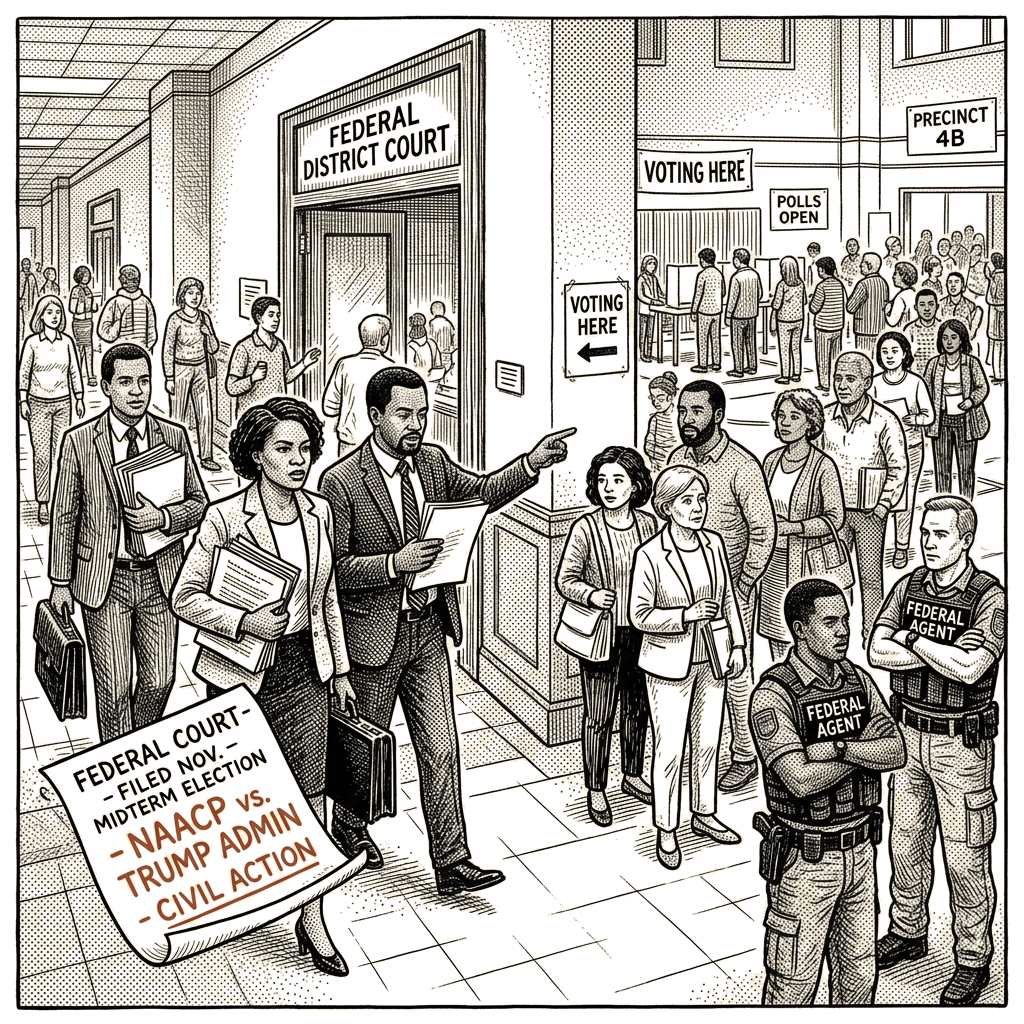
Federal statute already bars armed federal officers from polling sites
The NAACP-led suit, filed Friday in federal court, alleges that by threatening to deploy law enforcement to survey elections and initiating new voter roll oversight, the Trump administration has violated the section of the Voting Rights Act that prohibits voter intimidation. “The result is predictable: voters across the country – particularly Black, Latino, and Asian voters, naturalized citizens and members of mixed-status families – are afraid to vote, help others vote and participate in civic life,” the plaintiffs wrote in the complaint.
The complaint cites other recent administration actions as evidence of intimidation: President Donald Trump’s primetime address exaggerating claims of noncitizen voting, the administration’s immigration enforcement operations in communities of color, and its efforts to create a national voter eligibility list. The lawsuit is the latest attempt by civil rights groups to stop the administration from asserting more control over US elections as the country heads into what is expected to be a competitive midterm in November.
The Guardian asked the Justice Department and the Department of Homeland Security for comment. DHS did not respond. The FBI declined to comment. ICE referred questions to DHS.
A White House official pointed to the administration’s past remarks denying any plan to deploy ICE agents to polls in November. Karoline Leavitt, the former White House press secretary, told reporters in February it was “not something I’ve ever heard the president consider.”
Federal law already prohibits armed federal officers or members of the armed forces from being placed at a location where an election is being held. So far, the administration has not sent any armed officers or military members to polling locations. DHS has maintained that “ICE is not planning operations targeting polling locations,” that the agency conducts “intelligence-driven targeted enforcement,” and that it would only respond to public safety threats at a polling location.
But recent mixed messaging from top administration officials has raised concerns among election integrity advocates.
In May, Trump did not rule out the possibility of sending the National Guard or ICE officers to polling locations. This week, Kash Patel, the FBI director, told lawmakers the FBI “will not shy away” from its efforts to ensure elections are safe and honest when asked whether he planned to send FBI agents to polls. “If there’s a reason to go there because there’s been a violation, we will, otherwise we won’t,” Patel said, adding that “we’re going to house our agents and intel analysts in our field offices.”
Earlier this month, Markwayne Mullin, the homeland security secretary, told reporters ICE would not be at polling locations to patrol but could be present if there was a threat or if they were serving a warrant to someone.
“As a nation, we have no need for armed presence at polling locations – our elections are safe and transparent, which has been the hallmark of our democracy,” said Kristen Clarke, general counsel at the NAACP, in a statement after the lawsuit was filed. “Turning the fundamental right of exercising our vote into a high-stakes encounter with the militarized strong arm of the current administration isn’t protection and it isn’t oversight; it’s disenfranchisement, period.”
Friday’s lawsuit is at least the second of its kind. Last week, a coalition of groups led by the League of United Latin American Citizens also sued the administration seeking to stop it from deploying ICE officers to polling locations.