Bacon criticizes firing of 80 generals but says ‘being dumb is not a crime’
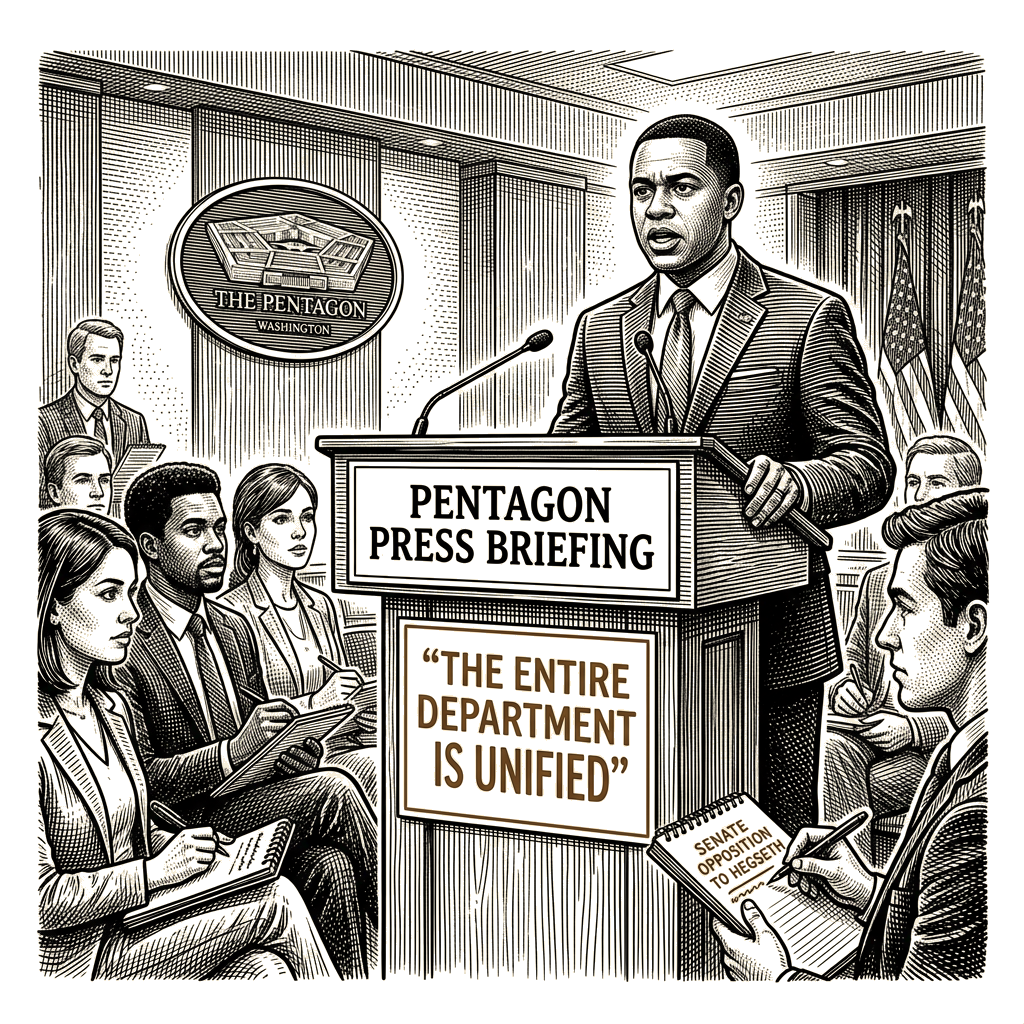
Pentagon press secretary Kingsley Wilson said “the entire Department is unified” behind Defense Secretary Pete Hegseth, pushing back publicly against lawmakers who say the defense secretary has politicized the military through the ouster of top generals and his campaign against diversity initiatives. The defense came as congressional aides told Pentagon officials that Hegseth would need to find someone else for his top pick to lead the Army — chief Pentagon spokesman Sean Parnell — because of firm Republican opposition on the Senate Armed Services Committee, according to people familiar with the discussion.
“Secretary Hegseth has slashed bureaucracy, unleashed innovation, and delivered for our warfighters every step of the way. By every measurable metric, the Department of War is better under President Trump and Secretary Hegseth’s leadership than before,” Wilson said.
The public defense followed months of criticism of Hegseth’s leadership, including from within his own party. Republican Rep. Don Bacon of Nebraska, a retired Air Force brigadier general, offered his own mixed assessment. “I really don’t like that 80 generals and admirals were fired or redlined for promotion,” Bacon said. “I don’t know that this is impeachable. Being dumb is not a crime.”
Speaker Mike Johnson sent House lawmakers home early this week, deferring until after the November midterm elections an impeachment resolution against Hegseth introduced by Kentucky Republican Thomas Massie. The deferred vote would have marked the first impeachment vote against a civilian Pentagon chief since Secretary of War William Belknap was impeached in 1876. Johnson vociferously defended Hegseth and insisted the move had nothing to do with the defense secretary.
Twenty months into the job, Hegseth has outlasted some Washington expectations after a bruising confirmation process beset by allegations of sexual assault and alcohol abuse, which he adamantly denies. His early days in office were followed by an accidental White House leak of a Signal chat in which he detailed plans for a military strike. President Trump has stood firmly behind Hegseth, who has served as a reliable messenger for the administration and a loyal aide. Hegseth ordered a campaign of military strikes against drug smugglers and deployed troops in American cities, a step the administration says was needed to fight crime but which critics say overstepped the law against using troops for domestic law enforcement.
At the Pentagon, Hegseth has publicly inveighed against diversity initiatives and urged that rules for combat be relaxed. On Friday, his office released details for mandatory testosterone testing for servicemembers, with the stated goal of building a “High-T Department.”
Critics pointed to a different record. They say Hegseth has gutted Army leadership, overseen a dwindling supply of critical munitions and presided over operations that have strained the U.S. military in a seven-month war with Iran that lacks a clear exit strategy. Earlier this week, Iowa Republican Zach Nunn was among seven Republicans who backed a resolution introduced by Democrats to curb Trump’s ability to continue the war against Iran without congressional approval, a step the Journal reported came as public support for the Trump administration’s ongoing conflict with Iran has begun to sag.
According to current and former officials, Hegseth has grown more insular in recent months, relying on a small group of close advisers. Early in his tenure, he gathered aides in a secure conference room to debate military options against the Houthis; participants in that April 2025 meeting said the goal was to have a spirited discussion. More recently, he has turned to polygraphs in a hunt for leakers, requiring that members of the Joint Staff submit to the tests, officials said.
At one point, Hegseth stopped inviting the civilian leaders of the Army, Navy and Air Force to regular biweekly meetings, according to former officials. Of the three service secretaries, one was fired and another quit after months of friction with Hegseth, leaving no confirmed successor in their place. He has also dispensed with outside panels of technocrats and former defense officials who have advised the Pentagon for decades; the Army Science Board was working on a study on whether the service was prepared to fight a protracted war when it was disbanded last year with no notice.
Hegseth still meets regularly with Gen. Dan Caine, the quiet-spoken chairman of the Joint Chiefs of Staff, and talks regularly with Adm. Brad Cooper, the commander of U.S. Central Command, and Gen. Alexus Grynkewich, the commander of U.S. European Command, officials said.
Parnell pushed back on the characterization, saying that the secretary “constantly asks his senior aides for their thoughts and suggestions on all topics related to the Department.” Parnell declined to comment on the polygraphs, saying only that the Pentagon “takes all leaks of classified national security information extremely seriously and investigates accordingly.”
Though there is little prospect that two-thirds of the Senate would vote to convict Hegseth if the House were ever to vote to impeach him, his strained relations with Congress and infrequent briefings have posed an obstacle to Pentagon attempts to win support for stepped-up military spending, Bacon and other lawmakers say.
Running the Pentagon is challenging under the best of circumstances. A third of the defense secretaries who have held the post since it was established in 1947 have been fired or forced to resign, according to Charles Stevenson, a lecturer at Johns Hopkins University and longtime Senate staffer who wrote a history of defense secretaries. To be effective, Stevenson said, defense secretaries need to have solid working relationships with the president, his National Security Council, the military and Congress.
Hegseth has worked to forge some of those relationships by helping Republicans in their political campaigns. As the war in Iran continued this summer, Hegseth flew to Iowa last month to campaign for Republican Zach Nunn’s re-election in a tossup race. Straying from his defense portfolio into immigration politics, Hegseth criticized his home state of Minnesota, saying its annual fair should be called the “Mogadishu State Fair” because of the state’s large Somali immigrant population. However, even his support for lawmakers like Nunn might not be enough to defuse the growing unease over Trump’s Middle East war.