Nearly 20 active fires burn nationwide as weather agency issues red alerts
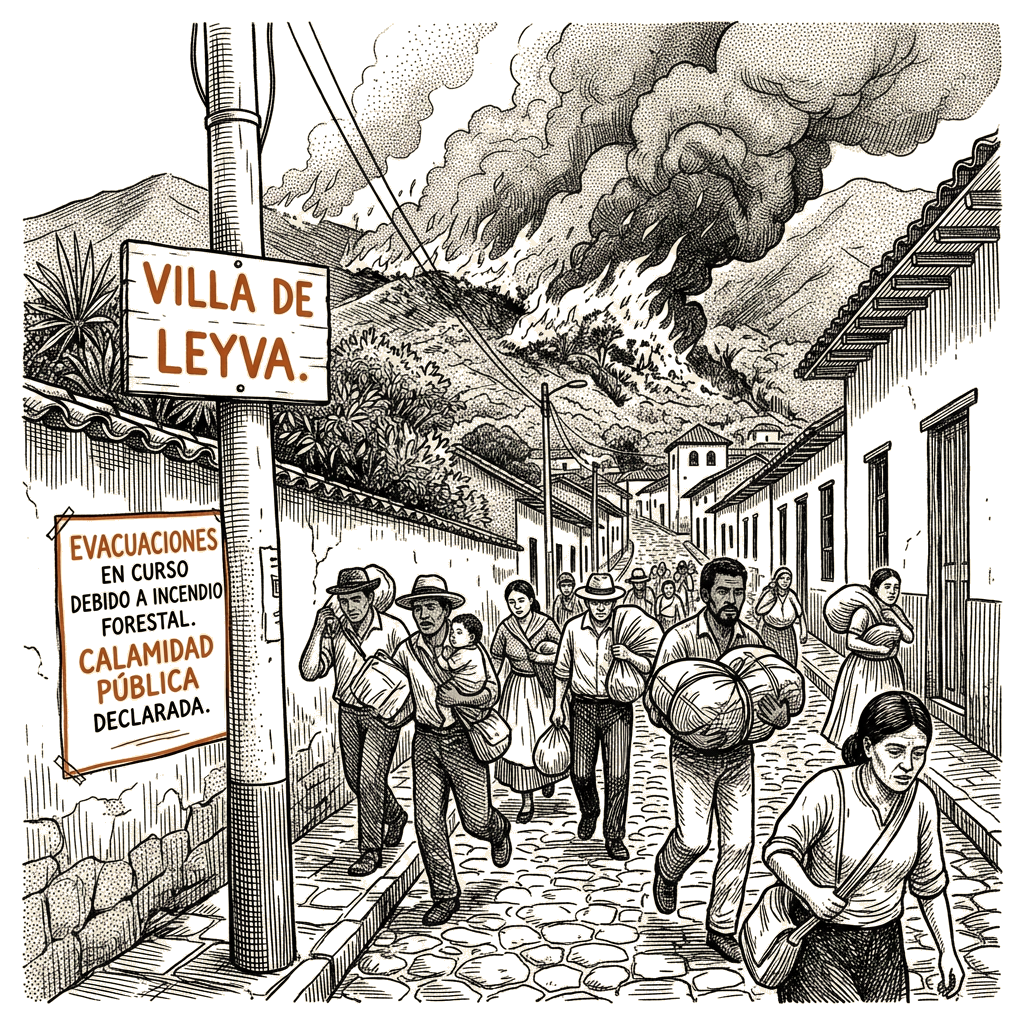
The wildfire began Saturday on a mountain overlooking Villa de Leyva, a popular tourist destination about 160 kilometers north-east of Bogotá and one of Colombia’s best-known colonial towns. By Sunday evening, the national disaster management agency reported that about 290 hectares had burned — an area roughly equivalent to 400 soccer fields — and that the blaze was about 50% under control.
Local authorities declared an emergency, suspended in-person classes for Monday and carried out preventive evacuations, including at hotels near the fire. Strong winds complicated efforts to contain the flames, which at times advanced toward populated areas.
Carlos Amaya, the provincial governor where Villa de Leyva is located, said aircraft carried out about 170 water drops Sunday, releasing 240,000 liters. Fabio Arjona, Colombia’s environment minister, said preliminary information from the disaster management agency suggested the fire may have been deliberately started, though authorities were still investigating. Colombian President Abelardo de la Espriella said Sunday on X that the fire was about 50% controlled and contained on the ground.
The Villa de Leyva fire was one of nearly 20 active wildfires burning across Colombia. The national disaster management agency said in its latest nationwide update that authorities were monitoring 27 forest fires, with 19 still active and eight under control. Nine of the active fires were in Tolima, a mountainous region south-west of Bogotá, while others were burning across several parts of the country’s Andean region.
Colombia’s weather agency said last week that 279 municipalities were under some level of wildfire warning, including 36 under its highest, red-alert level, with much of the risk concentrated in the Andean and Caribbean regions. Between June 16 and August 6, Colombia recorded 438 forest fires in 191 municipalities, affecting about 7,153 hectares of vegetation, according to government figures.
Dry conditions have increased fire danger as Colombia braces for the effects of El Niño, a periodic warming of the tropical Pacific Ocean that can reduce rainfall and raise temperatures. Disaster officials have said the period of greatest risk across the region from the developing El Niño is expected between October and April, with wildfires and water shortages among the main concerns.
Neighboring Ecuador is also battling a wave of wildfires. Ecuador’s national risk management agency said Sunday that 12 fires remained active across the country, while more than 21,800 hectares of vegetation have burned so far this year. A fire on the slopes of Ecuador’s Imbabura volcano burned about 300 hectares before being brought under control Sunday after three days of firefighting.