Tofel, MacFarlane and Fournier urge press to report ‘off campus’
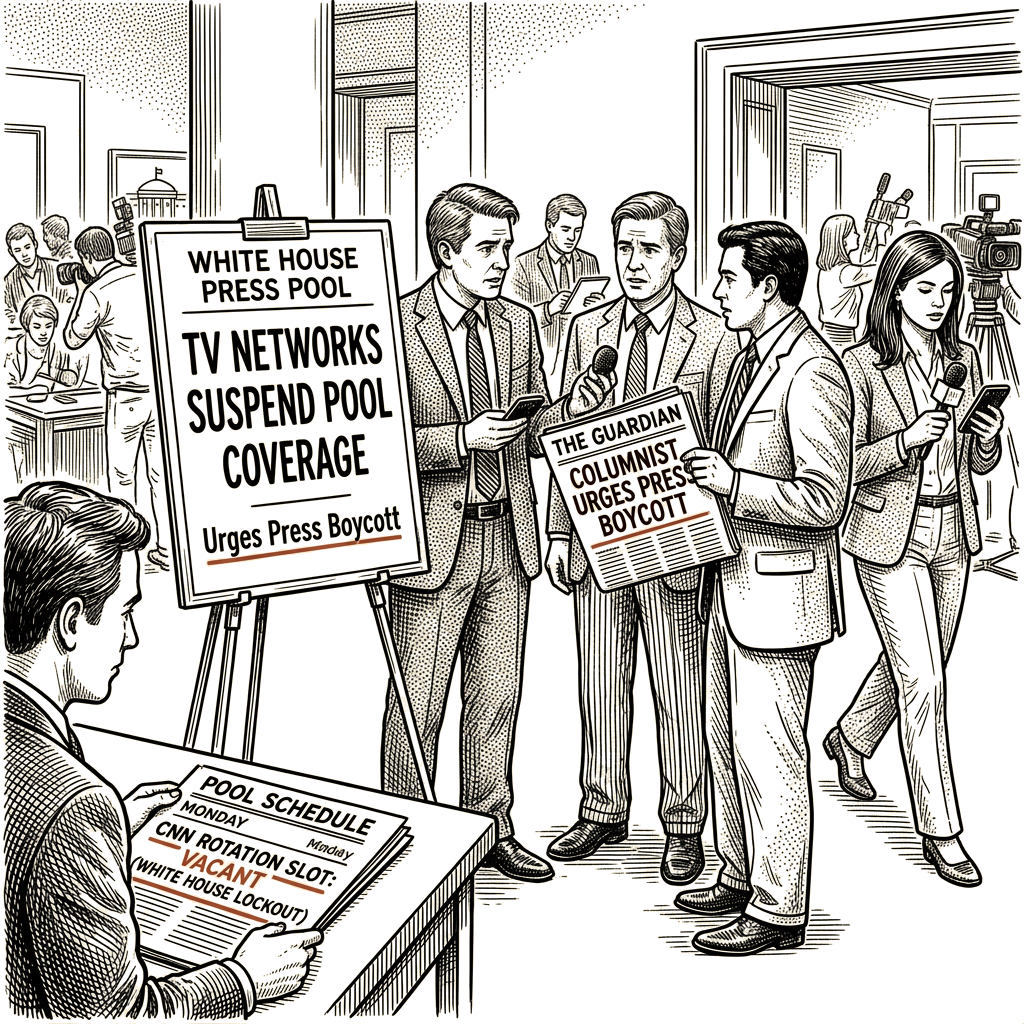
The major broadcast television networks suspended their shared “pool” coverage of presidential events on Monday, after CNN’s rotation slot was left vacant by its lockout from the White House. Fox News Washington bureau chief Bryan Boughton, who chairs the TV pool, said in a memo to the White House press corps that “there will be no replacement pool put in place.”
The pool is a cooperative arrangement in which one outlet records an event and distributes footage to the broader press corps. CNN had been assigned to the duty when its reporters were locked out.
Margaret Sullivan, a Guardian US columnist writing on media, politics and culture, called the pool suspension “especially good to see” in an opinion column published Monday. She wrote that “the White House press corps often talks a good game about solidarity and press rights, but they’ve mostly kept doing what they’ve always done – treating Trump like any other president.”
Sullivan argued that while the lawsuit filed the same day by CNN, MS Now and Politico against Trump and three top advisers is “the right move” and “may prevail,” it is insufficient on its own. She called on The New York Times, The Washington Post, The Wall Street Journal and the major broadcast networks to take collective action by boycotting the briefing room and similar White House events until the locked-out outlets regain their credentials.
“Time for the New York Times, Washington Post and Wall Street Journal to report on the White House from off campus,” wrote Richard J. Tofel, an attorney and the longtime president of ProPublica who writes a press-related newsletter, Second Rough Draft, as quoted by Sullivan.
Scott MacFarlane, a former CBS News justice correspondent now chief Washington correspondent at MeidasTouch, told Sullivan that press coverage should continue from outside the building. “We don’t need our journalistic watchdogs to have ‘access’ to Trump,” MacFarlane said. “Everyone in the press room should walk out in protest … and source up.”
Sullivan wrote that the lockout resembles what press-rights lawyers call “viewpoint discrimination.” “In other words,” she wrote, “Trump didn’t like their stories so he removed their access.”
Ruth Ben-Ghiat, a scholar of authoritarianism quoted by Sullivan, called the lockout “a moment of reckoning for America” and said it is “part of the autocratic playbook.” Ben-Ghiat added that “Trump is well into the autocratic backfire process, thus entire media outlets he sees as threats must be banished.”
Sullivan placed the lockout within what she described as a broader pattern of actions Trump can take against news organizations. Trump, she wrote, can ban the Associated Press from the briefing room for refusing to use the term “Gulf of America” instead of “Gulf of Mexico.” He can respond to a reporter’s question with the disrespectful command “Quiet, piggy.” He can, through his defense secretary, try to revoke journalistic access to the Pentagon and fire top staffers at Stars and Stripes, the military newspaper. His “weaponized justice department,” Sullivan wrote, can subpoena New York Times reporters or show up at a Washington Post reporter’s home and seize her devices. She added that Trump “can even trash as the ‘worst’ his loyal rightwing media outlet, Fox News, for its recent polling that showed Americans’ deep dissatisfaction with his handling of the economy,” calling him “an equal opportunity media-basher.”
The accompanying statement by CNN, MS Now and Politico, Sullivan reported, called last week’s sudden lockout “a direct assault on the first amendment.”
Sullivan noted that Trump still receives an annual invitation to the White House Correspondents’ Association dinner in Washington, where he can insult the press and make personal attacks on reporters. “And the reporters who are not in particular disfavor continue to go to White House briefings and press gaggles,” she wrote. “He still gets treated with deference.”
“In other words,” Sullivan concluded from the preceding observations, “he mostly gets away with it.”
Sullivan described Trump as “a bully” and wrote that “bullies will keep bullying until they get a punch in the nose.” She called the most recent ban “one of the most serious actions yet.”
“As much as he professes to hate the mainstream media,” Sullivan wrote, “Trump depends on it. He wants the constant attention. He loves being in the spotlight, where his every utterance – no matter how unhinged or false – is blasted out to the public.” She argued that withdrawing that kind of attention “will get through to him,” pointing to Monday’s pool suspension as an example.
When the Associated Press was barred from White House briefings last year over its use of “Gulf of Mexico,” Ron Fournier, a former Washington bureau chief at the news service, urged journalists to boycott. “No self-respecting journalist should attend a White House briefing while the White House bans the AP for not accepting state-mandated language,” Fournier wrote on social media, according to Sullivan.
Sullivan wrote that “media organizations may issue strongly worded statements, and may join in lawsuits, but solidarity is too often a theoretical thing, not a practical action with real-life consequences.” She reported that journalists and their bosses offer a rationale for continuing to attend White House events: that covering the president is of utmost importance, that not doing so would be a dereliction of duty and would stoop to the president’s level, and that it would be, as she put it, “God forbid, unprofessional.”
“It is a matter of principle at this point,” Sullivan wrote. “And principle should trump access. Especially at a time when American democracy is teetering on the brink.”
Sullivan writes for The Guardian’s “Comment is free” opinion section.