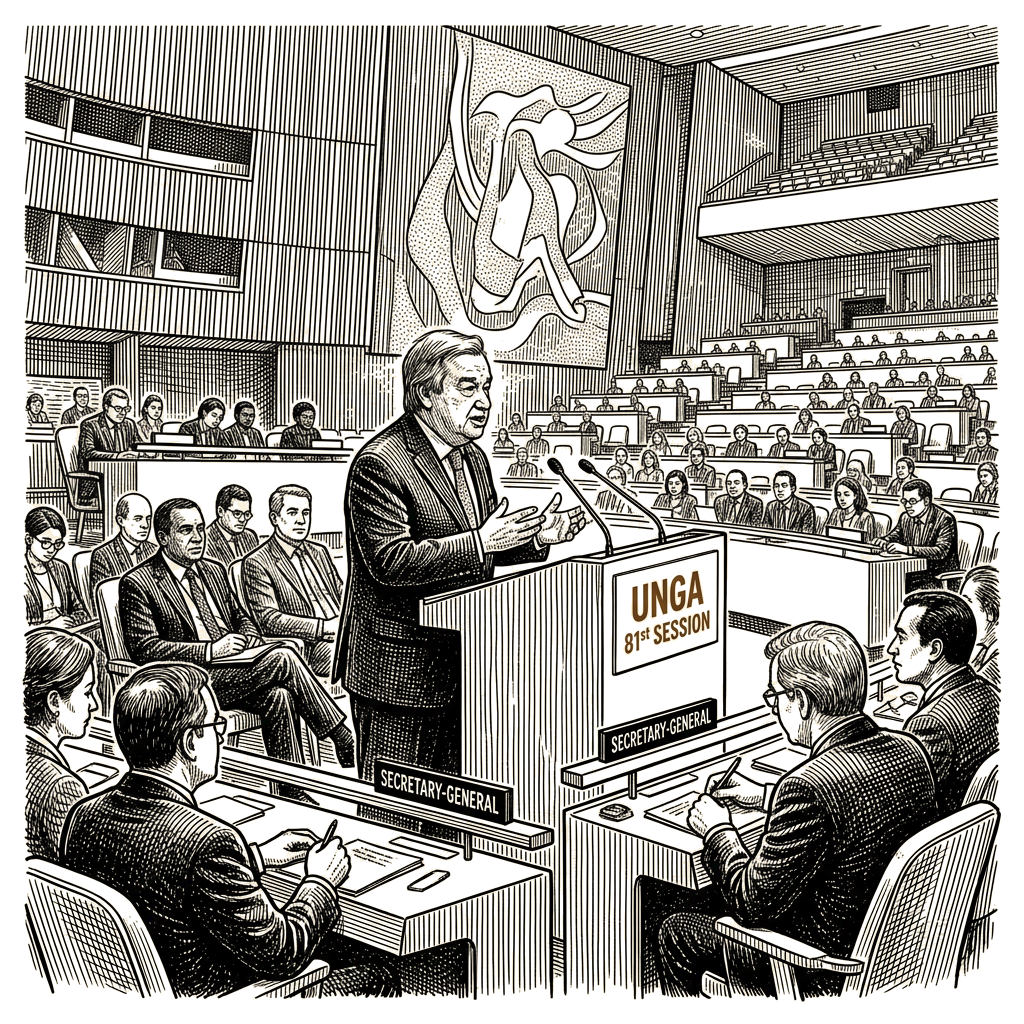
UN chief frames war, inequality, climate, AI as four tests of power
Antonio Guterres opened the 81st United Nations General Assembly on Tuesday in New York with an address that framed the world’s most pressing crises as interconnected tests of power that will shape the international order. The secretary-general’s remarks set the thematic agenda for the annual high-level diplomatic week, during which heads of state and government are expected to deliver their own addresses to the chamber.
Guterres, who is nearing the final 100 days of his term as the world’s top diplomat, identified war, inequality, climate change and artificial intelligence as the four defining challenges of the moment. He said the choices leaders make in addressing each will determine whether the international community moves toward greater cooperation or deeper fracture.
“The fault lines in our world are widening. Cracks have become canyons,” Guterres said in his opening address. “Our future will be shaped by how we address four great tests of power. Across all four tests, the decisive issue is power.”
The secretary-general argued that the crises are not independent of one another but connected through how power is expressed and who wields it. He urged leaders to choose construction over domination.
“The greatest power is not the power to dominate,” Guterres said. “It is the power to build a future that works for everyone.”
Fighting in the Middle East cast a long shadow over the gathering. Guterres described cease-fires that have been reached and subsequently broken as merely “lesser fires,” and he warned that further expansion of Israeli settlements in the West Bank threatens to end the possibility of a two-state solution. On Ukraine, he condemned Russia for violating the United Nations Charter in its ongoing invasion.
On artificial intelligence, Guterres drew a distinction between the technology itself and the governance vacuum surrounding it. The danger, he said, is not AI but “technology without accountability.” He called on government leaders to cooperate on rules and regulations that place transparency and trust at the forefront.
Guterres also spotlighted a milestone inside the institution he leads. The United Nations, he said, has achieved gender parity across its senior leadership, headquarters staff and professional workforce for the first time in its history. “Equality is not a dream,” Guterres said. “It is a decision.”
The high-level week of the General Assembly will continue with addresses from heads of state and government in the coming days.