Group’s post-Trump direction divides founders and current members
The House Freedom Caucus, formalized more than a decade ago as Tea Party-aligned conservatives were elected to Congress, has long wielded influence by pushing the Republican Party to the right on social and fiscal policy, according to NPR. Its members have used parliamentary maneuvers to disrupt the flow of legislation in an effort to force policy and procedural concessions from Republican leadership.
One central tenet has remained consistent through the group’s history: that rank-and-file lawmakers, particularly members of the Freedom Caucus, should play a central role in the policy-making process, a position that has consistently frustrated Republican leadership.
Over the past decade, President Trump has elevated a number of the group’s members to the most senior roles in his administration. Two of the group’s founders, Mick Mulvaney and Mark Meadows, served as White House chiefs of staff, and John Fleming, another founder, was deputy chief of staff.
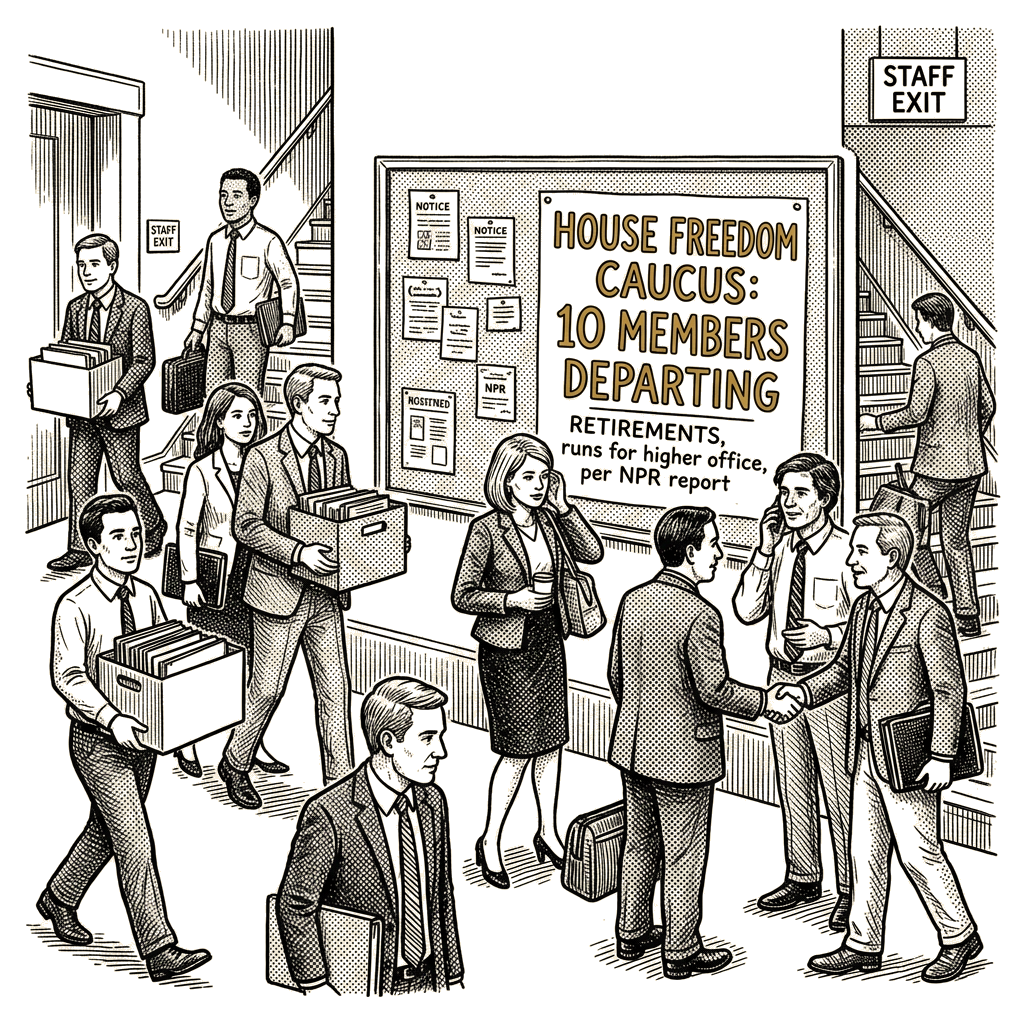
Now, at least 10 of the group’s more than two dozen members from the current Congress will not return next term, NPR reported, and more may lose their seats in November.
“After the 2018 elections, after the 2020 elections, people said, ‘Oh, the group doesn’t matter, or they’ve lost their members,’” said Matthew Green, a professor at Catholic University who wrote Legislative Hardball about the group. “It was always, ‘this group is destined for the dustbin’ and yet they find a way to maintain themselves.”
Fleming, who now serves as Louisiana state treasurer, told NPR that executive branch accountability was a priority in the group’s early days, when he felt then-Speaker John Boehner, an Ohio Republican, was working too closely with the Democratic administration of President Barack Obama. He suggested that need has waned under Trump.
“Remember that when we started this, Barack Obama was President of the United States,” Fleming said. “Today we have a Republican president who really is kind of a breakthrough president when it comes to reforms, new ideas.”
“The Freedom Caucus, I would say, was really the predecessor to President Trump. In fact, I’ve often said that we were really MAGA before MAGA was cool,” Fleming said.
The caucus “aligns itself with President Trump because the beliefs are very similar,” Fleming added. He noted that there have been select occasions this term where members stood up to the White House, including on a warrantless federal surveillance authority known as FISA 702 and during negotiations over Trump’s One Big Beautiful Bill Act, though most members ultimately supported the legislation.
Many of the group’s alumni, like Florida Gov. Ron DeSantis, have become prominent party figures in their own right, and the group’s combative, tear-it-down style has come to define Republican politics, according to NPR.
Boehner, the former Speaker, described the group differently in a 2017 interview with POLITICO. “They can’t tell you what they’re for. They can tell you everything they’re against,” Boehner said. “They’re anarchists. They want total chaos.”
Fleming and other members describe the group’s goals differently. “What traditionally happens is when someone is elected to Congress, they’re told by the leadership that, ‘Look, you can advance here. You can get good committee assignments. You could be chairman of the committee one day. You just need to raise money for the party and you need to turn over your voting cards to leadership and everything will be fine,’” Fleming said. “That’s really in opposition to the way a republic, a representative democracy, is designed to work.”
Matt Salmon, another founder, told NPR the group’s frustrations under Speaker Boehner centered on how the chamber operated. “There were several things we were really frustrated about,” Salmon said. “There was no regular order. We hadn’t really passed the appropriations bills.”
Salmon served in Congress twice, first leaving in 2001 after six years in office. He said that at the time, bills were drafted through a committee process and the government was funded through 12 carefully deliberated annual spending bills, and Congress passed three straight years of balanced budgets.
By the time he returned to office in 2013, Salmon felt things had broken down. “Everything was really being done by a really small group of folks, mostly leadership, and then jammed down the members’ throats,” he said. “After being slapped around a lot by the folks who were trying to control everything, I remember [Rep. Jim Jordan of Ohio] came up to me on the floor and said, ‘Hey, man, we’re really tired of this process where, you know, just a few people kind of make all the decisions and we’d really like, you know, consider forming a group to try to make a difference.’”
Still, the group’s ideological ground in the party is contested territory among its alumni — between institutionalists who see the group’s obstructionist tendencies as a means to force a return to a more traditional style of governing by empowered members and rabble rousers in the mold of President Trump intent on fundamentally remaking how politics is done, according to NPR.
“I think that the Freedom Caucus originally started out with very, very noble motives, but it’s just become a political adjunct to the Trump administration,” Salmon said. “They’re not the people that used to stand up and go against the tide.”
“They morphed from being the entity that really was about getting back to regular order and protecting Article 1” — the section of the Constitution that lays out congressional powers — “to becoming the chief cheering squad for Trump,” Salmon said. “I couldn’t be more disappointed.”
“There can be a tension between wanting to maintain power and influence and the pursuit of certain institutional or policy goals,” Green said. “Now that caused some members to leave because they believed that. Fear of centralized executive power was the most important thing regardless of party.”
Inside Congress, the group’s track record is mixed. Leadership remains in near-total control of the legislative process, and Jim Jordan, whom Green describes as the group’s most successful member, has thrived in large part by being a reliable ally of House Republican leaders.
Green said that tension has been central in remaking the Freedom Caucus. “Do you want to quit a group that has influence because you’re concerned about some principle of presidential power? Or do you want to take advantage of having a Republican president?” he said. “The latter is very tempting, understandably, for members of the caucus — and most members of Congress for that matter.”
Three of the group’s current members are running for governor with Trump’s endorsement: Biggs in Arizona, Donalds in Florida, and Tiffany in Wisconsin.
Turnover is inevitable in Congress as members seek higher office or simply retire, and this cycle has seen a record number of departures, according to NPR. That means a new era for the caucus.
Some of its most vocal and prominent members are among those departing — including Roy and Rep. Ralph Norman of South Carolina, both prominent advocates on civil liberties issues and press stalwarts who regularly make the case for the caucus’ views.
“At the end of the day,” Roy, a departing member, told NPR, members of the group are “bound together by wanting to do what we said we would do. We get a lot of speeches about all this stuff, but then, you know, you got to deliver.”
“It’s going to be better because we’re at a point now where the Freedom Caucus adds value,” Norman told NPR, “by questioning and putting the budget front and center stage, we’re going to add value.” He was upbeat about the changeover. “We’re losing a lot of seniority, but we’re also picking up a lot of people.”
Fleming, one of the founders, also left room for the idea that the Republican Party and the Freedom Caucus itself could move in a different direction in the future — if not in the new Congress, then beginning with the next presidential election.
“Most likely the successor to President Trump, whether it’s Republican or Democrat, is likely to begin to move back to the status quo, more of the norm,” Fleming said. “And that’s where I think the Freedom Caucus, again, will likely come in.”
Roy echoed the idea that departing members would remain influential. “Some of us, we’re not going to go far. We can have a voice, and we can have an influence from outside, maybe every bit as much so as inside,” he said. “So there’s going to be a lot more to do.”