Judge who restored Acosta’s credentials in 2018 set to hear arguments
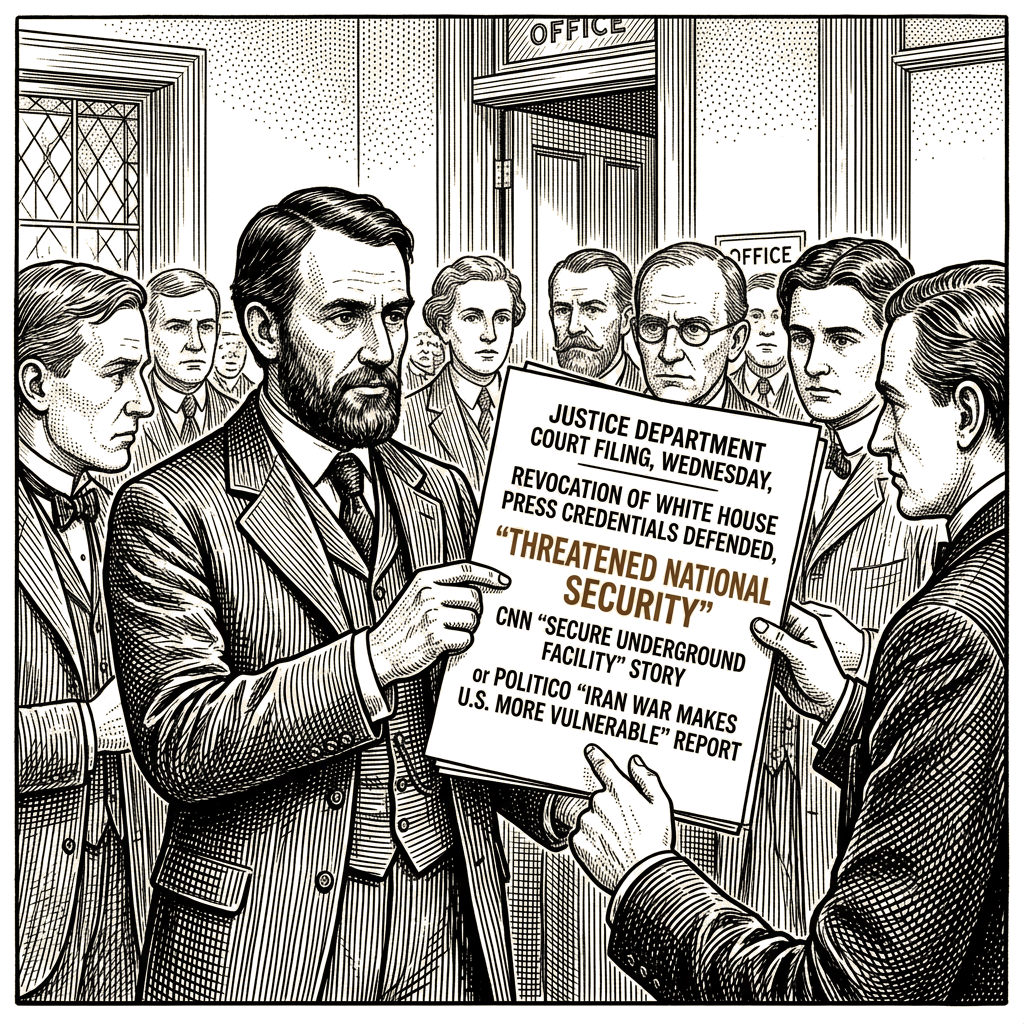
The Justice Department’s Wednesday court filing defended the Trump administration’s decision to revoke White House press credentials for CNN, MS NOW and Politico by pointing to two specific news articles — CNN’s story about the construction of a secure underground facility beneath the White House East Wing, and a Politico article saying the Iran war has made the United States more vulnerable.
“Access to the White House is a privilege — not a right,” the administration argued in the filing. “The President’s actions must be sustained because the President has ‘compelling interest[s]’ in enforcing minimum standards for bona fide journalists and safeguarding national security information.”
The White House had sent letters to the three outlets explaining that the reporters had “exhibited behavior in violation of the standards of professionalism and decorum expected of those given access to the White House Complex, including by trafficking in verifiable falsehoods about national security and other issues, and publishing sensitive or classified information.” The letters cited the CNN and Politico articles as examples.
The administration’s filing elaborated that “[h]ard pass credentials are reserved for those who abide by standards of professional conduct, demonstrate a level of trustworthiness commensurate with the privilege of unfettered access to the White House Complex, and perform their duties in a way that does not interfere with the White House’s daily operations.” It added that “The President believes basic journalistic standards require calling, asking for comment, and providing a reasonable opportunity for a response. At a bare minimum, it is a significant violation of decorum to publish classified and sensitive national security information.”
There is no law that explicitly makes it a crime for a journalist to obtain or publish classified information.
The lawsuit, filed after the White House barred the three outlets’ reporters on Friday, identifies the plaintiffs as the three media outlets and their White House correspondents: MS NOW’s Akayla Gardner, CNN’s Betsy Klein and Politico’s Cheyenne Haslett, all of whom lost their credentials. The defendants are Trump, White House Chief of Staff Susie Wiles, White House communications director Steven Cheung and Secret Service Director Sean M. Curran. The three outlets said they were suing “to protect our First Amendment rights and defend the principle that the government does not decide what the press reports or publishes.”
Other media outlets that provide video coverage of Trump’s events and press conferences decided to stop doing so, leaving Trump’s media events without microphones.
Department of Justice lawyers and lawyers for the media outlets are scheduled to meet in court Wednesday before U.S. District Judge Timothy Kelly. In 2018, Kelly granted a temporary restraining order to allow CNN reporter Jim Acosta access to the White House after Trump banned him.
Trump has said he will follow Kelly’s ruling if the judge orders the White House to allow the reporters back in, while maintaining that he should have the right to remove them. “I’m talking about national security, and I think we have a right to clean out fake news,” Trump said Tuesday.