North Africa and Middle East buyers seek alternative grain suppliers
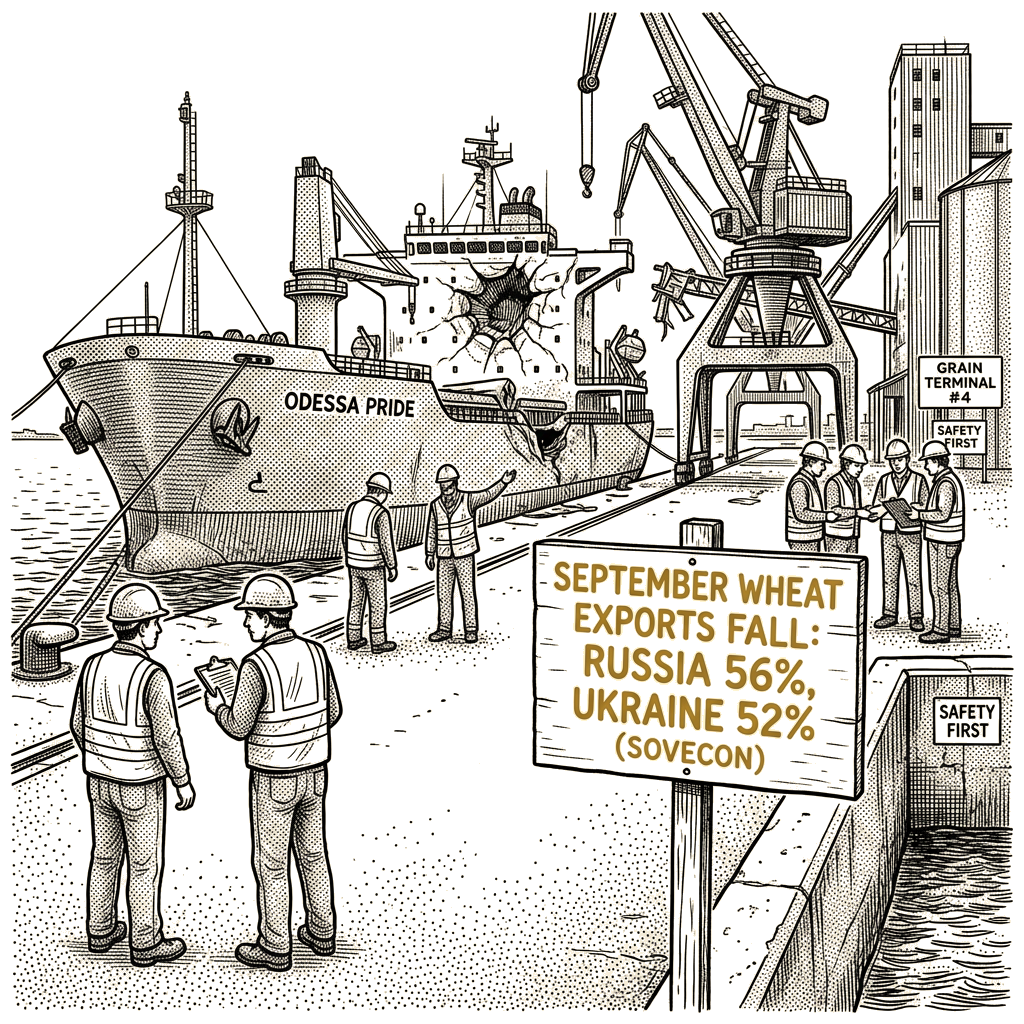
September wheat exports from Russia are projected to drop 56% from a year earlier, while exports from Ukraine are projected to fall 52%, according to SovEcon, an agricultural consulting firm.
The two countries typically ship the bulk of their wheat and corn through Black Sea ports, and waves of drone and missile strikes on those ports and on vessels in the region have throttled both countries’ exports. The cutoff is forcing countries in North Africa and the Middle East — the largest buyers of Russian and Ukrainian grain — to find new suppliers.
“These shocks are converging,” Christopher Elliott, founder of the Institute for Global Food Security at Queen’s University Belfast, told the Journal. “We all have to expect increased prices, if not shortages, in the not-too-distant future.”
Wheat futures on U.S. markets have reached three-year highs in recent weeks, and analysts warn the increase will eventually reach grocery shelves if the bottleneck is not removed. The disruption has echoes of the war’s early days in 2022, when Russian attacks largely halted Ukrainian grain exports — though the situation has shifted in one respect. Starting in early July, Ukraine’s drone forces struck more than 100 Russian vessels in the Sea of Azov, cutting off fuel supplies to the occupied Crimean Peninsula and a key shipping corridor for Russian grain.
The commander of Ukraine’s drone forces, Robert Brovdi — a prominent Ukrainian grain trader before the war — wrote on social media in July that Ukraine’s strikes would deny Russia foreign-currency revenue from Black Sea grain exports. Further Ukrainian strikes damaged Russian grain-export facilities in the ports of Taman and Novorossiysk. Russian retaliation has hit Ukrainian grain-export hubs, including the Black Sea port of Odesa.
Both sides have limited alternatives for getting their grain out. Ukraine can use Danube river ports or overland routes. Russia has Baltic and Caspian Sea ports and has offered subsidies for rail transport of grain. The capacity of those alternatives is a fraction of normal Black Sea volumes.
Farmers in both countries are stuck with grain they cannot sell at viable prices. In Russia, Arkady Zlochevsky, president of the Russian Grain Union, said wheat prices have fallen around 40% over the past four months because of the stockpile buildup. “The situation is catastrophic,” Zlochevsky said. Russia is normally the world’s biggest wheat exporter. On Wednesday, Russia’s southern Krasnodar region declared a state of emergency over farmers’ inability to sell their grain, according to Russian state media.
Oleg Vasilenko, a farmer in Russia’s Voronezh region, told the Journal he is selling wheat at a loss to free up storage space for other crops. Strapped for cash, he expects to cut back on fertilizer and only repair equipment when absolutely necessary. “I’m thinking about changing careers,” said Vasilenko, who has run his own farm since 2010.
Across the border, Dmytro Krasnoshchok’s farm in Ukraine’s Sumy region sits near the front lines and is at constant risk of shelling. He provides his tractor drivers with radio devices to detect incoming drones so they can try to take cover. “Right now the price of wheat in Western Europe is rising almost every week, while in Ukraine there has been no price increase at all,” Krasnoshchok said.
The disruptions could linger into 2027. Both countries are planting winter wheat this fall — the seed that lies dormant through winter and accounts for the bulk of their annual wheat production. Farmers in both countries are struggling to pay for seeds and fertilizer while facing a surge in diesel costs driven by drone strikes on refineries and gas stations, as well as fighting in the Middle East.
The war is not the only factor driving up wheat prices. Record heat and sparse rainfall across Europe this summer hurt production. Shipping disruptions in the Strait of Hormuz sent fertilizer prices higher. And the world is experiencing the strongest El Niño in decades — a weather pattern marked by warming water in the Pacific Ocean that tends to cause droughts across much of the world.
At this week’s United Nations General Assembly in New York, Turkey and the European Union called for a resumption of exports. Rubio told reporters on Wednesday that both Russia and Ukraine have expressed interest in a “limited ceasefire” that would cover attacks on grain and energy facilities, following a meeting with Russia’s foreign minister. “That won’t be easy,” Rubio added.
An earlier deal to allow Black Sea grain exports fell apart in 2023 after Russian President Vladimir Putin withdrew. Ukraine has indicated openness to a deal resuming grain shipments as long as Russia moves to de-escalate. Moscow has so far been dismissive of Kyiv’s ceasefire proposals.
Wheat prices remain well below their 2022–23 peaks, in part because the world entered this year well-supplied with wheat. So far the run-up in wheat futures has not translated into substantial price increases at U.S. stores, but analysts say that is likely to change if supplies remain tight.