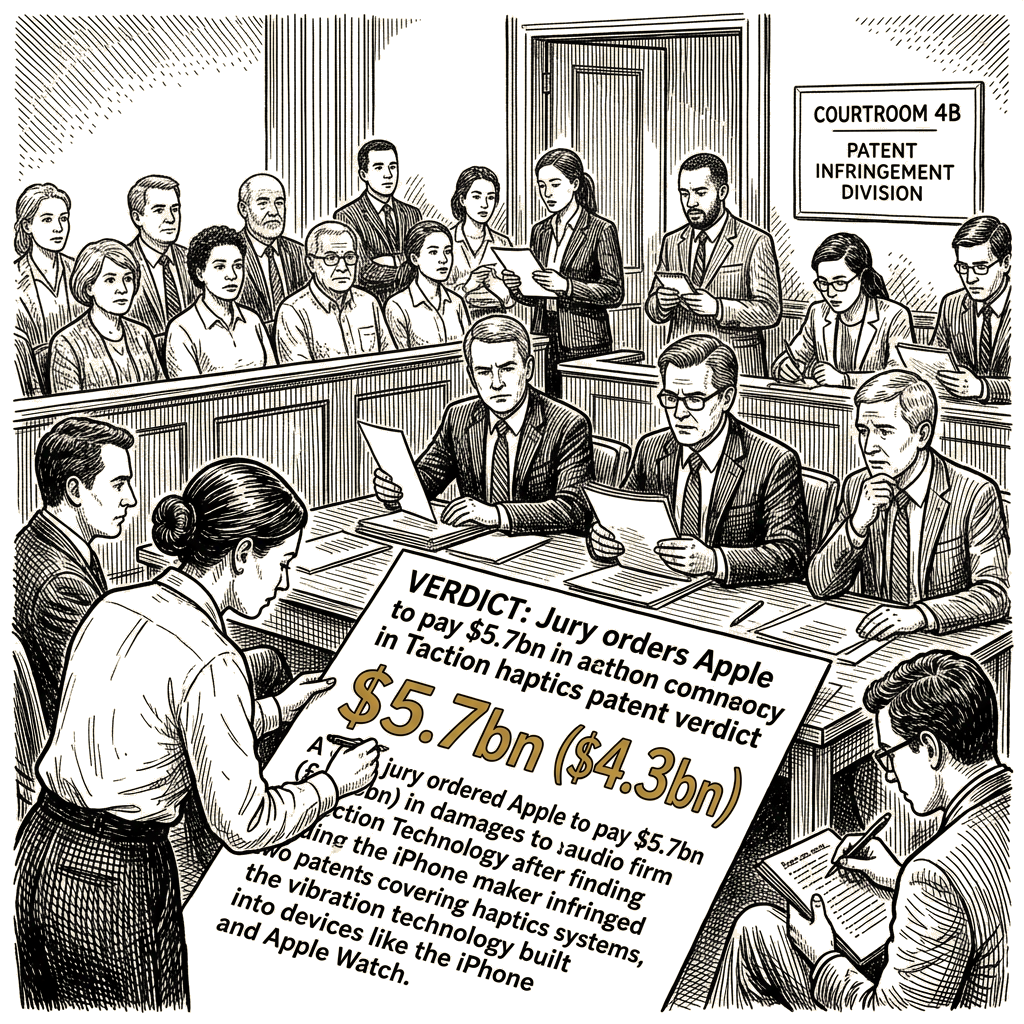
Jurors did not find Apple willfully infringed the patents
A US jury ordered Apple to pay $5.7bn (£4.3bn) in damages to audio firm Taction Technology after finding the company infringed two patents covering haptics systems, the vibration technology built into devices like the iPhone and Apple Watch. The verdict came Friday in the US District Court for the Southern District of California, following a September jury trial.
Taction, which makes headphones and gaming headsets, claimed in its 2021 lawsuit that Apple had infringed patents issued to Taction in 2020 covering the haptic systems that simulate touch or feel through vibrations. Haptics have become a hallmark of modern devices, with smartphones, watches and video-game controllers among those containing small motors that respond to specific electronic signals.
A San Diego judge ruled in 2023 that Apple did not infringe upon Taction’s patents. A federal appeal circuit subsequently took up the case, leading to a September jury trial at the US District Court for the Southern District of California, which found in Taction’s favour.
In Friday’s verdict, the jury found for Taction but did not find that Apple had willfully infringed the patents.
Apple said it strongly disagreed with both the verdict and the damages award and would appeal. “While we thank the jury for their consideration, we strongly disagree with today’s verdict and the damages awarded, which are entirely unsupported by the facts,” the company said. “Apple’s Taptic Engine is fundamentally different from Taction’s technology, which Taction’s own testing of Apple’s products confirmed during trial.”
Apple’s Taptic Engine, the haptic feedback system built into its devices, first debuted with the Apple Watch in 2014. The company has since expanded haptics across its product line, including the iPhone.
In its 2021 complaint, Taction argued that Apple’s improvements to haptic vibrations had allowed it to enhance the overall user experience of its devices, and that the tech giant had been “capitalising on Taction’s innovation and success by selling devices that infringe [its] patents.” Taction also accused Apple of using its inventions “without license or authority.”
The verdict follows a separate patent loss for Apple in November 2025, when a judge ordered the company to pay $634m to medical technology firm Masimo after a jury found it had infringed a patent for blood-oxygen reading technology.
The Taction case is one of many similar patent suits Apple has defended against in recent years.