Plan Patriota Siglo XXI expands U.S.-Colombia security cooperation
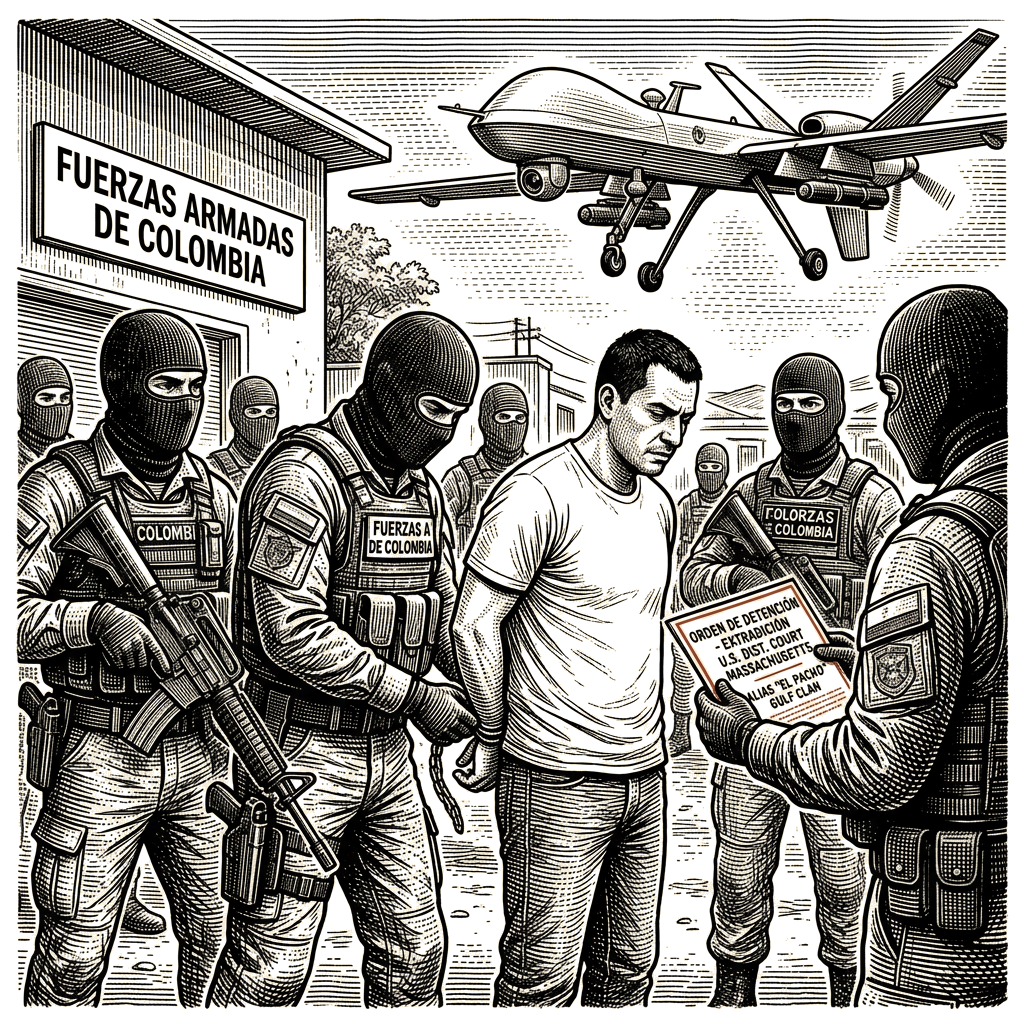
Colombian security forces, supported by the U.S. Drug Enforcement Administration, used American-supplied drones equipped with infrared surveillance technology to track and capture an alleged Gulf Clan cocaine trafficker wanted for extradition by a federal court in Massachusetts, Colombian authorities said Tuesday.
Norbey Goez Sepúlveda, 48, also known by the aliases “El Paisa,” “Ñato” and “Cachaco,” was arrested in a rural area of Turbo, in Colombia’s northwestern Antioquia department, according to the Colombian National Police. The operation involved Colombia’s National Police, Attorney General’s Office and Army.
Goez is wanted by U.S. authorities on charges related to drug trafficking and criminal conspiracy and is subject to an extradition request from a federal court in Massachusetts, Colombian news outlet Caracol Radio reported.
Authorities said the U.S.-supplied drones played a key role in locating Goez, who had evaded detection for more than seven years. The aircraft carried electro-optical and infrared systems that allow operators to conduct surveillance during the day and at night and detect thermal signatures in low-visibility conditions, according to Caracol.
Investigators accuse Goez of working with the Roberto Vargas Gutiérrez structure of the Gulf Clan, one of Colombia’s largest criminal organizations. Authorities said he helped coordinate the collection and movement of cocaine from the departments of Córdoba and Antioquia’s Urabá region before shipments were transported toward Central America and the United States.
According to investigators, the organization used high-speed boats to move cocaine through Panama and Mexico before it reached the United States. Authorities accuse Goez of helping coordinate shipments totaling more than one metric ton of cocaine per month through maritime, land and air routes.
Goez had been involved in criminal activity for more than seven years but maintained a low profile to avoid detection, the police said. He moved between rural communities and presented himself as a businessman, farmworker or cattle rancher while limiting his presence on social media and other records.
Following his arrest, Goez was transferred to the International Affairs Directorate of Colombia’s Attorney General’s Office while authorities proceed with the extradition process. U.S. authorities must submit the required documentation through diplomatic channels before the extradition can proceed.
The arrest comes as President Abelardo De La Espriella’s government expands security cooperation with Washington. After meeting with Secretary of State Marco Rubio on Sept. 8, De La Espriella proposed what he calls “Plan Patriota Siglo XXI,” a security modernization initiative that includes cooperation with the United States on drones, counter-drone systems, radar, aircraft, intelligence, cyber defense and special forces.
“Colombia wants to consolidate itself once again as the United States’ main hemispheric security partner,” De La Espriella said after the meeting, according to the Colombian presidency. He said Colombia would provide its own resources but would also seek U.S. support to build those capabilities.
The government has also tightened restrictions on imports of drone components after authorities said criminal organizations were obtaining the technology for attacks against Colombian security forces. Earlier this month, De La Espriella said customs authorities had seized drones intended for criminal groups and announced that imports of drone components would be restricted to designated entry points in Bogotá and Cartagena. The government said the effort includes cooperation with U.S. Homeland Security Investigations.
Tuesday’s arrest also came amid a broader security offensive. De La Espriella said Colombian forces had arrested 30 people allegedly linked to armed and drug-trafficking organizations during the previous 24 hours, including seven suspected members of the Rodrigo Cadete structure in Caquetá, two alleged National Liberation Army members in Boyacá and 15 alleged members of a criminal network known as Los Fantasmas in Risaralda.
The president also reported the seizure of 149 kilograms, about 328 pounds, of marijuana and the destruction of a cache containing 36 improvised grenades and explosive material in Huila. The figures were announced by De La Espriella and subsequently reported by Colombian media.