Legal experts, lawmakers dispute claim of armed conflict with cartels
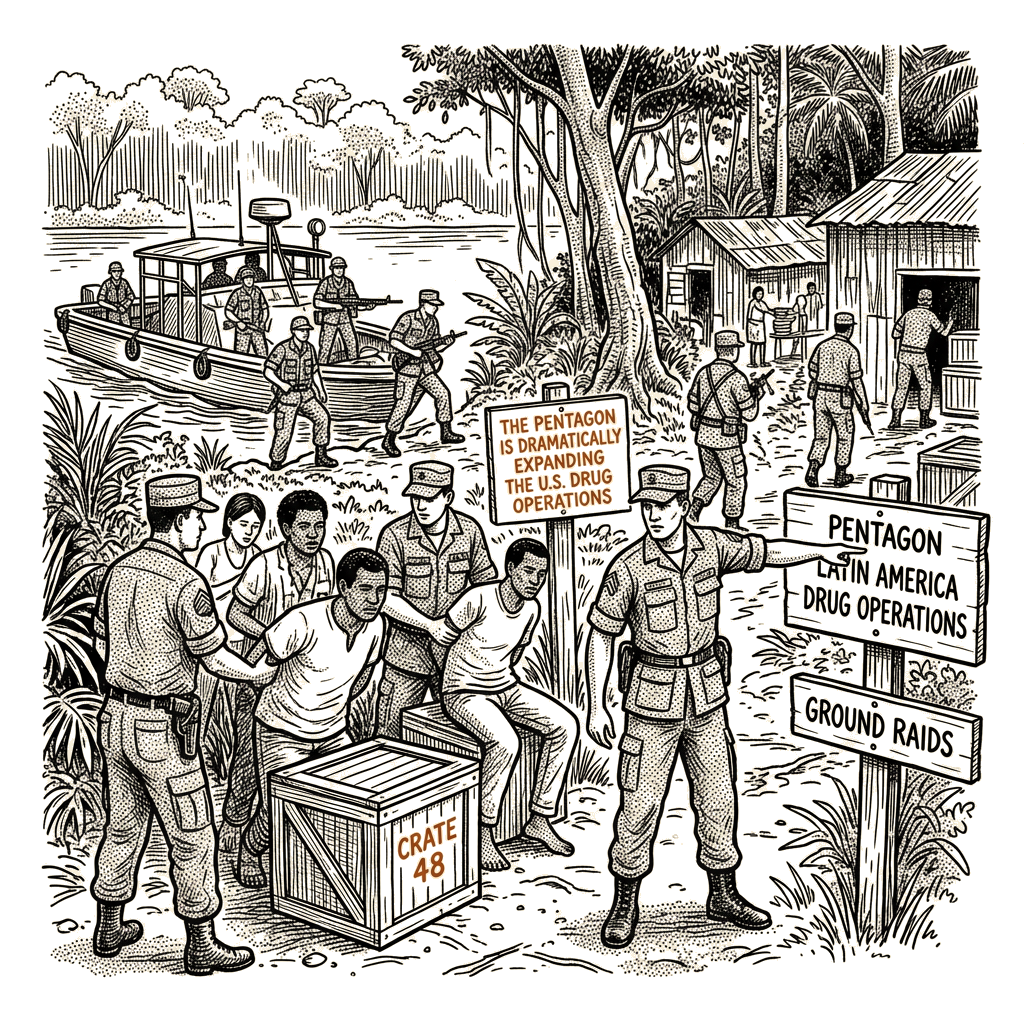
The Pentagon is dramatically expanding the U.S. military’s role in tracking drug cartels across Latin America and the Caribbean one year after the Defense Department began striking boats suspected of ferrying drugs, deploying high-tech drones to map smuggling networks and sending troops to assist in ground raids, The Wall Street Journal reported Tuesday.
The top general in charge — a Marine four-star who spent years disrupting terror networks in the Middle East — said in a recent interview that the goal is to help countries in the region step up antidrug operations with U.S. assistance. The deployments are part of a broader effort by the administration to disrupt illicit trafficking networks worldwide using sophisticated military technology and other counterterrorism tools, other U.S. officials said.
“Do I see land strikes as options? Yes. We want all options at the table,” said Gen. Francis Donovan, head of U.S. Southern Command, which oversees troops in the region. “Those actions might be strikes, arrests, or the takedown of a safe house. It could even be something as routine as increasing the use of cargo scanners at border checkpoints,” Donovan said, adding that the goal is to put “total systemic friction” on the cartels.
The expanded operations build on recent joint actions in the region. Last week, roughly 50 U.S. troops and law enforcement personnel joined Ecuadorean police in predawn raids against an alleged cocaine-trafficking network linked to a Mexican cartel, according to Ecuadorean and U.S. officials. The operation marked the first time U.S. troops directly participated in police raids in Ecuador, Ecuadorean officials said, and was supported by high-tech U.S. military assets, including drones and jamming equipment.
The operation is a model Trump officials plan to expand across the region. So far this year, the U.S. military has helped Ecuador bomb a suspected drug-trafficking camp, worked with Venezuela to carry out a strike that killed the leader of the Tren de Aragua gang, and provided intelligence support for operations in Colombia. On Monday, Colombian forces captured an alleged drug-gang leader after tracking him with the help of U.S. law enforcement and American-supplied drones equipped with infrared sensors, according to local authorities.
The growing operational role marks a significant shift for Southern Command, which has traditionally maintained a light U.S. military footprint in the region and focused largely on intelligence sharing, interdictions, training, and disaster relief.
Donovan said a range of high-tech systems is needed because Latin America poses geographic and topographic challenges unlike those U.S. forces have faced in the Middle East. “It is incredibly challenging,” he told the Journal. “When you add the river networks, their daily flows, and tidal changes of up to 20 feet, it presents a unique geographic and topographic problem set that we simply haven’t had to face before.”
Some of the drones being used, including unmanned boats that can launch quadcopters, will operate along riverways and deep in the jungle, where smugglers can shield their activities under several layers of canopy. “This allows us to see under the canopy and right at the waterline. That is where we find drug labs and where they build these large semi-submersible platforms deep in the jungle,” Donovan said.
To support expanding operations, the Pentagon is considering moving MQ-9 Reaper drones to Central and South America from Africa, according to U.S. officials familiar with the plans. Donovan did not comment on the proposed shift. MQ-9s, which can pick up electronic communications, detect heat signatures, and conduct precision strikes, have been crucial in America’s counterterrorism efforts and, in the past year, have also been used in several attacks on drug boats. CNN reported earlier the deployment of Reaper drones to the region.
The effort is being coordinated across the Defense Department. Officials from several combatant commands met in Washington last week to discuss a global effort to counter drug cartels, U.S. officials said. The commanders of U.S. European Command, Africa Command, Southern Command, Northern Command, and Special Operations Command participated. “The Department is focused on synchronizing our commands, interagency partners, and international partners share information, close operational seams, and apply sustained pressure across these networks,” Pentagon spokesman Sean Parnell said in a statement.
According to the Journal, the ramped-up campaign reflects what the paper described as a more muscular approach to Latin America — with the Trump administration designating more than 20 groups as foreign terrorist organizations and cultivating an expanding set of military-cooperation agreements across the region to counter cartel activity. The State Department notified Congress earlier this month that it plans to redirect $52 million in foreign military financing from Slovakia, North Macedonia, Tunisia, and Iraq to Colombia, Ecuador, Peru, and Panama. The move could help the Latin American countries buy more U.S. military equipment and services.
In recent months, Colombia, Paraguay, and Jamaica have all signed agreements that expand the ability of U.S. forces to operate in, train in, and temporarily deploy to their countries. Ecuador’s Trump-allied president tried to offer the U.S. military a base on its soil, but voters rejected the proposal.
The expansion of U.S. military operations beyond boat strikes to land operations could intensify legal scrutiny. Trump officials have argued that the U.S. is engaged in an armed conflict with drug cartels, likening them to Islamist terror groups — an assertion that has been disputed by legal experts and lawmakers who say Congress has not authorized such a war.
Donovan said the growing list of countries working with the U.S. is a testament to the threat that drug gangs pose throughout the region, and that the goal is to see those countries take the lead in executing counterdrug operations. “They are not only fed up, but under immense stress because of the impact these narcoterrorist organizations have had on their societies,” he said. “The majority of them are willing to employ their military and law enforcement forces to achieve those objectives.”