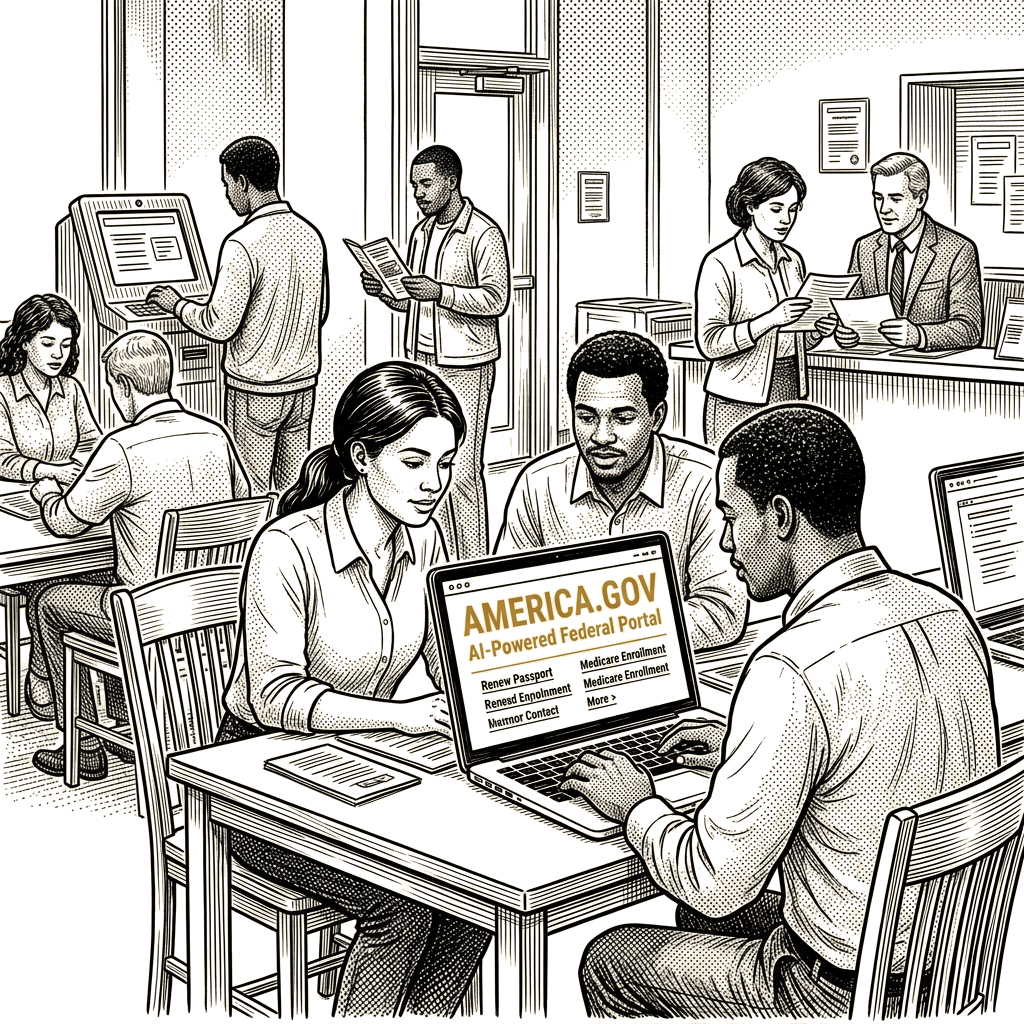
Portal powered by Grok and Gemini AI agents
Version 1.0 of America.gov launched Tuesday, with the portal built by the administration’s National Design Studio under Airbnb co-founder Joe Gebbia and powered by two artificial-intelligence agents — Grok from SpaceXAI and Gemini from Google. The site is designed, Gebbia said, to let users eventually start and finish tasks such as renewing a passport, beginning Medicare enrollment, reserving a federal campsite or checking the status of federal student loans in plain language.
In a preview for The Wall Street Journal, Gebbia framed the portal as a new “digital front door” to the federal government and said the technology would, in time, serve as the final destination for all federal constituent services — setting a standard “you’d expect of a superpower.” “This is reorientating this notion that you have to do the work for the government to figure out what the entry point is,” Gebbia said. “We turn the whole thing around, and now the government orientates itself around you. You tell us what you need, and the government goes and gets it done for you.”
The launch comes against the cautionary precedent of HealthCare.gov, which crashed when it launched in 2013 and became a lasting headache for the Obama administration. White House officials said America.gov would not only avoid a similar fate but would contribute a lasting legacy for President Trump. One senior administration official predicted the new digital front door would have a larger effect on the lives of everyday Americans than the White House ballroom.
General Services Administrator Edward Forst said the GSA would provide what he described as “the ongoing backbone” of the technology as more advanced iterations are released. “We’re the ones who are going to actualize this and bring it forward,” Forst said.
The technology behind the portal is meant to make every government website immediately searchable, with full integration of certain services expected to begin in a matter of months, developers said. Gebbia said the administration is confident in its code and tech because he and his team “come from industry, Airbnb and have amazing partners like SpaceXAI and Google who are experts at managing scale.”
The ambition is not new. Beginning with the Clinton administration in the early days of the internet, each administration has tried, in one form or another, to create a one-stop-shop portal to the federal government. The Obama administration estimated in 2011 that there were more than 24,000 government domains.
Mikey Dickerson, a former Google engineer who helped reset HealthCare.gov after its disastrous 2013 launch and went on to become the first administrator of the United States Digital Service, said the idea was “the first idea that everybody has.” Dickerson, who recalled conversations with then-President Barack Obama about why the federal index of websites was so fragmented, said creating a true one-stop shop becomes nearly impossible because federal agencies define even basic criteria differently. The IRS and USDA, he said, treat income differently in their application of the tax code and administration of food stamps.
To truly consolidate federal services into a single platform, Dickerson said, lawmakers would need to write new legislation, not just computer code. “I hope somebody notices if they promise the moon and stars,” Dickerson said, “but then come up with the same half-broken thing everybody has done before.”
Gebbia joined the administration as part of Elon Musk’s Department of Government Efficiency and helped the government transition to a fully paperless retirement process for federal employees. The National Design Studio also helped launch the TrumpRx platform and the Trump Gold Card website earlier this year. Gebbia also drafted brand architect Peter Arnell — known for campaigns for Chrysler and M&M’s — to serve as the first chief brand architect of the U.S.A.
Arnell called the project “one of the most powerful contributions that he leaves to mankind,” referring to the president, a longtime friend. He predicted that America.gov, in its final forms, would be seen by everyday Americans as “a kind of partner in your life.”