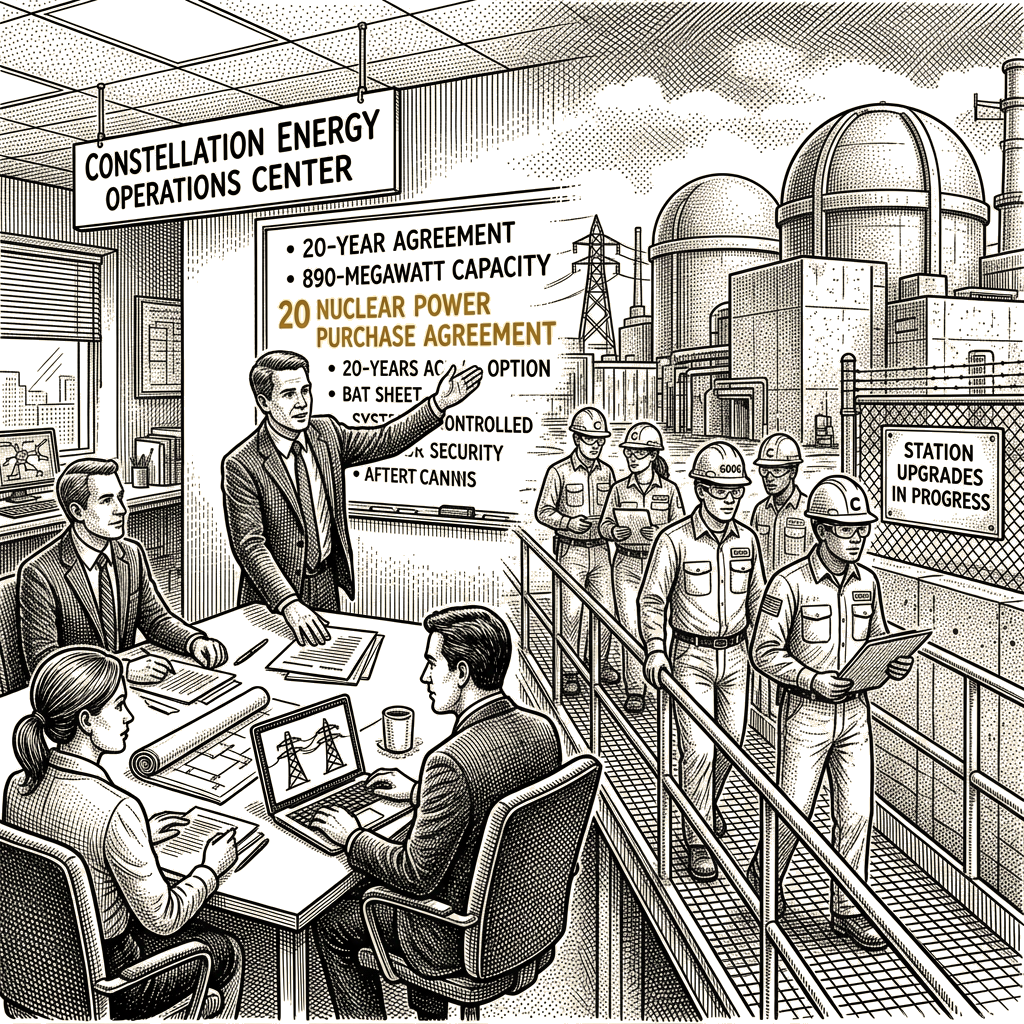
Eleven reactors in three states face efficiency upgrades
Google and Constellation Energy announced Tuesday a sweeping 20-year agreement to boost output at 11 nuclear reactors in Illinois, Pennsylvania, and New Jersey, in what the companies described as the largest-ever efficiency-upgrade project between a nuclear operator and a technology company.
The 890-megawatts power-purchase agreement is one of several recent deals tying the energy and tech industries together to supply new data centers. Under the arrangement, Constellation plans to invest more than $4.3 billion in upgrades to its existing reactors, with the additional output roughly equivalent to building a new large reactor.
“These are expensive things to be done, and we’ve known that we could do this for a number of years now,” said Joe Dominguez, Constellation’s chief executive. “But it’s really Google stepping up to the plate and providing the financial backing for us to be able to bring on what is effectively a new reactor.”
Constellation aims to deliver the first uprate project in 2028, with construction on the others continuing through 2032 or 2033, according to Dominguez. The companies also agreed to a separate 15-year supply deal covering an additional 2,700 megawatts of electricity in the PJM power market serving the Mid-Atlantic and Midwest.
Shares of Constellation rose about 14% in midday trading Tuesday, sparking a rally among other power producers. Talen Energy climbed 13%, Vistra rose 11%, and NRG Energy was up 8%.
Amanda Peterson Corio, Google’s global head of energy and power, framed the deal in terms of the company’s priorities. “The speed to firm, clean power in a responsible way was incredibly important to us,” she said, noting that the deal comes “in a moment where data centers are under a lot of criticism.”
The two companies said they also plan to work on new power generation, battery storage, and demand-response programs that shift or reduce power consumption when the grid is stressed.
Big technology companies have been trying to secure power for new data centers that require as much electricity as a city. They have been especially drawn to nuclear power, which provides clean, 24-7 electricity but is difficult and costly to build new.
Google’s nuclear plans have been among the more ambitious of any tech company as it has focused on adding new capacity to the grid. Last month, the search giant said it would support nuclear plant upgrades in Georgia. It is also working with NextEra Energy to restart the Duane Arnold Energy Center, a nuclear reactor in Iowa, and has paired with reactor developer Kairos Power to purchase electricity from its projects.
The new deal adds to a series of long-term nuclear commitments by competitors. Meta earlier this year signed a 20-year agreement with Vistra that included 433 megawatts of generation-output increases across three plants in Ohio and Pennsylvania. Last week, Amazon said it had signed a 20-year power-purchase deal with Constellation that included an upgrade of a nuclear plant on the western shore of Chesapeake Bay, adding 190 megawatts of power.
Constellation, the country’s largest owner of nuclear power reactors, also has a deal with Microsoft, which is supporting the restart of the undamaged reactor at Pennsylvania’s Three Mile Island, the site of the country’s worst nuclear power accident. The reactor, now called the Crane Clean Energy Center, closed in 2019 prior to the AI-driven power boom.
The Trump administration has been eager to add nuclear power, including by squeezing more output from existing reactors. Nuclear power has traditionally taken a long time to build and gone over budget in the U.S., a history that has made it difficult to get a new wave of projects under construction. Upgrades at existing plants and restarts of recently closed reactors are considered the quickest, lowest-hanging fruit for adding more nuclear power.