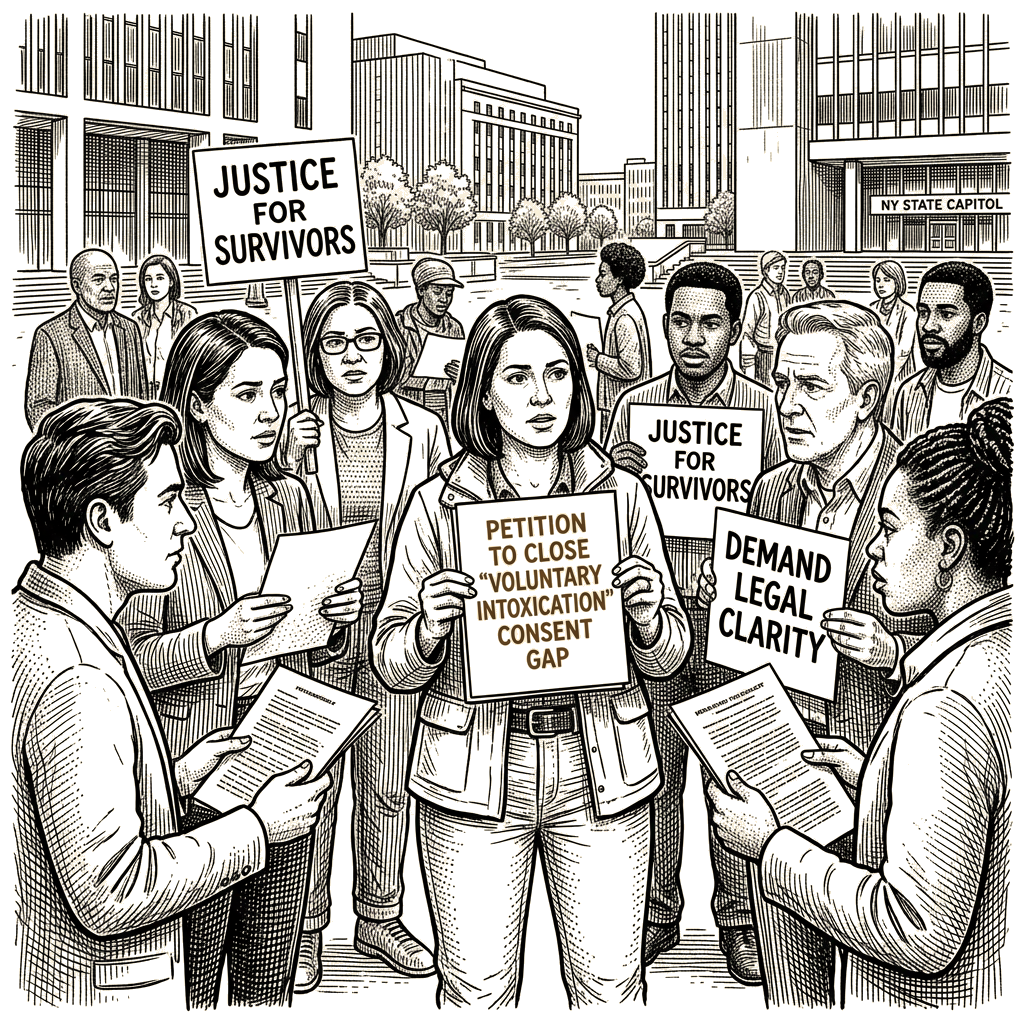
Bills to widen New York’s consent law have stalled in the Assembly
The lawsuit, filed in New York by a woman identified as Jane Doe in legal documents, alleges she was pressured to snort ketamine and plied with alcohol at a fraternity house before several men advertised a “free” sexual encounter with her in a group message. The woman said she was too intoxicated during the alleged incident to provide consent.
At issue is whether someone who voluntarily consumes alcohol or drugs can be considered unable to consent to sex under state criminal law. New York Governor Kathy Hochul said last week that “voluntary intoxication is not a license for sexual assault or gang rape” and pledged to work with the legislature to close what she called a “loophole.”
Under current New York law, a person who voluntarily consumes drugs or alcohol is not automatically considered unable to consent to sex. The statute requires that a person be “unconscious or for any other reason physically unable to communicate an unwillingness to an act” before they are deemed unable to consent, according to the BBC’s reporting.
U.S. media has widely reported this gap as the “voluntary intoxication loophole.” Some legal experts told the BBC that the law has been misinterpreted and does not stop voluntarily intoxicated people from reporting sexual assault, though it does require them to meet a higher standard of incapacitation than merely being intoxicated.
Dan Schorr, a former sex crimes prosecutor who also helps universities review sexual assault cases, said New York law still protects victims of assaults who chose to drink or take drugs. “If a person cannot express consent or lack of consent due to the consumption of alcohol or drugs, any sexual activity with them is always non-consensual, whether the ingestion of alcohol or drugs was voluntary or involuntary,” Schorr said. “I prosecuted many people who sexually assaulted someone who was voluntarily intoxicated. I got convictions. They went to prison.”
Mitchell Epner, a former prosecutor who has handled sex trafficking cases, said the current standard is difficult to meet. Some prosecutors “may not bring charges or defendants may be acquitted because someone ‘gave consent’ while intoxicated, but not completely incapacitated,” Epner said. In other states, he said, lower legal bars for incapacitation use language such as “impaired” or “significantly impaired,” and being too drunk to drive could qualify. “If somebody’s too drunk to drive, they’re too drunk to - fill in your verb of choice,” Epner said.
A proposed New York bill would widen the scope of when someone is too intoxicated to consent. The legislation states that people cannot give consent if they are under the influence of substances that have rendered them “temporarily incapable of appraising or controlling” their conduct, and “such conduct was known or reasonably should have been known” to the other person.
Cornell’s campus disciplinary process uses a different standard than criminal law. The university applies an “affirmative consent” standard, defined as “a knowing, voluntary, and mutual decision among all participants to engage in sexual activity.” Under that standard, silence or lack of resistance does not constitute consent.
The New York state Senate has passed the bill to widen the criminal-consent law multiple times, but the state Assembly has not brought it up for a vote. Pennsylvania has also moved to make it easier for victims who were intoxicated to prove they were assaulted. Representative Lea Webb, whose district includes Cornell, told the BBC News Channel she and her fellow lawmakers were working to push legislation through that has gone through several amendments. New York’s current law, she said, “puts the onus of proof on the victim.”
The New York State Association of Criminal Defense Lawyers said in a statement that the state’s current laws were sufficient and that “people have been convicted of rape in cases involving voluntarily intoxicated victims.” The group said language defining a victim as “incapable of appraising or controlling their conduct” was “simply too vague to be fairly enforced” and did not give clear details on what constitutes someone being too intoxicated to engage in sexual conduct.
Schorr, the former sex crimes prosecutor, said finding “a clear standard that will be evenly applied” was challenging. “How should the law address that? It is very challenging to find a clear standard that will be evenly applied,” he said. “It’s a conversation we should have as a society, as a state.”