Firing squad permitted in five U.S. jurisdictions; unused for 15 years
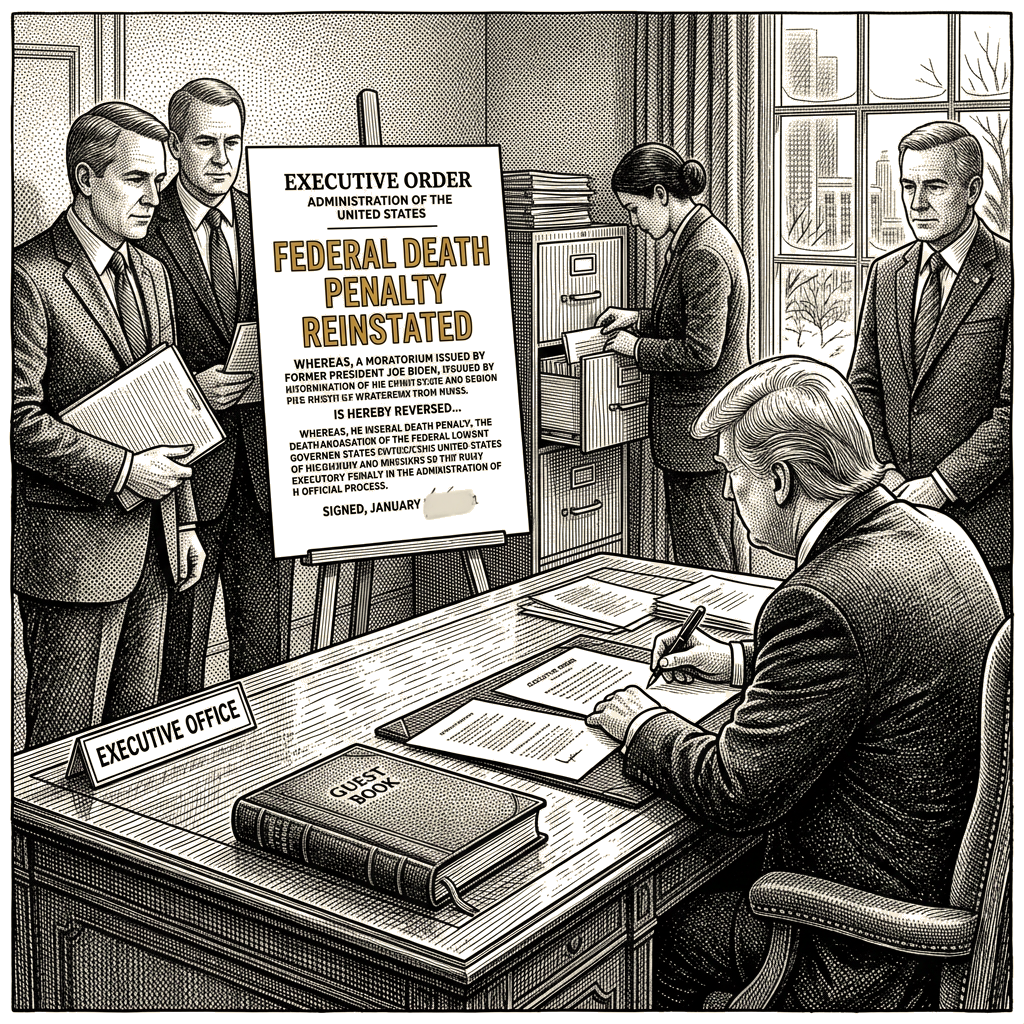
President Donald Trump signed an executive order on the first day of his administration in January 2025 reinstating the federal death penalty, reversing a moratorium that the Justice Department had issued under former President Joe Biden. The order describes capital punishment as “an essential tool for deterring and punishing those who would commit the most heinous crimes and acts of lethal violence against American citizens.”
The reinstated federal death penalty operates within a U.S. capital punishment system in which 27 states, the military, and the federal government still have capital punishment as a legally available option. The majority of executions in the U.S. are carried out at the state level, where the military method is not used.
Death by firing squad is permitted in only five U.S. jurisdictions: South Carolina, Idaho, Mississippi, Oklahoma, and Utah. South Carolina carried out an execution by firing squad last year, a first for the state and the first time the method was used in the U.S. in 15 years.
The U.S. military’s death penalty has its own legal history. The U.S. Court of Appeals for the Armed Forces deemed the military death penalty unconstitutional in 1983, but it was reinstated the following year by an executive order under then-President Ronald Reagan.
The Pentagon announced Monday that it will execute Nidal Malik Hasan, a U.S. Army major and psychiatrist from Virginia, by firing squad — the first U.S. military execution by that method in more than 60 years and the first since the end of World War Two.
Pentagon spokesperson Sean Parnell announced on social media on Monday that Secretary of War Pete Hegseth had made the recommendation and President Donald Trump approved it. Parnell said the Secretary of the Army will set the time and place of the execution. “Judgement day for Hasan has finally come,” he wrote on X.
Hasan, a U.S. Army major and psychiatrist from Virginia, fatally shot 13 unarmed soldiers at Fort Hood, Texas, on 5 November 2009 and wounded 32 others. The attack took place in a crowded medical building where deploying soldiers were awaiting check-ups and vaccines. It was the deadliest non-combat attack on an American military base.
Hasan later admitted in court he was the gunman and apologized for “any mistakes.” During his court-martial in 2013, he said he believed he was protecting Muslims and the Taliban in Afghanistan.
A jury panel of 13 officers convicted Hasan of 13 counts of premeditated murder and 32 counts of attempted murder and unanimously recommended the death sentence. He is currently one of four inmates on the U.S. military’s death row.
Under military law, a military execution requires approval from the U.S. president, appellate review, and a final judgment on its legality before it can move forward.