Bridge would close gap in 3,700-mile cross-country trail
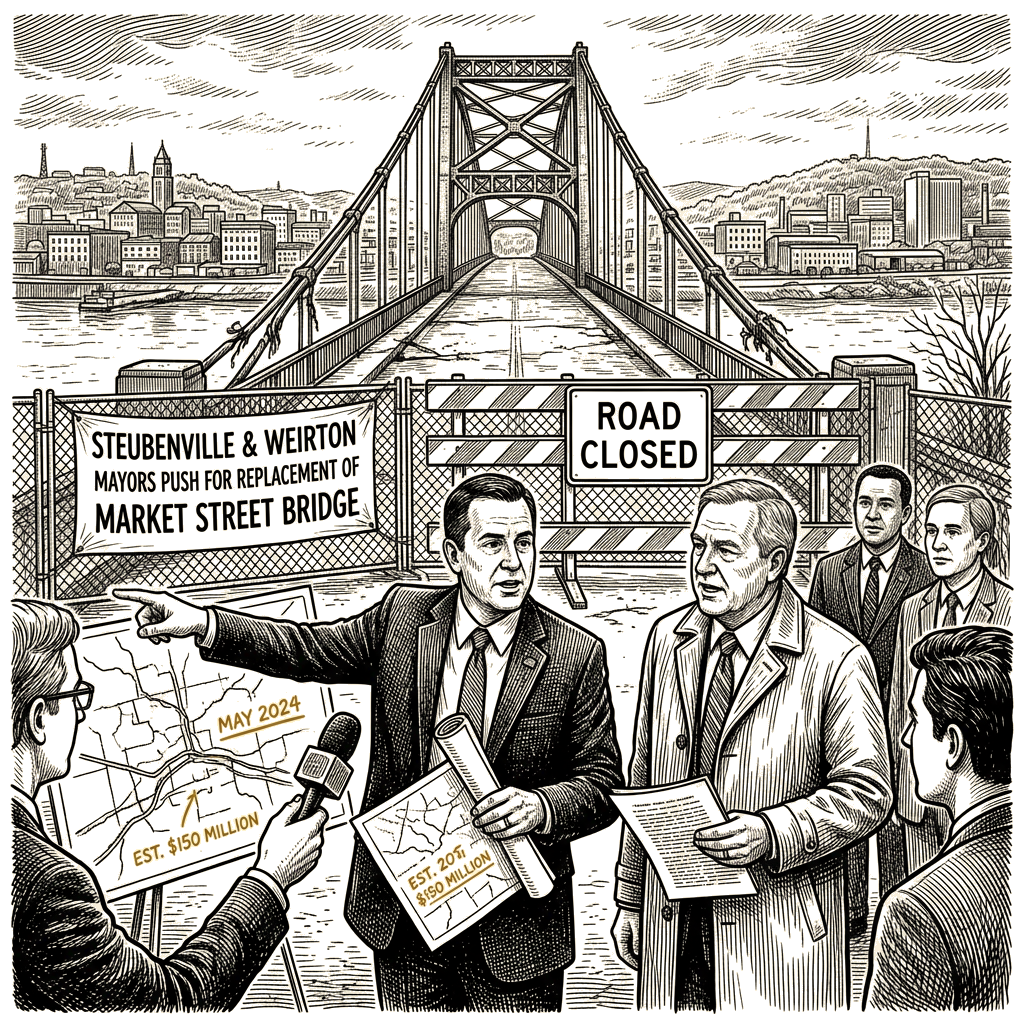
The Market Street Bridge once carried 40,000 cars a year across the Ohio River, connecting downtown Steubenville, Ohio, to the green hills around Weirton, West Virginia. It now sits closed. West Virginia officials shut the bridge in late 2023 after the cables anchoring its piers to the ground failed.
The 1,800-foot steel suspension bridge is considered beyond repair by transportation officials. “You got severe rusting under here,” said Michael Paprocki, executive director of the Brooke Hancock Jefferson Metropolitan Planning Commission, pointing to visible holes in the rusted beams under the bridge’s deck. “In reality, if it stood long enough, it would probably collapse under its own weight,” Paprocki said.
Now, the mayors of both cities are pressing to replace the bridge with a new one a few blocks away that would include a dedicated trail for bikes and pedestrians. They gathered at an event in Steubenville in September organized by the Rails To Trails Conservancy, the nonprofit behind the Great American Rail-Trail, a 3,700-mile plan to convert former rail corridors into a continuous bike and pedestrian path from coast to coast. More than half of the proposed trail already exists, but the Ohio River crossing remains a major gap.
“This is huge,” said Republican Ralph Petrella, mayor of Steubenville. “This is a national entity that would help our economic development and continue the momentum we have for revitalization.”
Democratic Mayor Dean Harris of Weirton, who worked at a local steel mill for 48 years before it closed in 2024, said the city is “in the process of sort of rebranding ourselves.” Steel “made us, and brought people to our area,” he said. “But obviously it’s time for us to move on from that.” Harris added: “We need to look at the future and what’s going to be good for future generations. And that’s what we’re in the process of doing.”
Harris said Weirton already has a rail-trail that connects to the suburbs of Pittsburgh, about 30 miles east, and that it helped the city attract a battery factory that opened several years ago.
The push for the bridge comes as the Trump administration has signaled opposition to federal spending on bicycle infrastructure. Transportation Secretary Sean Duffy has said he does not want to spend federal dollars on what he calls “DEI bike lanes.” Eric Oberg, the senior director of programs at the Rails To Trails Conservancy, said the administration’s stance creates “headwinds” for projects like the Steubenville replacement, though it does not have to stop progress on the replacement bridge.
“It’s gonna happen. This is an inevitable project. There’s too much support for it,” Oberg said. “The question is the timeline.”
Congress has appropriated $87 million so far, but local leaders say that is only a fraction of the total cost. “The challenge of crossing a body of water as big as the Ohio River is monumental,” Oberg said. Local officials are pressing state and federal lawmakers for more money, focusing their attention on the surface transportation reauthorization bill now being negotiated in Washington.
The closure has had tangible effects on the communities the bridge once connected. Maura Barnes, who grew up near Steubenville and stayed to raise her family, opened the Steubenville Grocery Box with her husband and some friends. “A lot of the businesses around us who had been open for years, they saw a pretty notable decrease in foot traffic and car traffic to their businesses when that closed,” Barnes said.
“I think a lot of it was almost spiritual,” Barnes added. “It’s a loss, and it was a blow to the morale of the community.”
The Veterans Memorial Bridge, less than 2 miles away, carries highway traffic across the river, but the Market Street Bridge was the only way for pedestrians and bicycles to cross the river safely, and the only one that brought cars directly into downtown.
Paprocki, who grew up in Steubenville, said bicycling does not follow the conventional political map. “It’s not just liberals that ride bikes,” he said. “Ohio is an extremely conservative state and a lot of them ride bikes. West Virginia is an extremely red state. And believe me, they love to go out and ride their bikes.”