Internal GOP memo warned data centers could sink Husted
Sherrod Brown stood in a Lima coffee shop earlier this month and described for a crowd of several dozen the moment, in his telling, when a driver rounding through the northwest Ohio countryside sees a data center for the first time.
“You’re driving on what looks like really good farmland, driving past fields, driving past barns, driving past milking parlors, and you see, all of a sudden, you see these huge cranes and you see these trucks coming,” Brown said.
Brown, 73, the former Democratic senator who lost his 2024 bid for a fourth term to Republican Bernie Moreno, has spent the past year traveling Ohio to argue that the “system is rigged” against working people. In his final speech on the Senate floor after that loss, Brown told the chamber: “It’s not, I promise you, the last time you’ll hear from me.” Months later, he announced another run for the Senate.
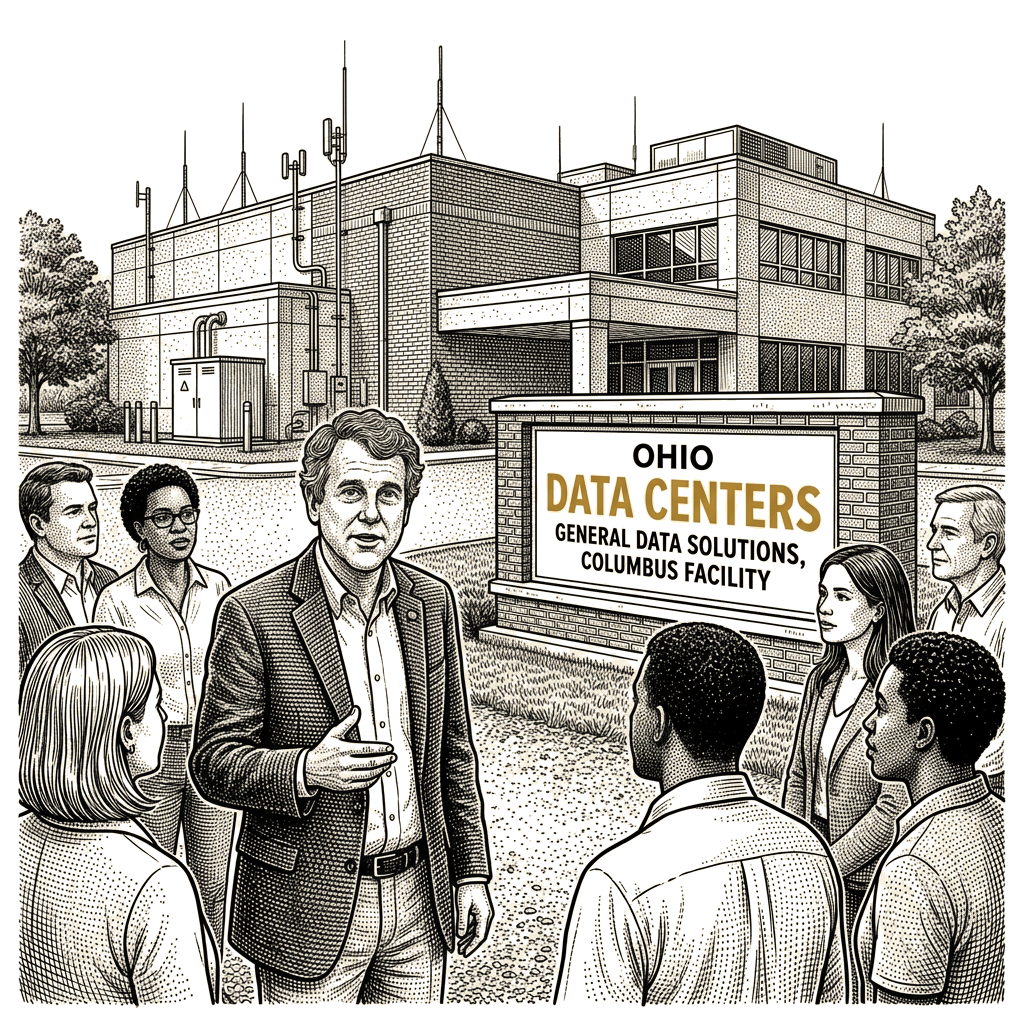
In the closing weeks of this campaign, the most visible iteration of Brown’s argument has become data centers — the large computing facilities that house artificial-intelligence infrastructure and consume land, water, and large quantities of electricity.
“Nobody knows they’re there,” Brown said in shirtsleeves, without notes. “They eat up our land. They swallow up our water … then once they’re built, our electricity prices go up.”
The pitch has been built around his Republican opponent, Senator Jon Husted, whom Brown calls “the face of datacenters.” A report from Ohio’s chamber of commerce found the state granted $2.5 billion in tax breaks to data center developers from 2017 to 2024 — a period during which Husted served as lieutenant governor under Governor Mike DeWine.
“John Husted, I mean, he’s the guy that — he’s talking like he didn’t now — but he’s the reason these datacenters are here — 200 of them,” Brown said.
Husted was elevated to the Senate in 2025 when DeWine appointed him to the seat JD Vance vacated upon becoming vice president. The winner of the November election will hold the remainder of the term, which expires at the end of 2028.
The contest carries national stakes. Democrats must win at least four Senate seats to reclaim the majority, most of them in states Donald Trump carried by double-digit margins in 2024, including Ohio, where Trump led by 11 percentage points.
Brown has folded data centers into a broader affordability message that congressional Democrats are pushing nationwide. He references the Iran war, Republican tariffs, Medicaid cuts approved by the Republican Congress, and rising prices for Affordable Care Act plans brought on by their inaction. When asked in Lima for one cost-lowering idea, Brown proposed expanding the child tax credit — a measure that, during its single year of enactment under President Joe Biden, reduced child poverty.
As the election has drawn closer, Brown’s campaign has sharpened the data center line. This week, the campaign unveiled billboards reading “See that datacenter? Jon Husted did that,” and launched a website critical of Husted that includes a map of data center sites in the state.
Husted’s campaign has pushed back. Spokesperson Amy Natoce accused Brown of lying and noted that Husted, while serving as lieutenant governor from 2019 to 2025, “did not have the authority to grant tax breaks.” She also cited Husted’s Senate sponsorship of the Ratepayer Protection Act, which would have required electric utilities to weigh standards that make data centers cover their grid impacts. The bill passed the House with bipartisan support, but Senate Democrats blocked its advancement last month, calling it ineffective.
“Sherrod Brown and his friends like to talk about affordability, but when the rubber meets the road, they’d rather play politics than actually lower Ohioans’ energy bills. It’s disgusting,” Natoce said.
Polling suggests the data center line may be moving. The New York Times and Siena University released a survey last week showing voters trusted Brown over Husted to handle data center development by 11 percentage points. The race itself remains close, with Brown leading the incumbent by 3 percentage points, within the survey’s margin of error.
The attacks land in a state whose politics on data centers have shifted visibly. In August, a memo from the National Republican Senatorial Committee — the GOP’s Senate campaign arm — warned that data centers could sink Husted.
“More than any other thing in this race, datacenters are the anchor hanging around Husted’s neck,” the memo read. “If he loses and datacenters get the blame, politicians across the country will take notice — and they will not go near the next one.”
Local politics have moved faster. Nearly 140 Ohio communities have imposed moratoriums on new data center construction, according to the Ohio Capital Journal, and in May DeWine announced a pause on data center tax exemptions. Last year, Democrats campaigned against datacenters to gain power in elections in Virginia, New Jersey, and elsewhere, and this year are lumping their perceived impacts on electricity prices with the Iran war’s upward pressure on gas prices to argue that Republicans have failed to accomplish Trump’s promise of fighting inflation.
“Husted has been involved in datacenters prior to this election year, and … he’s just more exposed,” said Dan Birdsong, a senior lecturer in political science at the University of Dayton. The issue, he added, lets Brown appeal to rural voters who typically do not vote Democratic but are sensitive to the prospect of a data center near their land.
“He has a bipartisan voting base that he can appeal to with this issue that’s different than other issues in the state,” Birdsong said of Brown.
Brown’s pitch faces a counter-pressure inside the labor movement. Data center construction has provided significant work for building trades unions — and some of those locals, including northwest Ohio’s Carpenters Local Union 351, are backing Brown despite the tension.
Lee Daher, the senior business representative for the local, called data centers “a really good source of employment for us.”
“It means a lot of work for our members, not only today, tomorrow, but for the years to come,” Daher said. The local backed Brown in 2024 and is backing him again, and Daher said the candidate’s criticism of data centers has not changed that.
“They’re coming one way or another, and is there some regulation that is needed? I think so, but I think big tech is hearing what is being asked of them,” Daher said.
Brown, asked about the tension, argued it was his cost focus that would win back workers who abandoned him two years ago.
“Those unions support me in large part because their members don’t like higher electric bills. Their members don’t like having no say on these datacenters coming to their towns,” Brown said. “I don’t think very many union members want the state to give these huge tax breaks to these out-of-state billionaires that are building these datacenters.”
Brown faces a difficult resource environment. Fairshake, a Super PAC linked to the cryptocurrency industry, plans to spend $30 million against him this cycle after backing Moreno’s 2024 victory. Brown, who led the Senate banking committee and was an adversary of the sector, acknowledged the disparity.
“We will be outspent for sure,” Brown told reporters in Lima.
Brown argues that he has the accomplishments to back up his record. An Ohio native with a bachelor’s degree from Yale University, he had been in office almost without interruption from 1975 until his 2024 loss, during which he won seven terms in the US House and three in the Senate. As a House member, he voted against implementing the North American Free Trade Agreement out of concern for Ohio manufacturers, and one of his last Senate votes was for legislation that boosts Social Security payments to public employees. By the end of his tenure, he was the last Democrat holding statewide elected office in Ohio, still describing himself as a champion for workers even amid abundant evidence that they had soured on his party. The durability of his name was visible last month, when a Bowling Green State University poll found a quarter of respondents incorrectly identified Brown as the incumbent.
The election is now about four weeks away.