More than 286,000 importers have filed for tariff refunds
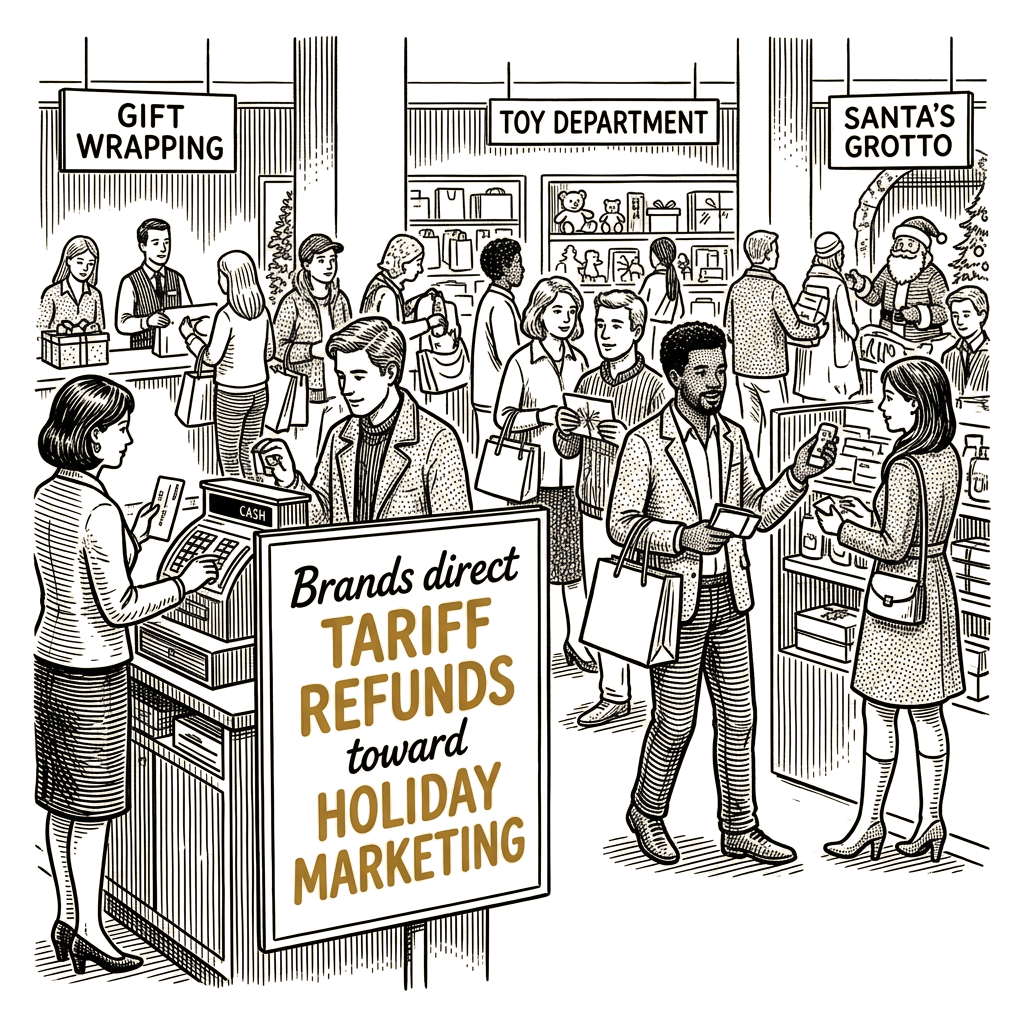
Macy’s, Levi Strauss, Warby Parker, and E.l.f. Beauty are among the major U.S. brands directing federal tariff refunds toward holiday-season marketing campaigns, executives said on recent earnings calls. The announcements come as U.S. Customs and Border Protection reported receiving approximately $136 billion in refund requests from more than 286,000 importers since the Supreme Court struck down President Trump’s tariffs in February 2026.
As of Oct. 2, Customs and Border Protection has received about $136 billion in refund requests and sent $126 billion to the Treasury Department for payment, an agency spokesperson said. More than 286,000 importers requested refunds, according to a September court filing. The money is being returned after the high court’s February decision invalidated tariffs the Trump administration had imposed on imported goods.
Warby Parker plans to draw on the $11.8 million it received last quarter to help market Intelligent Eyewear, a line of AI-powered glasses developed in partnership with Google and Samsung, the company said. “Within marketing, we plan to meaningfully increase our total brand and media investments, which will be shared with our partners as we scale Intelligent Eyewear campaigns,” Chief Financial Officer Adrian Mitchell said on the August earnings call. “With regards to the investments in the business and integrating Intelligent Eyewear—that’s fully funded by the tariff benefits.”
E.l.f. Beauty will use some of the approximately $50 million it has received to help raise awareness of its brands in markets including the U.K., Canada, and Germany, according to Kory Marchisotto, president of e.l.f. Brands. “Our tariff refunds are being reinvested first to support our value proposition through lower prices on ~10% of our portfolio, then to support marketing across our portfolio of brands, highlighting our holy grail innovations,” Marchisotto said in a statement. The company’s overall marketing spending for the fiscal year through next March will skew toward the high end of a 23% to 25% range of net sales, powered in part by the refunds.
Levi Strauss said Wednesday that a large portion of its tariff refunds will go toward holiday-season marketing campaigns. “We redeployed $60 million out of the $80-odd million from tariffs that we received,” Chief Financial and Growth Officer Harmit Singh said on the earnings call. “I would say a third is marketing, a third is distribution and logistics, and a third is promotional activities.” Upcoming projects include an extension of the company’s work with brand ambassador Beyoncé and a fall campaign targeting men, Chief Executive Officer Michelle Gass said.
After reducing its marketing budget last year due to tariff pressure, Macy’s is directing most of its $116 million refund to its “Bold New Chapter” turnaround strategy, including store redesigns and Bloomingdale’s marketing, the company said.
Other companies have announced similar plans. Women’s clothing maker J. Jill plans to reinvest the bulk of its $13.3 million refund in marketing with a focus on customer acquisition, Chief Financial Officer and Chief Operating Officer Mark Webb said on last month’s earnings call. Kimberly-Clark’s $45 million refund will help counterbalance recent brand investments, and footwear retailer Genesco plans to use part of its $22 million for incremental increases in marketing spending, according to the companies’ earnings reports and calls.
The announcements, however, may say more about the companies’ investor-relations strategies than their actual marketing plans, according to Brian Wieser, founder of consulting firm Madison & Wall. He compared the practice to “AI washing,” in which executives overstate the impact of artificial intelligence on actions or changes that would probably have happened anyway. “It’s almost more of a messaging thing than a question of whether the tariff refunds are really contributing meaningfully to the proportion of their budget that they do spend on marketing,” Wieser said. “In an established business, you don’t wake up in the morning and say, ‘I can’t wait to increase my budget’. You’re a hero when you cut your budget.”
The refund program follows the Supreme Court’s February ruling, which struck down tariffs the Trump administration had imposed on imported goods. Since then, public discussion about how companies would use the refunds has focused largely on whether recipients would cut prices; the recent disclosures show marketing as a major announced use of the funds.