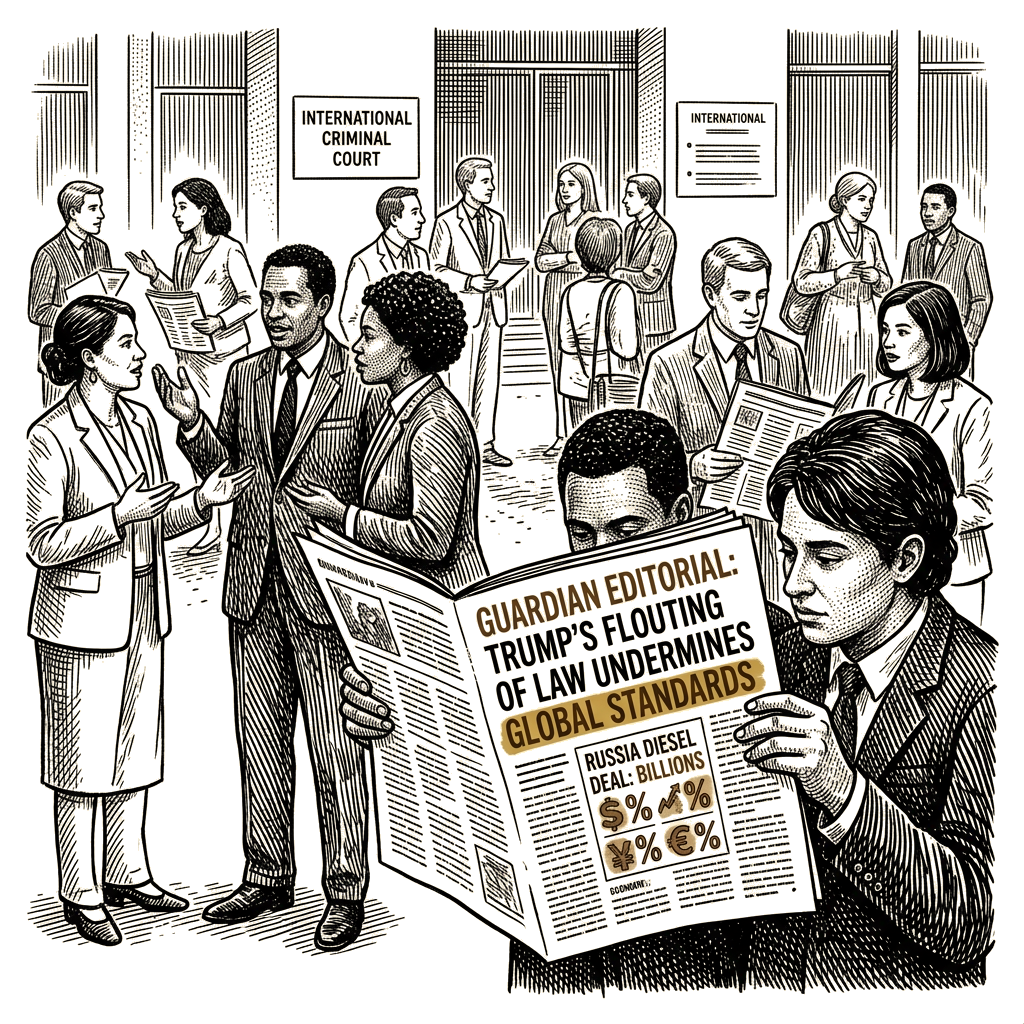
Editorial blames Trump’s Iran war for high diesel costs
The Guardian, in an editorial published Sunday, said Donald Trump drove home his belief on Friday that might is right and that the rule of law is “an obstacle rather than an essential foundation stone of international order.” First came the escalated assault on the International Criminal Court, sanctioning the body itself; then the announcement of a deal with Russia to buy diesel.
The editorial said the US has long chafed at the notion of being bound by the rule of law that it espoused publicly, and that this hypocrisy now “appears as a lesser vice” alongside the president’s declared reliance on his own morality. It said Trump has declared that “my own morality” is all that constrains him, and that his brazen flouting of the law, embrace of dictators and rhetorical attacks all undermine global standards.
The editorial traced the attack on the court first to its Afghanistan investigation, noting that the court has suspended consideration of US actions there, and then to the issuing of arrest warrants for Israel’s Benjamin Netanyahu and its former defence minister Yoav Gallant. The court has been preparing for these measures, the editorial said. Marco Rubio, the US secretary of state, said companies have six months to wind down ties and that US allies must rein in the court. “Either the ICC will end its threats, or we will end the ICC,” Rubio said.
The Moscow deal is unlikely to produce significant shipments because the Russian military runs on diesel, the editorial said, but Ukraine is supposed to heed its message “to make life easier on Vladimir Putin.” The editorial said it is Putin — for whom the ICC has issued a warrant — who launched the illegal war, and whose troops launched lethal attacks on civilians this weekend. A photograph accompanying the piece shows the site of a Russian attack on a residential area in Zaporizhzhia, Ukraine, dated 10 October. In what the editorial called a world turned upside down, Trump blames Volodymyr Zelenskyy for failing to cut a peace deal and says the democratically elected leader should go.
Weeks before the midterms, the editorial said, Trump blames Ukrainian attacks on Russian energy facilities for high diesel costs. It argued that it is Trump’s own “unlawful war on Iran” that has raised prices, and said the weekend’s attacks on Riyadh’s international airport — suspected as the work of Tehran-backed Houthis from Yemen — underscored that he cannot simply park that conflict when it suits him.
The editorial called it “similarly perverse” to wield measures designed to target human rights abusers and war criminals against those who seek to defend their victims. In what it called a stark and intentional contrast, the Nobel committee on the same day announced that this year’s peace laureate is Navi Pillay, a former ICC judge whom the editorial identified as chair of the UN commission that last year concluded Israel had committed genocide in Gaza. The editorial said the award was not only recognition of a remarkable career that began in apartheid-era South Africa, but a reminder that institutions defending universal principles are under increasing pressure and must be defended. “Peace requires justice,” the committee said.
The editorial noted that the ICC itself says it cannot stand alone, and that the UK, the EU and others were right to criticize the US decision and declare their commitment to the court. It said invoking blocking statutes against sanctions would add heft to that rhetoric, and called for similar resolve in standing with Ukraine.
The editorial said the nakedness of Trump’s hostility to the rule of law has one benefit: no one can explain it away or assume it is narrowly bounded. It cited the war on Iran, the kidnapping of Venezuela’s president, extrajudicial killings of alleged drug traffickers in the Caribbean and threats over Greenland and Canada as showing how far he will go and overturning assumptions that allies will be safe. The editorial concluded that the problem is not, as Rubio has claimed, a “rogue court,” but a rogue superpower.