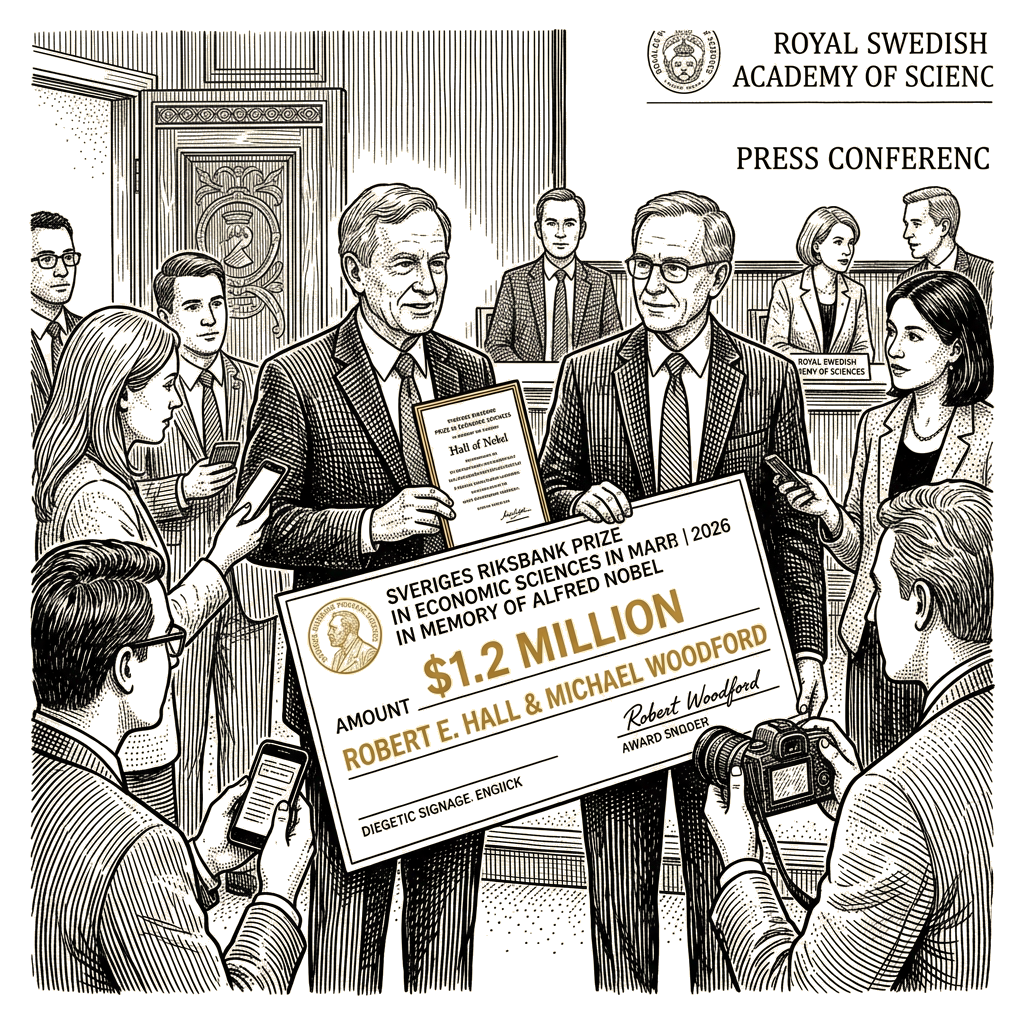
Committee says laureates’ models shape how central banks respond to shocks
The Royal Swedish Academy of Sciences announced the award in Stockholm on Monday, closing the 2026 Nobel cycle. The $1.2 million prize, formally the Sveriges Riksbank Prize in Economic Sciences in Memory of Alfred Nobel, was created by Sweden’s central bank in 1968.
The academy said the pair was selected for demonstrating that policy aimed at stabilizing the economy could be revitalized by refashioning models through the lens of the economic impacts of households and businesses whose actions are based on what they think the future holds, rather than the traditional indicators of inflation, production and consumption. When governments and central banks incorporated the forward-looking perspective and communicate the direction of economic policy, “they can influence this view of the future and move the economy in the right direction,” the committee said, crediting the models with providing a major leg-up in helping deal with recent recessions.
“The laureates’ work has provided us with a stable theoretical foundation for the models that are now used by central banks and governments around the world,” said John Hassler, chair of the Committee for the Prize in Economic Sciences. “With them, we are better equipped to deal with shocks in the economy, such as energy crises or sudden changes in how much households consume.”
Hall is a California-born professor at Stanford; Woodford is a Massachusetts-born professor at Columbia. The economics prize was the last of the 2026 awards, following on from announcements of the prizes for medicine, physics, chemistry and literature. Canadian poet and writer Anne Carson won the prize for literature on Thursday. On Friday, the Norwegian Nobel Committee named South African human rights lawyer Navanethem “Navi” Pillay the recipient of the Nobel Peace Prize.