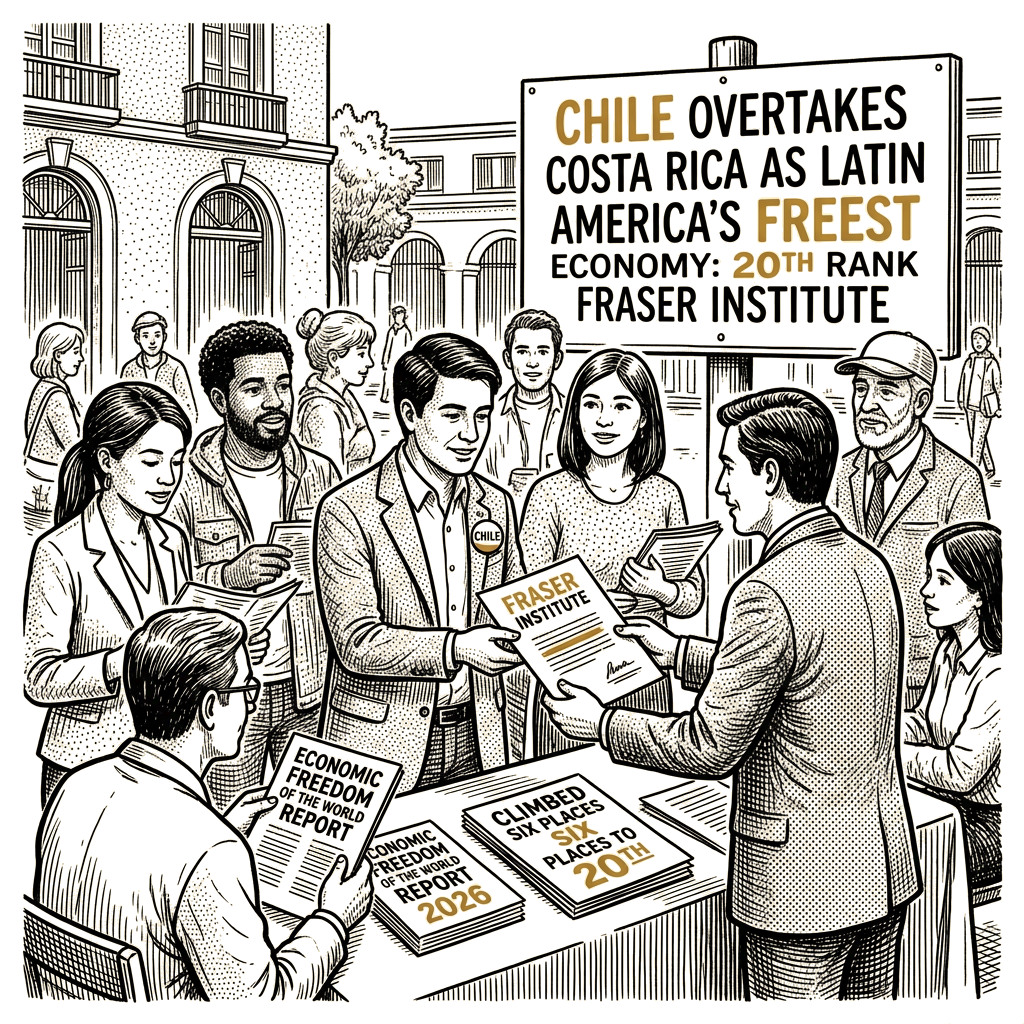
Monetary stability and constitutional finality drove Chile’s six-place rise
The Fraser Institute, a Canadian public-policy research organization, released the 2026 Economic Freedom of the World report on October 14. The report assesses how institutions and policies allow individuals to make their own economic decisions, including working, conducting transactions, starting businesses and using their property. It measures five areas: size of government, legal system and property rights, sound money, freedom to trade internationally, and regulation.
Although published in 2026, the report uses 2024 data. Hong Kong topped the global ranking, followed by Switzerland, Singapore, New Zealand and the United States.
“Where people are free to pursue their own opportunities and make their own economic choices, they lead more prosperous, happier and healthier lives,” said Matthew Mitchell, a senior fellow at the Fraser Institute and co-author of the report. The study links greater economic freedom to higher incomes and longer life expectancy, though it cautions that these associations do not, by themselves, establish causation.
Chile moved up six places to 20th position globally and tied with Malta. The country placed behind Germany in 19th and Canada in 18th, and ahead of Spain in 24th, Sweden in 33rd, France in 39th and Italy in 47th.
Chile’s improvement was driven primarily by monetary stability, where its score rose from 8.58 to 9.18 points, lifting the country from 59th to 44th place in that category. Economist Michele Labbé, a faculty member in economics, business and government at San Sebastián University, told UPI that average annual inflation in Chile fell from 7.3% in 2023 to 3.9% in 2024, improving conditions for economic activity.
“There was greater control over inflation, and that is always good news for a country because it allows investments to be planned,” Labbé told UPI. According to Labbé, price stability makes it easier for businesses to make investment decisions.
“When inflation is not under control, it is difficult to set prices, and when it is difficult to set prices, it is difficult to conduct economic activity. That is how the result should be interpreted,” Labbé said. She noted that Chile’s economic conditions improved compared with 2023 but remained below their 2018 levels.
Felipe Cerda, director of the MBA program and academic director of business engineering at Universidad Mayor, agreed that the improvement reflected the effects of the Central Bank’s restrictive monetary policy following fiscal expansion and external shocks during the COVID-19 pandemic.
Chile also improved its ranking in the size of government, legal system and property rights categories. Cerda linked those gains to reduced uncertainty following the conclusion of Chile’s constitutional reform processes, which resulted in voters rejecting proposed new constitutions in 2022 and 2023.
“As the existing constitution becomes firmly established, risks such as legal uncertainty diminish, which is a fundamental factor, for example, in long-term investment decisions,” Cerda told UPI.
Chile’s rise came largely at Costa Rica’s expense, with Costa Rica losing its position as Latin America’s leading economy and falling from 14th to 28th place globally. Labbé cautioned that Chile’s rise in the ranking reflected both improvements in its own performance and changes in other economies.
According to Cerda, the Central American country recorded declines in four of the five measured categories, particularly in international trade and the legal system and property rights. He cited administrative obstacles, protectionist pressures and difficulties in productive sectors as possible contributing factors.
“Costa Rica experienced a significant deterioration in its legal system and property rights, along with a 10% increase in tariffs that did not previously exist, making it less competitive,” Labbé said. Cerda also pointed to difficulties in productive sectors and administrative requirements, including environmental impact assessments that can act as recurring non-tariff barriers and undermine economic activity.
While Guatemala recorded smaller gains than Chile, Costa Rica and Panama posted weaker results than in the previous year. Other Latin American countries placed considerably further down the rankings: Panama ranked 34th, followed by the Dominican Republic in 40th, Peru in 45th, El Salvador in 58th and Uruguay in 59th. Argentina ranked 151st, while Venezuela finished last worldwide.
The report concluded that global economic freedom began recovering in 2024 but had not returned to pre-pandemic levels. Latin America and the Caribbean remained the region furthest behind in that recovery.
“Latin American economies still face serious problems with property rights and public policies,” Labbé said. “Although there is great diversity across Latin America, and Venezuela obviously has a major impact at the bottom of the ranking, the region has lagged for many years because of its public policies, particularly tariffs, restrictions on international trade, very rigid regulations and a lack of inflation control.”
Cerda attributed differences among Latin American economies to legal uncertainty and obstacles to investment. “Countries in the region live in a state of constant tension, transmitting legal uncertainty to the rest of the world,” he said. “This is compounded by rigid regulations and excessive bureaucracy associated with impact assessments that are not properly aligned with economic activity, permitting procedures and administrative burdens that make investment more difficult.”