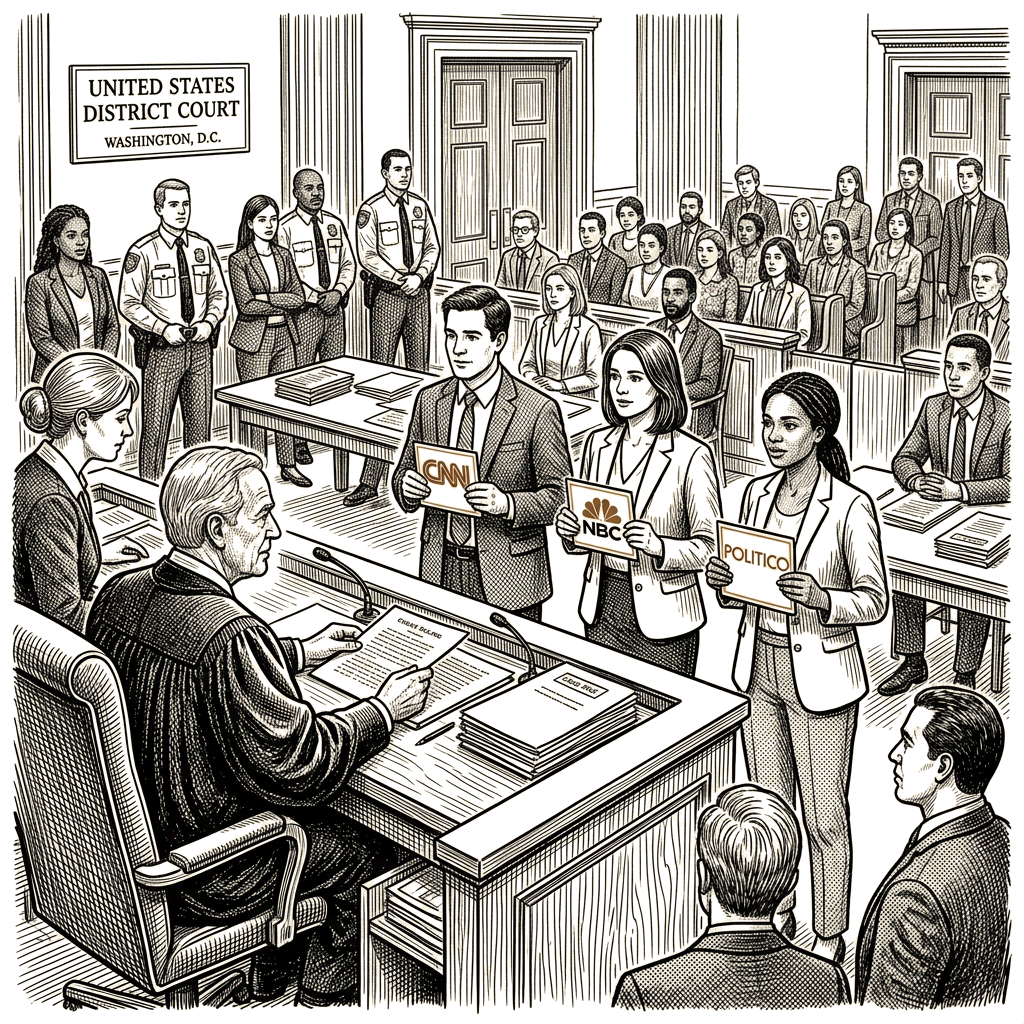
Kelly, a Trump appointee, finds reporters likely to win First Amendment and due process claims
A federal judge ruled Tuesday that the Trump administration must continue providing White House press credentials to reporters from CNN, MS NOW and Politico while the news organizations’ legal challenge plays out.
Judge Timothy Kelly of the U.S. District Court for the District of Columbia granted the outlets’ request for a preliminary injunction blocking the administration from enforcing the ban President Trump announced on Sept. 18. The order extends a temporary restoration Kelly first directed last month, which had been set to expire without additional court action.
In Tuesday’s ruling, Kelly said the outlets were likely to succeed on claims that their hard passes were revoked “without due process required under the Fifth Amendment” and that the White House “retaliated against them for exercising their First Amendment rights and discriminated against them based on their viewpoint.” Trump’s own public comments, the judge wrote, “suggest that he intended the revocation of Plaintiffs’ hard passes to alter their reporting on him, bolstering the case that his action here is sufficient to deter a reporter of ordinary firmness from reporting in the same way she had before.”
Kelly, who was appointed by Trump during his first term, added that his ruling should not be read as endorsement of the outlets’ coverage. The decision should not be interpreted, he wrote, “to suggest that President Trump’s concerns about accuracy and fairness in the media’s reporting are unfounded, or that the government is powerless when its true aim is to protect national security when classified information is unlawfully disclosed.”
The judge’s sharpest passage addressed the administration’s national security justifications. “Strikingly, there is just about no evidence in the record to explain or justify the ‘ban’ from a national security perspective,” Kelly wrote. At a hearing last week, he questioned what to do with the Justice Department’s invocation of “those magic words” — national security — “after the ban was already imposed and the president had publicly stated different reasons for it.”
Trump announced the ban on Sept. 18, citing what he described as a cumulation of negative stories over two years rather than pointing to any specific article. After the outlets sued, the White House Press Office sent the organizations letters listing examples of articles it said “threatened national security and/or spread falsehoods.” Trump’s decision was seen at the time as a sharp escalation of his administration’s efforts to curtail coverage he perceives as critical.
At Tuesday’s hearing, Theodore Boutrous, who represented the media outlets, urged Kelly to address the outlets’ arguments about violations of the First Amendment’s free-press protections. Michael Velchik, the government’s lawyer, argued that the president has a compelling interest in excluding journalists from the White House to enforce journalistic standards and protect national security information, and noted that the president had identified concerns about anonymous sourcing and spliced quotations.
Even with the reporters’ access restored, the administration has continued to take steps that limit CNN’s presence at presidential events. The network was removed from the scheduled rotation to accompany Trump on flights and to local events on three occasions. CNN is part of the TV pool — a rotating group that also includes ABC News, CBS News, Fox News and NBC News and shares coverage duties to save on production and travel costs.
When CNN was excluded from the rotation for Trump’s September trip to New York for the United Nations General Assembly, the TV pool briefly halted some coverage of the president. The Justice Department is now investigating whether the major TV networks violated federal antitrust laws when they decided to suspend coverage.
The preliminary injunction preserves the reporters’ physical access to the White House complex and the daily press operations that depend on it while the underlying First Amendment and due process claims continue in court.