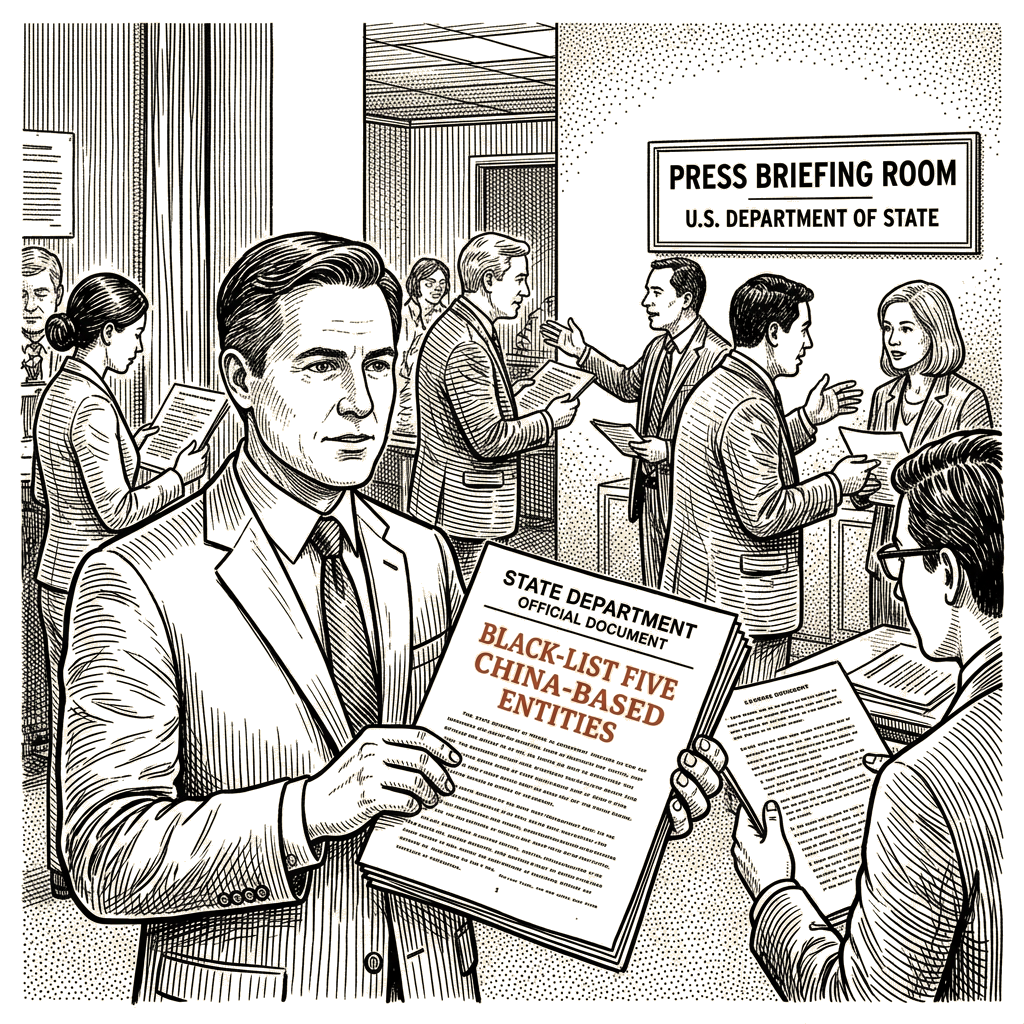
Designations block U.S. loans, freeze assets and bar new investment
The State Department on Monday blacklisted Shanghai Zhisuan Technology Co. Ltd. and Qiji Chuangtan Beijing Investment Management Co Ltd, also known as MiraclePlus, along with two venture capital funds managed by MiraclePlus and an entity wholly owned by one of those funds. The designations were issued under the Protecting American Intellectual Property Act of 2022.
The sanctions freeze assets under U.S. jurisdiction, bar U.S. financial institutions from extending loans to the named entities, prohibit certain foreign exchange and banking transactions, and restrict new U.S. investment in the companies.
“The United States has long been a leader in developing emerging technology,” State Department spokesman Tommy Pigott said in a statement. “This theft of trade secrets is a serious threat to U.S. economic, foreign policy and national security interests.” Pigott added that theft of trade secrets “related to sensitive and emerging technologies” “harms U.S. jobs, companies and investments, and costs U.S. industry billions of dollars each year.”
According to court documents, Ding was hired by Google in 2019 and began stealing the company’s trade secrets in May 2022. In 2023, while still employed at Google and without the company’s knowledge, he founded Shanghai Zhisuan Technology Co. Ltd., which was marketed as capable of developing a software platform to accelerate machine learning workloads. In May 2023, Ding applied on behalf of Zhisuan to a startup incubation program run by MiraclePlus.
Ding’s theft went undetected until early December, when he uploaded files from Google’s network while in China, setting off alarm bells. He submitted his resignation on Dec. 26 as Google was investigating his actions, and was arrested in March 2024 at his home in Newark, California.
A U.S. jury convicted Ding in January on seven counts of theft of trade secrets for stealing thousands of pages of confidential information containing Google’s AI trade secrets. He was also convicted on seven counts of economic espionage, but on Aug. 20, a U.S. judge granted a post-trial motion for acquittal on those counts, ruling that evidence was insufficient to conclude beyond a reasonable doubt that Ding knew during the period of his theft that his actions would benefit the Chinese government.
In September, Ding was sentenced to 12 months minus a day for the seven remaining counts of theft of trade secrets. The Monday action, part of the Trump administration’s effort to target the theft of U.S. intellectual property, extends penalties to the China-based entities connected to Ding’s activities, including the company he founded while still employed at Google and the venture program to which he applied.