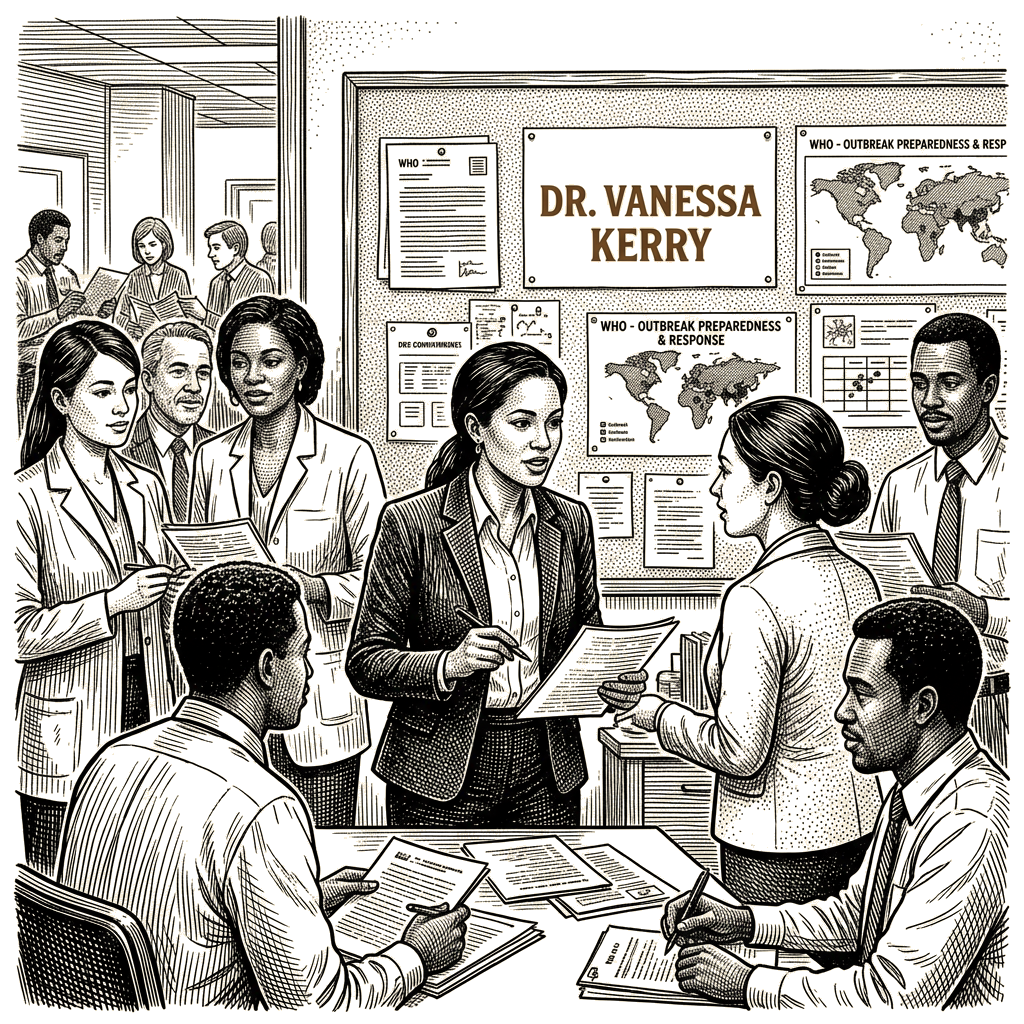
Kerry says 30 emergency medicine physicians and other specialists trained over 3,000 health workers in Uganda during this year’s Ebola outbreak
Dr. Vanessa Kerry has begun a new job as the World Health Organization’s special envoy for health resilience. Kerry said the role will be guided by “strong systems, primary care and the ability to respond.” She also said preparedness means building health-system infrastructure before an emergency rather than intervening only after an outbreak begins.
Kerry previously served as WHO’s first special envoy for climate change and health and currently directs global health and climate policy at Harvard School of Public Health. She is the founder and CEO of Seed Global Health. The nonprofit has been building resilience in lower-resource countries for over a decade by dispatching coaches and mentors to educate and train local health care students and practitioners and by building financial and material resources.
Seed Global Health is active in several sub-Saharan African countries. In Uganda, Kerry says Seed partnered with the Ministry of Health to build emergency medicine by training 30 emergency medicine physicians. When an Ebola outbreak occurred there earlier this year, she says those physicians and other specialists trained over 3,000 health workers around the country in Ebola case management and infection prevention and control.
Seed’s work taught Kerry that building resilience “is not a daunting task. If you train health workers, they can monitor and provide healthcare, they can provide surveillance, they can provide prevention.”
Kerry decided in grade school that she wanted to become a doctor. At age 14, she traveled to Vietnam with her father, former Senator and Secretary of State John Kerry, and was deeply struck by the poverty she saw there.
Between her third and fourth years in medical school, Kerry spent time in a hospital in Rwanda. One day, she was asked to “be a helping hand” with a woman’s labor and delivery while working with a nurse. Kerry said, “I’m a student.” The team consisted of Kerry, then a U.S. medical student, and a Rwandan nurse.
The mother was pushing, but the baby was not advancing, and the shoulder had gotten stuck, so they performed maneuvers to help deliver the baby. Kerry tried to remember what she had learned during an earlier labor rotation. There was no imaging, and neither she nor the nurse had specific training for that situation. They were lucky because what they remembered worked; the mother and child survived.
Kerry, now 49, recalled: “I remember walking out of that room thinking, that was extremely distressing — more than that, extremely shocking and terrifying.” She could only conclude, “this whole system doesn’t work.” The delivery became the germ for Seed Global Health.
Kerry knew many of her colleagues wanted to work to improve global health, but many opportunities involved flying in to perform certain procedures and then returning home. She framed the limitation in a retrospective question: “They made a contribution in that moment, but what then?”
After Kerry returned to Boston from Rwanda to finish her residency at Massachusetts General, she began developing the idea of working with the Peace Corps to send doctors and nurses to sub-Saharan Africa as medical educators. The plan was for them to train health care workers who could then train others and build a country’s internal health care system. Seed’s collaboration with the Peace Corps lasted from 2012 to 2018 and focused on country-led efforts to control HIV/AIDS epidemics.
Kerry said building responsive health-care systems is what her new job is about. “We’ve been funding disease by disease and crisis by crisis. We can be thinking about this differently.” Her goal is not merely to jump in when a new outbreak occurs. “If a nation does not have a health system infrastructure in place, they will probably not be prepared to respond to the emergency. Resilience means building a system that will already be in place,” she said.
Kerry said resilience also requires listening to local voices. “Countries know what their priorities are to care for their population,” she said. As the resilience envoy, she wants to make sure there is ample funding so “we more effectively address the biggest burdens of disease.”
NPR author Diane Cole writes for many publications, including The Wall Street Journal and The Washington Post. She is the author of the memoir After Great Pain: A New Life Emerges. Her website is DianeJoyceCole.com.