Training launched in August as additional screening continued during the pending litigation
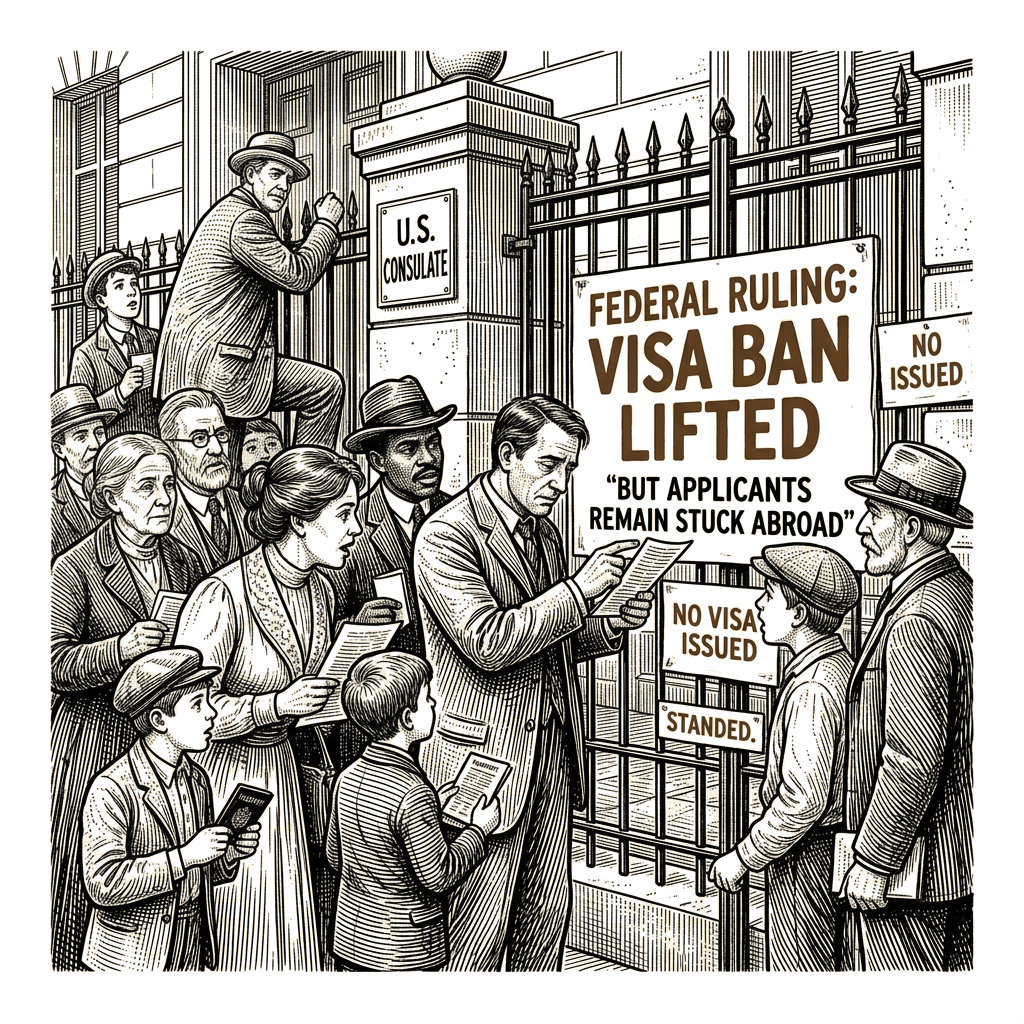
The August order ended the ban in law, but NPR reported that thousands of applicants still could not obtain visas. Many were already in the process when the policy took effect in January; some had approvals and were waiting for physical visas to be delivered, while others still needed interviews and visa stamps before they could enter the United States. NPR reported that the waiting was taking an emotional toll on many immigrants and their loved ones whose visas remained in limbo.
Late last year, Dustin Hoffman and his wife Gloria began paperwork to secure a visa for her to live in the United States. The couple and their children lived in Argentina, where Hoffman had moved in 2013 after a deployment with the U.S. Army in Iraq. Their daughter Chaya was 5, and Hoffman’s 12-year-old stepson Israel lived with them. Hoffman said, “My daughter is growing up and she’s very smart and my stepson he’s very smart.” He added: “But the resources in Argentina for an autistic child and the school system in Argentina … I don’t know. I just feel like I needed to give my daughter the same opportunities that I had growing up.”
Gloria is from Colombia, one of the countries covered by the January policy. Nearly a year after the family began applying, Gloria, Chaya and Israel remained in Argentina in bureaucratic limbo because of continuing delays in visa processing. Even after the August ruling, the Hoffman family had not obtained a visa. The State Department continued to ask the family for additional evidence that it had the financial means to live in the United States without becoming a public charge.
The waiting also took an emotional toll on Hoffman and his family. He said he missed his daughter, stepson and wife every day. His daughter cried “all the time” and asked for her father, while his wife was overwhelmed.
“Let me put it this way: Our family is a family. We need to be there for each other,” Hoffman said. “Just like any family, it’s not functioning very well while we’re separated.”
Hoffman, a U.S. veteran awaiting his wife’s visa, worried about his own mental health. He said his doctors had increased his psychiatric medicines. “I was OK before all this started happening,” he said.
Hoffman works as an Uber driver. NPR reported that gas prices had skyrocketed during the Iran conflict, cutting into his income. He said he was struggling to pay both his mortgage in the United States and rent in Argentina for his family. “We’re living on a dream and a prayer right now,” Hoffman said.
Dr. Fernando Lizcano, a Colombian national, researches major cardiovascular health challenges in the United States, including obesity. He applied for an EB-1A visa, reserved for immigrants “of extraordinary ability,” including “an outstanding professor or researcher,” according to the U.S. Citizenship and Immigration Services. From his office in Bogotá, Lizcano told NPR, “My intention is to continue with my academic biomedical research in the United States.” He added, “(I) have been exploring opportunities also where I could combine all my experience in endocrinology with molecular biology, translational research.”
U.S. Citizenship and Immigration Services deemed Lizcano qualified, leaving him to apply for the visa itself and obtain a stamp in his passport. He remained in Colombia awaiting the State Department’s final approval. “This is not fair,” Lizcano said.
Attorneys representing migrants described the Hoffman family’s situation as emblematic of a wider problem. They said the Trump administration was not complying with the federal court order and was instead slow-walking visa processing. Alexis Axelrad, the president-elect of the American Immigration Lawyers Association, said: “So while technically the ban doesn’t exist, it doesn’t matter practically if people are still not being able to get their green card interviews or have their interviews not be finished and not get their immigrant visa stamps foils and be able to come into the United States.”
The State Department declined to comment for NPR’s report, telling NPR, “the matter referenced is subject to pending litigation.” Its website acknowledged that the visa ban was no longer in effect because of the court ruling. In August, the agency told NPR it had paused visa processing as it launched an in-depth “training program” for embassies and consulates on identifying immigrants who could become a burden on taxpayers — a public charge. The training program added delays, and additional screening continued during the pending litigation; even immigrants whose visas had been approved had to undergo that screening.
The processing pause was uncommon, a former State Department consular officer told NPR. She asked not to be identified because she feared it could affect her job prospects.
“I’ve never seen a substantial pause on visa processing … I really haven’t,” the former consular officer said. “The department is doing this because this is what the policy is from the president … to reduce illegal immigration, remigrate people and only accept refugees from South Africa.”
The visa ban affected more than 280,000 immigrants who had applied for visas by the time the policy went into effect in January. An analysis by the Cato Institute said the ban targeted thousands of close family members of U.S. citizens and permanent residents, including spouses and minor children. The Cato report called it “one of the most extreme legal immigration policies in U.S. history.” NPR also reported that many people stuck in their countries and unable to come to the United States were rethinking what to do.
During his first term, President Trump said he wanted to attract the brightest immigrants to the United States. The America First Policy Institute endorsed a “merit-based” immigration system. In March 2026, the group wrote, “America’s immigration system should prioritize immigrants with education, skills, and well-paying jobs waiting for them in the U.S. because these individuals are most likely to contribute to America’s society and economy, benefitting all Americans.” NPR reported that the dispute over visa processing had affected many immigrants in the high-performing category.
As of NPR’s Oct. 26 report, the State Department’s website said the visa ban was no longer in effect, but additional screening and processing delays continued. The agency said the matter remained subject to pending litigation.