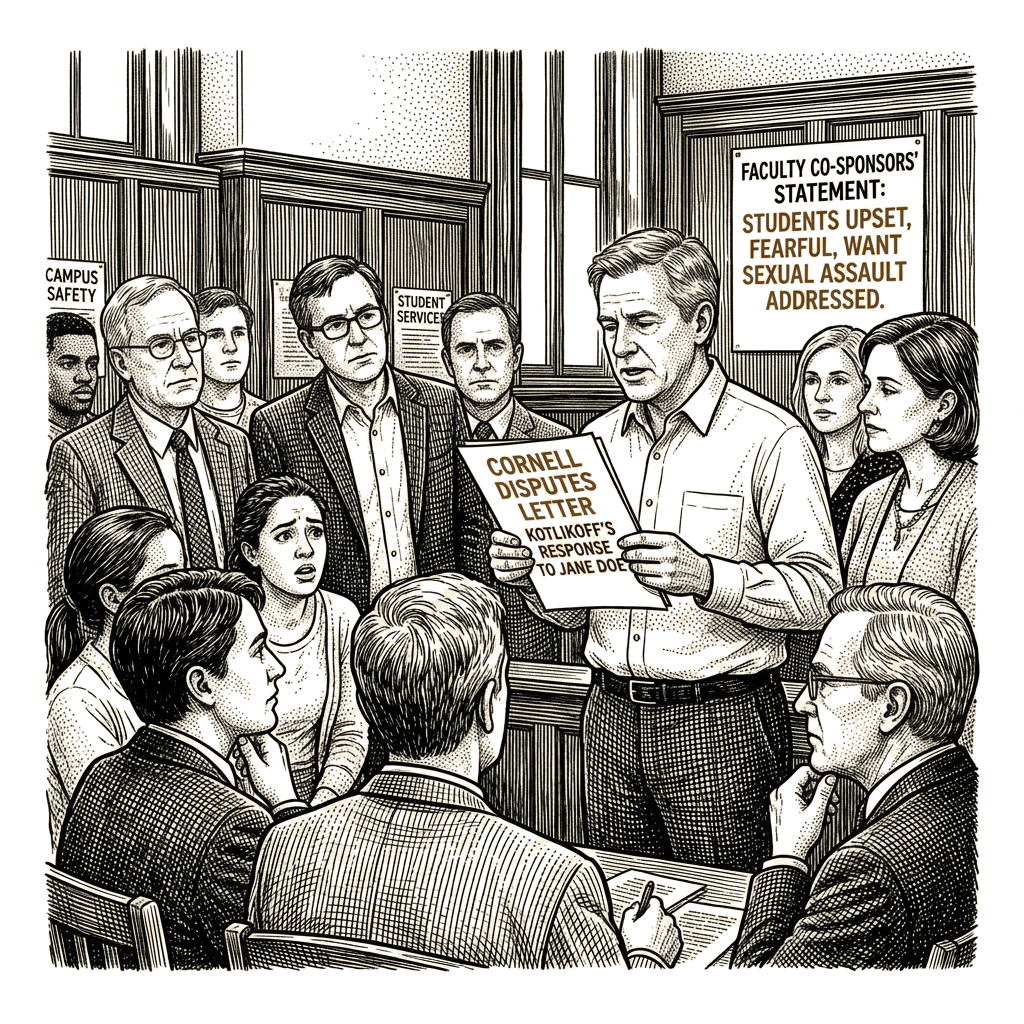
Faculty statement cites student safety fears and alumni accounts
A statement sent to the University Faculty Committee to explain the decision to vote said the faculty co-sponsors “deliberated at great length” on the resolution. It said the co-sponsors were approached in their capacity as faculty senators by numerous Cornell colleagues demanding action. The statement added: “Many of these faculty — including myself — were approached by students at Cornell who are upset, fearful for their personal safety and want our university to address the perennial problem of sexual assault on the campus.” The statement’s author included themself among the faculty approached. Cornell alumni, some of whom had shared their own traumatic stories as students, had also contacted faculty to share their frustrations about the matter. The statement concluded: “This is certainly a consequential moment in time for our campus!”
Jane Doe’s attorney sent a letter to the faculty senate that said Doe felt “unsupported and disbelieved” by Kotlikoff when she reported the alleged rape. The letter said his response “diminished my confidence in the administration’s ability to approach my experience with the understanding, sensitivity and fairness I had hoped for and expected from what had been my dream school.” It also stated: “President Kotlikoff’s initial response was along the lines of, ‘Why did she wait so long to report it?’”
A Cornell spokesperson disputed the account, saying the letter depicted a second-hand account that was disputed by the first-hand account. The disagreement concerned Kotlikoff’s initial response to the report, while the broader resolution asks senators to assess the central administration’s ability to address what the resolution calls the ongoing crisis of sexual assault.
The Presidential Task Force on Campus Sexual Assault reported that instances of non-consensual sexual contact increased dramatically at Cornell from 2021 to 2025. In 2025, 79% of students surveyed said they experienced sexual or gender-based harassment, while 35% said they experienced non-consensual sexual contact.
Faculty senators were scheduled to begin electronic voting Wednesday after a Wednesday-afternoon meeting. Debate over the resolution had continued since mid-October. The ballot asks senators to endorse the statement: “The Faculty Senate has no confidence in the ability of the central administration to effectively address the ongoing crisis of sexual assault at Cornell University.” UPI reported that the vote is symbolic because the faculty senate has no power to force administrative action, but that it could add pressure on the administration to make changes.
The Oct. 14 faculty senate meeting became heated as Kotlikoff defended his actions in response to the controversy. Professor Risa Lieberwitz told Kotlikoff that he “only seems to be responding to pressure from the public.” ABC News reported that Lieberwitz said: “This is a systemic problem that deserves systemic attention, and thus far, President Kotlikoff, it appears that you have simply reacted to pressure.” She added: “It feels that the administration is considering more about, ‘How do we respond to pressure?’ rather than the kind of leadership which should have been doing systemic work and prioritizing these issues all along.”
Kotlikoff responded: “I understand that people feel like this is reactive. I felt hearing about this, having much of this information come through for the first time, we ought to take some time.” He also argued that Cornell’s response and its Title IX investigation followed school policy and federal law. “That is due process in the way our process works,” he said. “You may disagree with the outcome, I may disagree with the outcomes, but that is our process.”
A woman known as Jane Doe said she was drugged and raped by seven members of the Chi Phi fraternity in 2024 when she was a 20-year-old undergraduate at Cornell. She said she reported the incident to the university, but no criminal charges were filed. Doe left the university after the incident and later filed a lawsuit against Cornell. After the lawsuit made the alleged attack public, Tompkins County District Attorney Matthew Van Houten reconsidered filing charges. New York Attorney General Letitia James’ office was also conducting an investigation.