Trump says he ordered suit blocking certification if Peltola wins
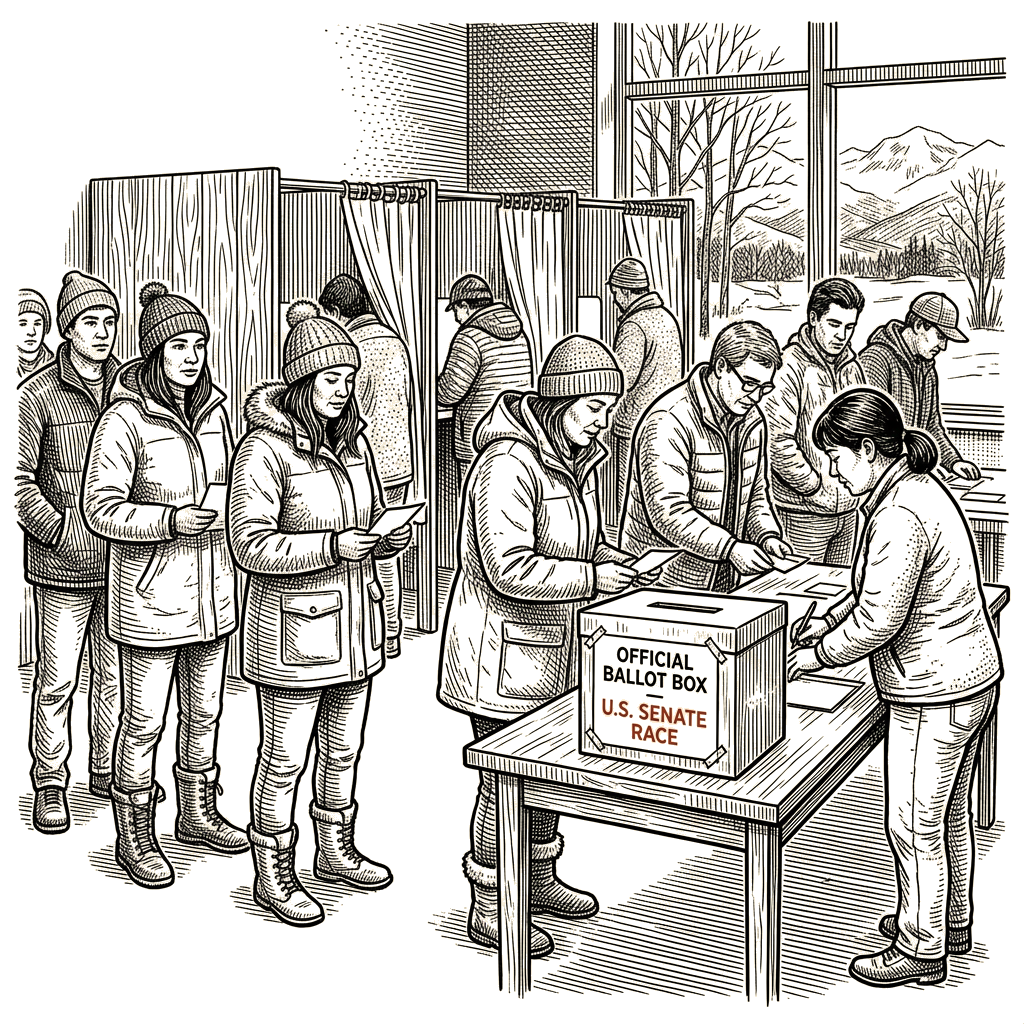
Alaska voters on Tuesday will settle one of the nation’s most competitive Senate races, with Republican Sen. Dan Sullivan seeking a third term against former Democratic Rep. Mary Peltola. The contest has drawn a federal criminal investigation into whether one of the candidates was recruited to run by the campaign of another in an effort to confuse voters, and it could help decide control of the chamber.
Among the two other candidates who advanced out of the Aug. 18 primary is a former teacher named Daniel J. Sullivan. The New York Times reported that Peltola’s campaign appeared to be involved in recruiting the challenger Daniel J. Sullivan, allegedly to siphon votes away from the incumbent Dan Sullivan. Daniel J. Sullivan remains on the ballot.
President Donald Trump announced on Oct. 23, before the Times story published, that he ordered the Department of Justice to file suit to block certification of the election if Peltola wins.
Sen. Sullivan appears on ballots as “Dan S. Sullivan” with the labels “Republican” and “Incumbent.” Challenger Sullivan is listed as “Daniel J. Sullivan Jr.” without any party affiliation indicated, although he filed for office as a Republican. State Republican Party officials had previously tried unsuccessfully to block Daniel J. Sullivan from appearing on the primary ballot, accusing him of colluding with Democrats to help elect Peltola; an Alaska court overturned efforts to boot the challenger from the primary ballot.
Peltola placed first among 16 contenders in the state’s Aug. 18 all-party primary, in which the top four vote-getters advanced to the general election regardless of party affiliation. She received 49.5% of the vote, followed by Sen. Sullivan with 41.4%. Daniel J. Sullivan and a fourth candidate advanced to the general election with a combined vote share of less than 4% of the primary vote. If no candidate receives a majority of the vote, the winner will be determined by ranked choice voting, as is the case for all federal and state general elections in Alaska following a law approved by voters in 2020.
The incumbent was first elected in 2014 after defeating Democratic Sen. Mark Begich, 48% to 46%, and he won his 2020 reelection with 54% of the vote and a 13-percentage-point lead over his Democratic opponent. Peltola was first elected in a 2022 special election to replace longtime Republican congressman Don Young, who died after almost 50 years in office. She defeated Republicans Sarah Palin and Nick Begich in Alaska’s first statewide ranked choice voting election, won a full term later that year, and lost her 2024 reelection bid to Begich, the nephew of former Sen. Mark Begich. Peltola has far outraised and outspent Sen. Sullivan by more than two to one.
Although Alaska has a long history of favoring Republican candidates for federal office, this year marks the third consecutive election cycle in which Alaskans could swing the balance of power in Washington. Peltola has been on the ballot in each of those cycles.
In the state’s lone congressional seat, Nick Begich is running for a second term against commercial fisherman and former Bristol Bay Borough School Superintendent Bill Hill and two others. Hill is running as an independent, with the backing of several local union organizations as well as Anchorage pastor Matt Schultz, the top Democrat in the race before he suspended his campaign and endorsed Hill. Begich placed first in the primary with about 45% of the vote, followed by Hill with about 33%. A New Jersey man, Eric Hafner, is running as a Democrat, but he is serving a 20-year prison sentence in New York for threatening various New Jersey officials and making false bomb threats; he received about 4% of the primary vote.
Three Republicans and one Democrat are running to replace term-limited Republican Gov. Mike Dunleavy. The Republicans are former Anchorage Mayor Dave Bronson, former state Attorney General Treg Taylor and business owner and conservative activist Bernadette Wilson; the Democrat is former state Rep. Jonathan Kreiss-Tomkins. Kreiss-Tomkins was the top vote-getter in the primary with about 23% of the vote in a 17-candidate field, followed by former Democratic state Sen. Tom Begich with about 21%, Wilson with 10% and Bronson with about 8%. Begich withdrew from the race on Aug. 31 so that Democratic voters could unite behind Kreiss-Tomkins, opening a general election slot for Taylor, who placed fifth with about 7% of the vote. Tom Begich is the brother of Mark Begich and the uncle of Nick Begich.
Voters will also decide two statewide ballot measures. One would repeal the state’s ranked choice voting law. The other would amend existing state law to specify that only citizens may vote in elections. Half of Alaska’s 20 state Senate seats and all 40 state House seats are up for election. Republican lawmakers outnumber Democratic lawmakers, but both chambers are organized by multiparty coalitions rather than along strict party lines.
Polls close at 8 p.m. local time, which is midnight and 1 a.m. ET. Almost all polls in the state close at midnight ET, but one polling location in the Aleutian Islands closes at 1 a.m. ET. About 262,000 votes were cast in Alaska’s 2022 Senate election, and about 35% of that vote was cast early in-person or by mail. Alaska is expected to release a mix of in-person Election Day and early in-person voting results in its first vote update of the night. Typically, nearly all in-person Election Day results and in-person early voting results are released by the last update of the night, with the bulk of mail voting results released in the days following election night.
In the 2024 general election, the AP first reported results in Alaska at 1:07 a.m. ET, seven minutes after the final polls closed, and the vote count reached the halfway mark at about 2:07 a.m. ET. The last vote update of the night came at 7:15 a.m. ET, with about 75% of total votes counted. Recounts in Alaska are automatic in the event of a tie vote, and candidates may also request and pay for a recount. The AP may declare a winner in a race that is subject to a recount if it can determine the lead is too large for a recount or legal challenge to change the outcome. The AP does not make projections and will declare a winner only when it’s determined there is no scenario that would allow a trailing candidate to close the gap.