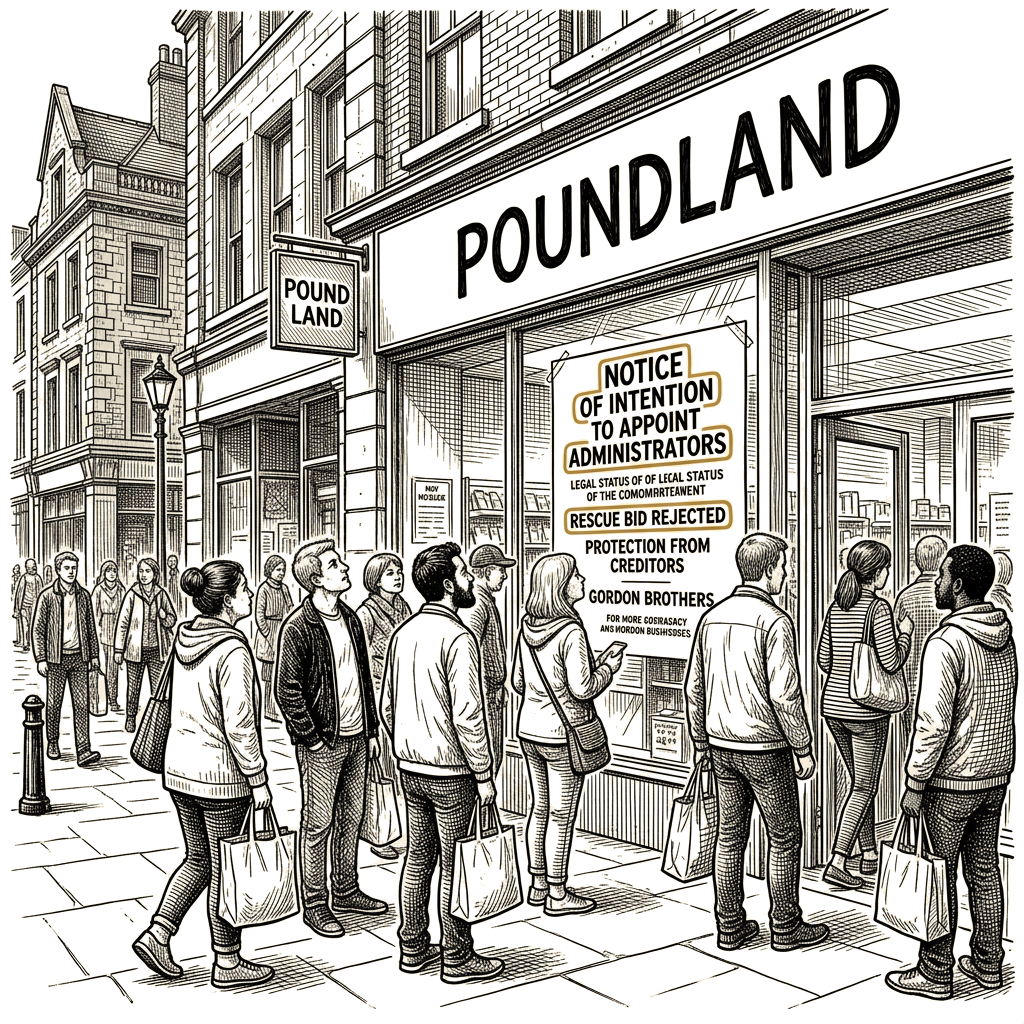
Up to 12,000 jobs at risk as suppliers hold back deliveries
Poundland filed a notice of intention to appoint administrators at the High Court on Thursday, buying the 600-store chain — which includes Dealz outlets in Ireland — 10 days’ protection from creditor demands while it seeks a way out of its troubles. The advisory firm AlixPartners is lined up to run the process. The filing came after Gordon Brothers, the American restructuring specialist that bought Poundland for a nominal £1 last year, rejected a management-backed rescue bid for the whole business, and it has brought distress for up to 12,000 staff heading into the Christmas season, just as shoppers also head to the chain for Halloween costumes and treats.
The threatened failure of the UK’s first and biggest nationwide single-price retailer would remove from the high street a chain whose pitch to shoppers was once the simplest in UK retail: every product sold at £1, with the price in its name. “It was a very successful and simple proposition,” one former Poundland boss said. Inflation has eaten into the chain’s ability to offer bargains, and its collapse would extend a wave of consolidation that has already swept through the cheaper end of UK retail. Poundland’s low-profile owners are meanwhile facing questions from the prime minister over their behaviour, in the week his government’s budget attempted to offer support to the high street.
Gordon Brothers rejected the rescue bid for the whole chain by Martin Property Group, a Northern Irish firm that remains in talks about taking on Poundland. Martin’s offer is understood to amount to about £15m, which would pay off only half of a £30m shareholder loan — the majority of which Gordon Brothers took on when it bought the company from its previous owner, Pepco, in June last year. The deal would also involve taking on a further, asset-backed loan worth about £90m, it is understood. Pepco, which holds the other £7.5m of the debt, was prepared to wait for repayment in the hope of saving the business, as first reported by Sky News.
Sources close to the process said Gordon Brothers was unwilling to accept the Martin deal because the latest offer includes only about £7.5m up front, with the remainder payable over the next two years — a structure the sources said would leave uncertainty for creditors, staff and suppliers.
One source who knows Poundland well said Gordon Brothers had already taken about £10m in fees and interest out of the chain over the past year, and that wanting another £30m was “egregious.” Gordon Brothers did not respond to a request for comment and has not confirmed the figure.
Gordon Brothers said earlier this week that options for the whole and parts of the business “are being thoroughly and objectively evaluated, with a view to minimising uncertainty for Poundland’s people and all relevant stakeholders.”
One source said Gordon Brothers had sought bidders for the whole of Poundland but that “the market had spoken”, leaving only one little-known financial bidder with no history of running a large retail chain in the UK — a buyer who might go on to break Poundland up itself. The restructuring specialist is instead understood to believe that suppliers and staff would be safer with the “trusted established retail operators” that have already put forward firm offers for parcels of outlets amounting to about half of Poundland’s stores, which could be converted to their formats. Gordon Brothers appears more keen on a break-up after losing faith in the likelihood of Poundland finding a route to long-term profitability amid tough trading on the high street and heavy competition.
A deal may yet be agreed with Martin over the next 10 days, especially with political pressure from Andy Burnham. On Friday, Burnham told the Telegraph: “We want to see jobs protected. If there was a potential owner to avoid this that hasn’t been accepted, then the business secretary and I want to know why that is the case.”
Accounts filed at Companies House show Poundland’s pre-tax losses widened to £85.3m in the year to September 2025, from £45.4m in 2024, as sales at its outlets in the UK, the Republic of Ireland and the Isle of Man slid almost 12% to £1.55bn. In September the chain said its revenues had returned to growth, up 3.3% at established stores in the latest three-month period, but sources said the business was not generating enough cash to pay off its loans.
Inflation — triggered first by Russia’s full-scale invasion of Ukraine and then the Middle East conflict — exposed a business model that always appeared to have a shelf life. Rapid rises in the cost of goods, labour, energy and business rates forced Poundland to take a hit on profits and sell products for more than £1, including items for £5 or more. Where the chain once removed products it could not sell profitably for a pound, its choices have become more limited. In most supermarkets a two-litre bottle of milk now costs over £2, a pack of KitKats at least £1.50 and a tin of Heinz baked beans about £1.40, according to the price comparison site Trolley. Shrinking the chain has also reduced its scale, making it harder to secure good deals from suppliers to protect margins, and Poundland has admitted it made mistakes in recent years, including putting its Pepco clothing ranges into stores, which proved unpopular with UK shoppers.
Competition has intensified at the same time. Cut-price chains such as Savers, The Range, B&M, The Works and Home Bargains have expanded alongside budget online rivals including Temu, Shein and Amazon, leaving the cheaper end of the UK retail market very crowded. The low-wage shoppers who make up the core of Poundland’s clientele have little spare cash for non-essentials amid rising household bills, while those with more to spend increasingly find their supermarket shopping locked in by loyalty-card-linked discounts.
Gordon Brothers, which is headquartered in the US, has a long history of involvement in selling off the assets of UK high street businesses, including offloading the stock and fittings of failed retailers such as Toys R Us. It previously owned the British fashion brands Laura Ashley and Ben Sherman, where it oversaw the closure of their stores, and it recently bought LK Bennett, which has also closed its stores this year. One advisory expert said Poundland’s owners had intended the buyout to be a rescue operation rather than a break-up, but said: “Gordon Brothers has ended up doing what Gordon Brothers do. Leopards do not change their spots.” The expert said Gordon Brothers was likely to “come out looking like the worst version” of a restructuring firm, and added that while the number of stores unlikely to find an immediate buyer “might not be as catastrophic as half”, it was unlikely buyers would be found for all of them.
Poundland’s predicament fits a decade of consolidation among single-price rivals. Poundworld closed its 350 stores in 2018, and Poundland had bought its rival 99p Stores in 2015. Poundland then closed about 200 of its then 800 UK stores in a restructuring last year, and Poundstretcher was bought by Majestic Wine’s owner, Fortress, in 2024.
The chain’s ownership has passed in and out of the hands of investment firms throughout a rocky history. Founded with one store in Burton upon Trent in 1990, Poundland was listed on the London Stock Exchange in 2014 at a value of about £750m by its then owner, the buyout firm Warburg Pincus. Just two years later it agreed to a £597m takeover by Steinhoff, a South African retail conglomerate, after struggling to digest the 99p Stores purchase. By 2018, an accounting scandal at Steinhoff forced Poundland to seek new investment, and it was hived off into Pepco, a company formed from Steinhoff’s European retail business. Poundland was preparing to rejoin the London stock market when the Covid pandemic hit in 2020, scotching those plans as high streets across the UK closed for months. Last year, with costs rising, Pepco looked to sell and Gordon Brothers stepped in with its £1 deal. It remains unclear whether someone new will now bet on turning Poundland around.