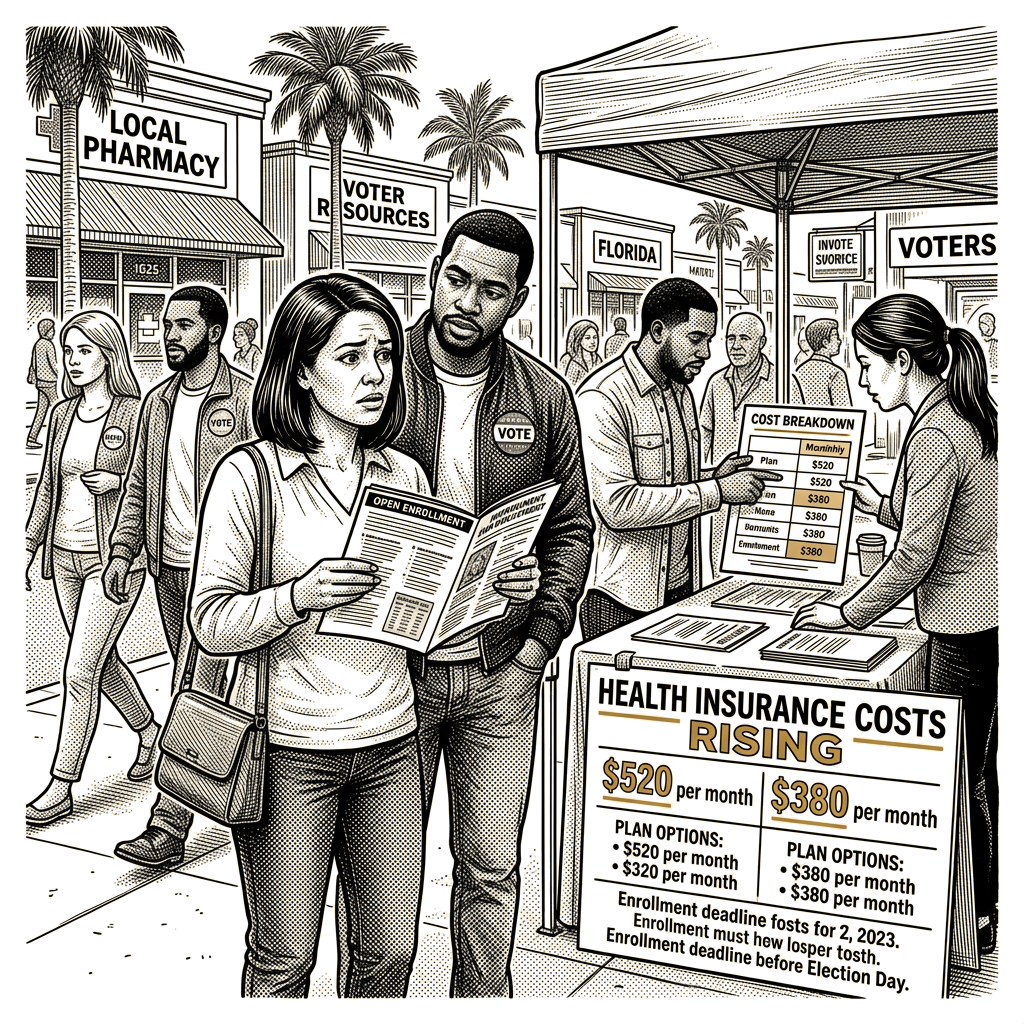
Open enrollment begins as average Florida exchange premiums rise 10.4%
As open enrollment begins days before Election Day, Floridians who buy coverage on the Affordable Care Act exchange are learning what their new premiums will be — and in Florida’s redrawn 22nd Congressional District, those numbers have become an election issue. Premiums in the state are rising an average of 10.4%, according to Florida’s Office of Insurance Regulation, after federal subsidies for ACA plans expired last year. NPR reporter Maham Javaid traveled the competitive district, which spans from the Gulf Coast to the suburbs of Palm Beach, to find out whether the rising costs are moving votes.
Florida was hit particularly hard when the subsidies expired. The newly redrawn 22nd District sprawls across south Florida, mixing rural, urban and suburban areas, wealthy communities and working-class families, and politically it swings between red and blue. Rohit Dandiya, the Democratic nominee’s father, said the district is “a microcosm of our country’s politics” — “truly purple,” with voters “just trying to find a way to make their ends meet.”
Pia Dandiya, the Democratic nominee, said that if Democrats win back the House she would work on restoring ACA subsidies, expanding funding to Medicaid and lowering drug prices. “Healthcare is not a blue issue or a red issue,” she said. “It’s a red, white and blue issue. It’s something that is impacting all of us.”
Her Republican opponent, Casey Askar, wants to eliminate the ACA altogether and crack down on fraud to preserve Medicare and Medicaid. His campaign did not reply to NPR’s interview requests.
On Naples Beach, where palm trees border pastel-colored mansions, Brittany Garcia walked the shore after an overnight shift. Garcia, a 23-year-old registered nurse, works as a contractor and has no health insurance. She searched the ACA marketplace and found nothing she could buy. “I started looking and nothing was available, so I couldn’t buy insurance,” Garcia said. “And to me, that was scary. You know, it made me think maybe I have to go to another country.” “I would hope that there is some reform soon,” she said, “because I literally have no access to healthcare.” Garcia has previously voted Republican. This year, she is not sure how she will vote. “This time, I’m just voting with my convictions,” she said.
Northeast of Naples, Collier County is a diverse area home to immigrants from Haiti, Mexico and Guatemala. There, Bianca and her husband have been without insurance since January, when her insurance agent called to warn her that the subsidy was going away and that the new price would be, in her words, “doubled or tripled of what we were paying.” She has paid out of pocket for an emergency visit to the hospital and for pneumonia treatment. Bianca asked NPR not to use her full name because political activists in her community have faced harassment for speaking up. She is voting for Dandiya, and her reason is healthcare: “She is trying to expand the Affordable Care Act, which I think is really important, especially for, like, families like mine and my husband, where we’re working 40 hours a week, and we can’t afford healthcare.”
The district runs deep into the Everglades, past sugarcane fields and cattle farms, where residents pick up their groceries at the Dollar General. Deanna Johnson, a 24-year-old dental hygiene student, has been looking for insurance plans on the marketplace. “We’re kind of in the middle of trying to get health insurance ‘cause currently, everything is so high now,” Johnson said. Her family has felt the affordability squeeze: they had to move inland from West Palm Beach when rent got too high. “I hope we get free healthcare like you know, in other countries,” she said. “They get free healthcare.” Johnson voted Republican last time. “I voted for the red last time,” she said, “but this time, now I’m thinking about voting blue to get our country back in order.”
At an early voting site in the suburb of Sunrise, Brent Harris, a 58-year-old construction worker, listed what is on his mind: “Democracy, corruption, how people are treated. Then, of course, there’s healthcare, immigration. I’m really, really not happy with the way things are.” Harris voted for President Trump in 2016. This year, he is voting for the Democrats. He worries about insurance for his family — one of his daughters is on Medicaid, but her 1-month-old daughter is uninsured, and two other adult children working multiple jobs cannot afford coverage. Harris thinks healthcare is a bipartisan problem. “But I think working together collectively is hopefully going to be solved,” he said.
The district is also home to many retirees and veterans, who often vote for Republicans. Several of those NPR spoke with expressed satisfaction with the healthcare options they already have, including Medicare and private insurance.
For voters like Harris, healthcare has become one more pressure on household budgets in an election shaped by affordability — and, days before the vote, one more consideration to carry into the booth.