Michigan Senate race has drawn well over $100 million in advertising
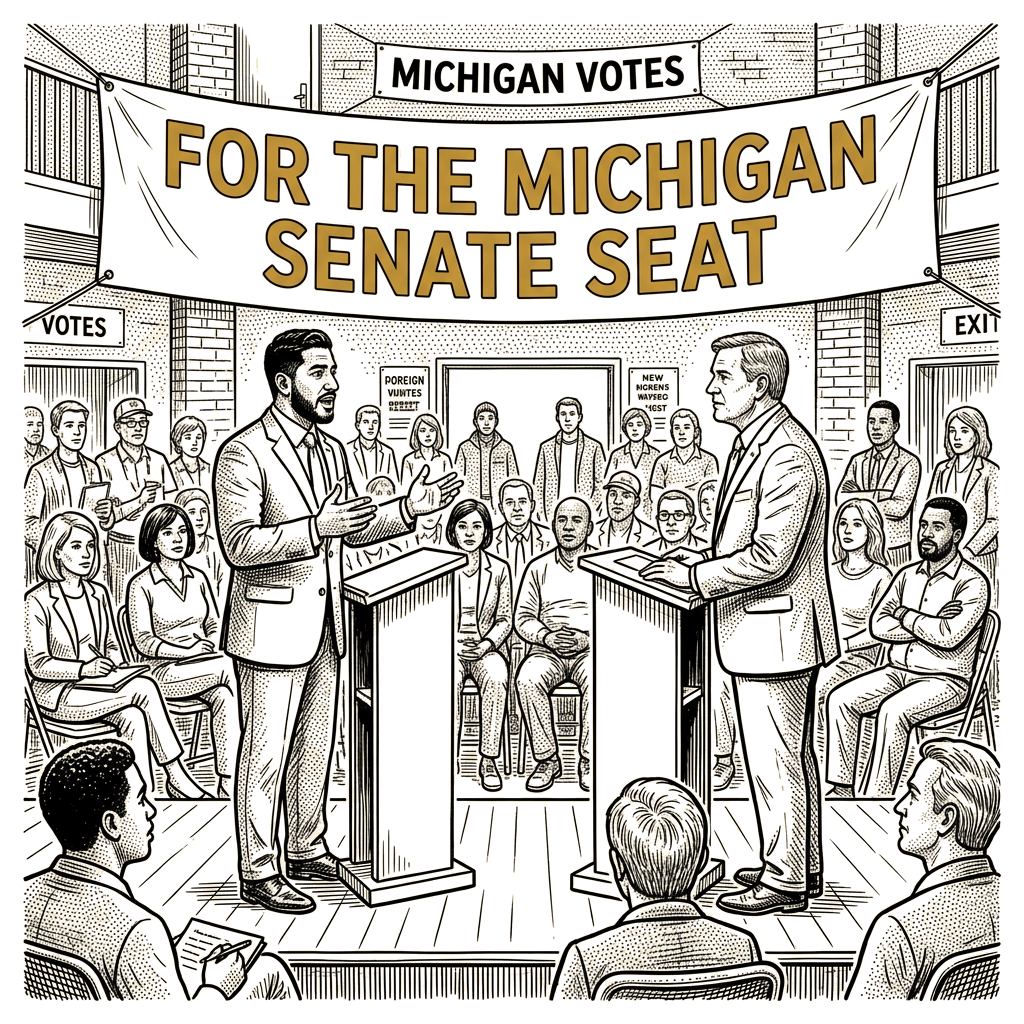
Abdul El-Sayed and Mike Rogers enter Tuesday’s Michigan Senate election with sharply different theories for winning one of the nation’s premier swing states. The Democratic nominee, a former Wayne County health director, is trying to prove that an unapologetically progressive agenda centered on universal healthcare can carry a state President Donald Trump carried two years ago. Rogers, the Republican nominee, is pursuing a second chance after his 2024 loss, without Trump at the top of the ballot serving as the same rallying point.
El-Sayed comes to the general election after narrowly defeating establishment-backed Rep. Haley Stevens in an expensive and bruising Democratic primary. He has sought to expand the state’s Democratic coalition with a populist message, months of campus rallies aimed at increasing youth turnout and efforts to win over disillusioned Republicans in rural Michigan. If elected, he would be the first Muslim senator.
Michigan’s diverse electorate has created a complicated political battleground, with both nominees seeking statewide support while navigating divisions among the state’s large Jewish, Muslim and Black communities. Disputes over U.S. support for Israel and accusations of antisemitism affected the race. In the final days, Stevens endorsed Rogers, a move that surprised Democrats and reflected tensions that had simmered since the primary among Stevens and some of her supporters. Stevens, a four-term representative of parts of metro Detroit, said her endorsement came after El-Sayed had not done enough to address the Jewish community’s concerns. In the August primary, Stevens received significant support from Black and Jewish communities in the parts of metro Detroit she represented.
Republicans repeatedly sought to link El-Sayed to terrorist organizations despite no evidence of such ties, the Associated Press reported. Trump repeatedly called him a “jihadist.” El-Sayed has drawn criticism from some in the Jewish community for his vocal criticism of Israel and his response to a March attack on a Michigan synagogue. The attacker had lost family in an Israeli strike in Lebanon. El-Sayed said that “hurt people hurt people” and later said he was “sorry” to “anyone who feels like my comments might have been hurtful.”
Republicans also highlighted El-Sayed’s ties to Hasan Piker, a popular political streamer who has made comments about Israel, Jews and the Sept. 11 attacks. El-Sayed appeared with Piker multiple times during the primary but has since distanced himself from him. El-Sayed faced nearly $60 million in spending from outside groups during the August primary against Stevens. The American Israel Public Affairs Committee spent nearly $30 million, its largest investment in a single race.
The Senate race is a focal point in the national fight for control. Democrats need to pick up four seats to win the majority, and losing Michigan could put that goal out of reach. The open seat came after two-term Democratic Sen. Gary Peters retired. No Republican has won a Senate race in Michigan since 1994, and the contest has drawn well over $100 million in advertising since the Aug. 4 primary.
Republicans opted to nominate Rogers again after his razor-thin 2024 loss to then-Rep. Elissa Slotkin by fewer than 20,000 votes, even as Trump won Michigan by more than a percentage point. The former CNN contributor, who once criticized Trump, has aligned himself more closely with the president in recent years. This year, Rogers faced no viable Republican primary challenge, allowing him to spend months raising money and preparing for the general election while Democrats navigated a costly and divisive primary.
Rogers must now win without Trump at the top of the ballot, while high gas prices and other costs weigh on Republicans nationally. He has focused more on attacking El-Sayed than on touting Republican accomplishments in Congress and the White House. He has nevertheless campaigned alongside Trump, including at an Oct. 25 rally in Port Huron. As a former chairman of the House Intelligence Committee who built much of his career around national security, Rogers has had to navigate the war with Iran while remaining aligned with Trump.
The political environment has added fresh challenges. The war with Iran continues as everyday costs, particularly at the gas pump, remain high. Trump has also waged a trade war with neighboring Canada, a longtime economic partner of Michigan. In September, Rogers wrote on social media: “The war with Iran needs to end, and end quickly.”
El-Sayed’s post-primary sprint focused on winning over Black and Jewish voters in the parts of metro Detroit Stevens represented who had supported her. In September, Kamala Harris, the first Black vice president, campaigned with El-Sayed and told a gathering of the NAACP that he could be a “stopgap” on Trump. Barack Obama, the nation’s first Black president, joined a rally for El-Sayed and other Democrats in Michigan days before Election Day. The appearances came during that post-primary effort.
Campaign disputes have included El-Sayed’s positions on Israel, his response to the synagogue attack and his association with Piker. Rogers built much of his career around national security and had to navigate the war with Iran while remaining aligned with Trump, as high gas prices and Trump’s trade war with Canada added pressure. Their campaigns are testing whether El-Sayed’s progressive, universal-healthcare argument can expand Democratic support in Michigan and whether Rogers can win after his 2024 loss without Trump at the top of the ballot. Voters cast ballots Tuesday.