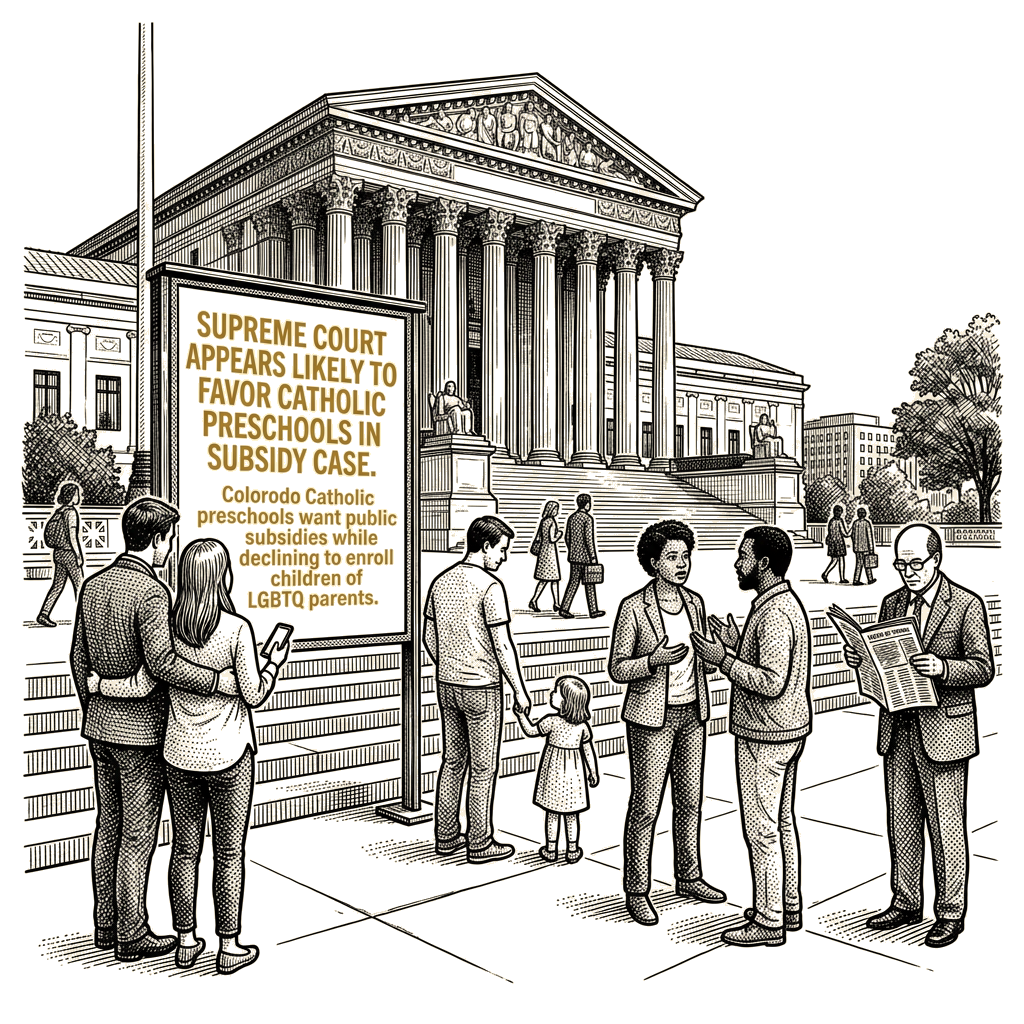
Colorado’s lawyer stressed equal opportunity and no evidence of animus
During a two-hour oral argument Tuesday in Washington, the Supreme Court appeared likely to rule for Colorado Catholic preschools that want taxpayer support but do not want to enroll children of LGBTQ parents. Conservative justices suggested the schools could be exempted from Colorado’s nondiscrimination rule so they could join the state’s universal pre-K program. The court has not ruled, and a decision is expected by next summer.
Colorado’s program provides taxpayer funds covering as many as 15 hours a week for families that send their children to participating schools. Religious schools may already participate, but every participant must accept that it will not discriminate based on a family’s LGBTQ status or other protected characteristics. The dispute is whether Colorado can condition public subsidies on that commitment.
Justice Brett Kavanaugh said, “This is a clash of rights—and strong beliefs and strong interests,” and called it a “win-win” if the state allowed tuition subsidies without compliance with the rule. Kavanaugh said, “There’s an ability for everyone to go to a good school and to respect religious rights.”
A lawyer for Colorado and the court’s three liberal justices argued that the state has a vital interest in barring discrimination on the basis of sexual orientation and gender identity. Justice Ketanji Brown Jackson said the court’s precedents make clear that broad policies should apply to everyone, even religious objectors. “You have to follow the general rules of society as long as they’re not discriminating against you on the basis of your religion,” Jackson said.
The Catholic schools argued that Colorado’s nondiscrimination rule conflicts with their religious rights. They want to work only with families who adhere to the church’s beliefs about gender and sexuality, and they say it is unconstitutional to condition the public funds on compliance. A lawyer for the schools relied primarily on a string of Supreme Court cases from the past decade that expanded religious schools’ ability to obtain taxpayer-funded benefits. A lawyer for the Trump administration also argued in favor of the schools.
Several conservative justices said that although the rule is written in broad terms, its clear effect is to disproportionately exclude religious institutions with strict views about marriage. Justice Samuel Alito said, “We have a requirement that has a very severe impact on religion, and that is something that everybody could have anticipated.”
Alito and other conservative justices noted that the litigation is the latest in a series of Colorado cases involving collisions between pro-LGBTQ policies and individuals with traditional beliefs. They also noted that Colorado has lost a string of cases at the high court, where the conservative majority found other state nondiscrimination policies violated First Amendment rights.
Colorado’s deputy solicitor general Helen Norton resisted the suggestion that the state disfavors religion, especially in the preschool program. “The program welcomes religious providers while requiring equal opportunity,” Norton said. She added there was “no evidence of any animus or hostility in this case.”
EdChoice, a group that supports school choice, said only Maine, Maryland and Vermont have similar nondiscrimination conditions in programs that provide public funds to private schools.
The oral argument produced no ruling. The Supreme Court is expected to decide the case by next summer.